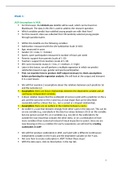
Psychology Revision
Biological Psychology
Stress
Stress …
Is a general response to any demand made of the body that occurs when a person perceives
that they don’t have the ability to meet the perceived demands of a particular situation
Stressors – causes of stress
Selye (1956) defines stress as the individuals physiological response, mediated largely by the
ANS and Endocrine system to any demand made on the individual.
Signs of Stress …
High HR and BR
Pupils dilate – Positive as you can see more, you’re more alert
Peristalsis – Don’t feel hungry, digestive system slowed
Liver – Glucose released into the blood stream – gives you more energy
Increased Blood Pressure – enables you to deal with problem more effectively
The body’s response to stress …
Autonomic Nervous System
Sympathetic Nervous System Parasympathetic Nervous System
Arousal/Aggitation Serenity/Calm
Maintains equilibrium
SHORT TERM STRESS
FIRST PHASE OF STRESS – SHORT TERM
SAM (Sympathetic Adrenal
Medullary Pathway) RESEARCH POINT:
Taylor et al (2000) found a gender
difference in stress response - that
Hypothalamus acute stress produced FOFR in
men but Tend and Befriend in
women.
Triggers SNS Explanation: Evolutionary
ancestors would need to look after
and protect offspring through a
Triggers Adrenal Medulla to group act rather than fight or flee
produce … from possible attackers.
HOWEVER females would also
need the ability for FOFR as well
as bonding as a group. Tend and
Adrenaline Noradrenaline befriend wouldn’t be the only
response developed by females.
FOFR
Biological Psychology
Stress
Stress …
Is a general response to any demand made of the body that occurs when a person perceives
that they don’t have the ability to meet the perceived demands of a particular situation
Stressors – causes of stress
Selye (1956) defines stress as the individuals physiological response, mediated largely by the
ANS and Endocrine system to any demand made on the individual.
Signs of Stress …
High HR and BR
Pupils dilate – Positive as you can see more, you’re more alert
Peristalsis – Don’t feel hungry, digestive system slowed
Liver – Glucose released into the blood stream – gives you more energy
Increased Blood Pressure – enables you to deal with problem more effectively
The body’s response to stress …
Autonomic Nervous System
Sympathetic Nervous System Parasympathetic Nervous System
Arousal/Aggitation Serenity/Calm
Maintains equilibrium
SHORT TERM STRESS
FIRST PHASE OF STRESS – SHORT TERM
SAM (Sympathetic Adrenal
Medullary Pathway) RESEARCH POINT:
Taylor et al (2000) found a gender
difference in stress response - that
Hypothalamus acute stress produced FOFR in
men but Tend and Befriend in
women.
Triggers SNS Explanation: Evolutionary
ancestors would need to look after
and protect offspring through a
Triggers Adrenal Medulla to group act rather than fight or flee
produce … from possible attackers.
HOWEVER females would also
need the ability for FOFR as well
as bonding as a group. Tend and
Adrenaline Noradrenaline befriend wouldn’t be the only
response developed by females.
FOFR