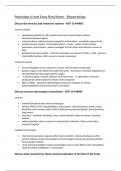
Psychology A Level Essay Plans/Notes – Biopsychology
Discuss the nervous and endocrine systems - NOT 16 MARKS
nervous system
specialised network of cells, primary internal communication system,
electrical/chemical signals
main functions: collect/process/respond to information ; coordinate organs/cells
central nervous system - brain/spinal chord → brain - centre of all concious
awareness, spinal chord - passes messages to/from brain and connects nerves to
PNS
peripheral nervous system - transmits messages via neurons to CNS → ANS - governs
vital bodily functions, SNS - governs muscle movement
endocrine system
works alongside nervous system to control vital functions in the body
glands: organs in the body that make hormones ; hormones: chemical substances in
the bloodstream that target specific organs
→ pituitary gland: controls realease of all hormones ; → adrenaline: hormone
produced by adrenal gland to release stress response
fight or flight - automatic (physiological arousal in response to stress),
parasympathetic action (returning to rest state)
Discuss neurons and synaptic transmission - NOT 16 MARKS
neurons
transmit electrical and chemical messages
sensory (PNS to CNS, long dendrites, short axons), relay (sensory to motor, short
dendrites, short axons) motor (CNS to effectors eg muscles/glands, short dendrites,
long axons)
structure - cell body, dendrites, axon, myelin sheath, nodes of ranvier, terminal
buttons
action potential: when a neuron is activated by a stimulus, it fires and creates
electrical impulse
synaptic transmission
chemical transmission, signals within neuron electric, chemical between, when
electric impulse reaches presynaptic terminal triggers release of neurotransmitter
from synaptic vesicles
some neurotransmitters makes postsynaptic neuron more likely to fire (excitation),
some less likely (inhibition) → summation
Discuss what research has shown about localisation of function in the brain
, AO1
different areas of brain responsible for different behvaiours, processes, activities
motor area (frontal lobe, regulating movement), somatasensory area (parietal lobe,
sensory information eg touch), visual area (occipital lobe, visual information)
auditory area (temporal lobe, speech based information), broca’s area (frontal lobe
left hemisphere, speech production), wernicke’s area (temporal lobe left
hemisphere, language comprehension)
AO3
strength - evidence from neurosurgery, damage to areas of brain linked to mental
disorders, Dougherty (2002), cingulotomy (isolating cingulate gyrus) for OCD, follow
up after 32 weeks showed success, serious disorders localised
strength - evidence from brain scans, wernickes area active during listening/brocas
area and reading tasks, review of long term memory studies, semantic and episodic
memories lie in pre frontal cortex, scientific evidence brain functions are localised
limitation - language localisation questioned, advances in brain imaging techniques
eg fMRI, studied more clearly, language function more holistic, language streams
identified across the cortex plus subcortical areas eg thalamus, contradicts
localisation theory
Discuss research on hemispheric lateralisation (split brain research)
AO1
certain mental processes/behaviours controlled/dominated by one hemisphere eg
language, sugestion LH is analyser/RH is synthesiser, split brain research
Sperry (1968), corpus callosum cut in epileptic patients, image/word projected to
RVF/LVF, pictures shown to RVF could be described but not LVF (language centres in
LH, connect to RVF), emotional reaction when shown to LVH (eg giggle) but nothing
seen, LH verbal, RH emotional
AO3
strength (HL) - lateralisation in the connected brain, Fink (1996), PET scans, identify
which brain areas active during visual processing task, global elements of picture (eg
whole forest), RH active, details (eg single trees), LH active, shows lateralised in
connected as well as split brain
limitation (HL) - one brain, RH as synthesiser may be wrong, research shows no
dominant side that creates personality, 1000 brain scans analuysed, used different
HS for tasks but no dominant side (eg math/art brains), notion of left/right brained is
wrong
strength (SBR) - recent research support, Gazzaniga, split brain perform better than
connected on certain tasks, eg faster identifying odd one out, normal brain - LH
better cognitive strategies watered down by inferior RH, supports Sperry (distinct
left/right brains)
Discuss the nervous and endocrine systems - NOT 16 MARKS
nervous system
specialised network of cells, primary internal communication system,
electrical/chemical signals
main functions: collect/process/respond to information ; coordinate organs/cells
central nervous system - brain/spinal chord → brain - centre of all concious
awareness, spinal chord - passes messages to/from brain and connects nerves to
PNS
peripheral nervous system - transmits messages via neurons to CNS → ANS - governs
vital bodily functions, SNS - governs muscle movement
endocrine system
works alongside nervous system to control vital functions in the body
glands: organs in the body that make hormones ; hormones: chemical substances in
the bloodstream that target specific organs
→ pituitary gland: controls realease of all hormones ; → adrenaline: hormone
produced by adrenal gland to release stress response
fight or flight - automatic (physiological arousal in response to stress),
parasympathetic action (returning to rest state)
Discuss neurons and synaptic transmission - NOT 16 MARKS
neurons
transmit electrical and chemical messages
sensory (PNS to CNS, long dendrites, short axons), relay (sensory to motor, short
dendrites, short axons) motor (CNS to effectors eg muscles/glands, short dendrites,
long axons)
structure - cell body, dendrites, axon, myelin sheath, nodes of ranvier, terminal
buttons
action potential: when a neuron is activated by a stimulus, it fires and creates
electrical impulse
synaptic transmission
chemical transmission, signals within neuron electric, chemical between, when
electric impulse reaches presynaptic terminal triggers release of neurotransmitter
from synaptic vesicles
some neurotransmitters makes postsynaptic neuron more likely to fire (excitation),
some less likely (inhibition) → summation
Discuss what research has shown about localisation of function in the brain
, AO1
different areas of brain responsible for different behvaiours, processes, activities
motor area (frontal lobe, regulating movement), somatasensory area (parietal lobe,
sensory information eg touch), visual area (occipital lobe, visual information)
auditory area (temporal lobe, speech based information), broca’s area (frontal lobe
left hemisphere, speech production), wernicke’s area (temporal lobe left
hemisphere, language comprehension)
AO3
strength - evidence from neurosurgery, damage to areas of brain linked to mental
disorders, Dougherty (2002), cingulotomy (isolating cingulate gyrus) for OCD, follow
up after 32 weeks showed success, serious disorders localised
strength - evidence from brain scans, wernickes area active during listening/brocas
area and reading tasks, review of long term memory studies, semantic and episodic
memories lie in pre frontal cortex, scientific evidence brain functions are localised
limitation - language localisation questioned, advances in brain imaging techniques
eg fMRI, studied more clearly, language function more holistic, language streams
identified across the cortex plus subcortical areas eg thalamus, contradicts
localisation theory
Discuss research on hemispheric lateralisation (split brain research)
AO1
certain mental processes/behaviours controlled/dominated by one hemisphere eg
language, sugestion LH is analyser/RH is synthesiser, split brain research
Sperry (1968), corpus callosum cut in epileptic patients, image/word projected to
RVF/LVF, pictures shown to RVF could be described but not LVF (language centres in
LH, connect to RVF), emotional reaction when shown to LVH (eg giggle) but nothing
seen, LH verbal, RH emotional
AO3
strength (HL) - lateralisation in the connected brain, Fink (1996), PET scans, identify
which brain areas active during visual processing task, global elements of picture (eg
whole forest), RH active, details (eg single trees), LH active, shows lateralised in
connected as well as split brain
limitation (HL) - one brain, RH as synthesiser may be wrong, research shows no
dominant side that creates personality, 1000 brain scans analuysed, used different
HS for tasks but no dominant side (eg math/art brains), notion of left/right brained is
wrong
strength (SBR) - recent research support, Gazzaniga, split brain perform better than
connected on certain tasks, eg faster identifying odd one out, normal brain - LH
better cognitive strategies watered down by inferior RH, supports Sperry (distinct
left/right brains)