Transport in Cells
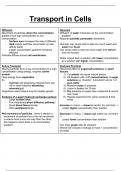
Diffusion Osmosis
Movement of particles down the concentration Diffusion of water molecules up the concentration
gradient from high concentration to low gradient
concentration Requires partially permeable membrane
- Surface area increases the rate of diffusion
- Heat means particles move faster so also Osmosis can cause cells to take too much water and
diffuse faster swell then burst
- Larger concentration gradient increases Can cause cells to lose too much water and shrivel
diffusion and not function
Particles diffuse across cell membranes
Water moves from a solution with lower concentration
to a solution with higher concentration
Active Transport Osmosis Practical
Moving particles from a low concentration to a high Observing effect of sugar/salt solutions on plant
concentration using energy, requires carrier tissues
protein 1) Cut potato into equal cuboid pieces
Uses energy from respiration 2) Fill beakers with 4 dif concentrations of sugar
Ex solution(e.g 1mol/dm3, 0.4mol/dm3 etc) & 1 of
- root hair cell absorbing minerals from soil pure water
- villi in small intestine absorbing 3) Measure mass of potatoes
minerals(gut) 4) Leave in beaker for 30 min
Organisms need mineral ions for healthy growth 5) Dry potatoes on paper then measures & record
new mass
Features of a good molecule exchange surface: 6) Repeat experiment for same solutions & find
- Large surface area mean
- Thin membrane(short diffusion pathway)
- Good blood flow(animals) Increase in mass → drawn in water by osmosis →
- Well ventilated(plants) potato higher concentration than solution
Net movement of particles - there is always a Decrease in mass → drawn out water by osmosis
movement of particles but a the net movement →
is where more move one way than the other, potato lower concentration than solution
this happens when there is a concentration
gradient Can draw graph with dif solutions
Where line crosses 0 change in mass = concentration
of potato
Diffusion Osmosis
Movement of particles down the concentration Diffusion of water molecules up the concentration
gradient from high concentration to low gradient
concentration Requires partially permeable membrane
- Surface area increases the rate of diffusion
- Heat means particles move faster so also Osmosis can cause cells to take too much water and
diffuse faster swell then burst
- Larger concentration gradient increases Can cause cells to lose too much water and shrivel
diffusion and not function
Particles diffuse across cell membranes
Water moves from a solution with lower concentration
to a solution with higher concentration
Active Transport Osmosis Practical
Moving particles from a low concentration to a high Observing effect of sugar/salt solutions on plant
concentration using energy, requires carrier tissues
protein 1) Cut potato into equal cuboid pieces
Uses energy from respiration 2) Fill beakers with 4 dif concentrations of sugar
Ex solution(e.g 1mol/dm3, 0.4mol/dm3 etc) & 1 of
- root hair cell absorbing minerals from soil pure water
- villi in small intestine absorbing 3) Measure mass of potatoes
minerals(gut) 4) Leave in beaker for 30 min
Organisms need mineral ions for healthy growth 5) Dry potatoes on paper then measures & record
new mass
Features of a good molecule exchange surface: 6) Repeat experiment for same solutions & find
- Large surface area mean
- Thin membrane(short diffusion pathway)
- Good blood flow(animals) Increase in mass → drawn in water by osmosis →
- Well ventilated(plants) potato higher concentration than solution
Net movement of particles - there is always a Decrease in mass → drawn out water by osmosis
movement of particles but a the net movement →
is where more move one way than the other, potato lower concentration than solution
this happens when there is a concentration
gradient Can draw graph with dif solutions
Where line crosses 0 change in mass = concentration
of potato