Cells
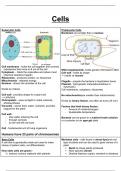
Eukaryotic Cells Prokaryotic Cells
Bacterium are smaller than a nucleus
Cell membrane - holds the cell together and controls
substances that move in & out of the cell DNA loop/plasmids -holds genetic information/ DNA
Cytoplasm - holds the organelles and where most Cell wall - holds its shape
chemical reactions happen → made of murein
Ribosomes - produces protein, on ribosomes
Mitochondria - releases energy Flagella - propels the bacteria in liquid(stem have)
Nucleus - directs the activities of the cell Plasmid - hold genetic material(sometimes in
eukaryotic)
Divide by mitosis Cell membrane, cytoplasm, ribosomes
Cell wall - provides shape for a plant cell No mitochondria(are smaller than mitochondria)
→ cellulose
Chloroplasts - uses sunlight to make nutrients, Divide by binary fission, (as often as every 20 min)
photosynthesis
Vacuoles - stores food, water, nutrients, provides Factors that limit binary fission:
support for the plant - Amount of nutrients/oxygen
- Sustainable temperature
Cell wall:
- stop water entering the cell Bacteria can be grown in a nutrient broth solution
- through osmosis or a colonies on an agar gel plate
- so the cell will not burst
Cell - fundamental unit of living organisms
Humans have 23 pairs of chromosomes
Stem Cells Meristem cells - cells found in shoot tips(and root
A cell that is genetically made and used to make tips) of plants and can be used to grow clones of a
clones of patient cells, not differentiated plant
+ Quick & cheap plants produced
How stem cells are grown - + Rare species cloned
1) embryo nucleus replaced with patients + Desired features copied, resistant to diseases
Eukaryotic Cells Prokaryotic Cells
Bacterium are smaller than a nucleus
Cell membrane - holds the cell together and controls
substances that move in & out of the cell DNA loop/plasmids -holds genetic information/ DNA
Cytoplasm - holds the organelles and where most Cell wall - holds its shape
chemical reactions happen → made of murein
Ribosomes - produces protein, on ribosomes
Mitochondria - releases energy Flagella - propels the bacteria in liquid(stem have)
Nucleus - directs the activities of the cell Plasmid - hold genetic material(sometimes in
eukaryotic)
Divide by mitosis Cell membrane, cytoplasm, ribosomes
Cell wall - provides shape for a plant cell No mitochondria(are smaller than mitochondria)
→ cellulose
Chloroplasts - uses sunlight to make nutrients, Divide by binary fission, (as often as every 20 min)
photosynthesis
Vacuoles - stores food, water, nutrients, provides Factors that limit binary fission:
support for the plant - Amount of nutrients/oxygen
- Sustainable temperature
Cell wall:
- stop water entering the cell Bacteria can be grown in a nutrient broth solution
- through osmosis or a colonies on an agar gel plate
- so the cell will not burst
Cell - fundamental unit of living organisms
Humans have 23 pairs of chromosomes
Stem Cells Meristem cells - cells found in shoot tips(and root
A cell that is genetically made and used to make tips) of plants and can be used to grow clones of a
clones of patient cells, not differentiated plant
+ Quick & cheap plants produced
How stem cells are grown - + Rare species cloned
1) embryo nucleus replaced with patients + Desired features copied, resistant to diseases