
Inherited change
Homologous chromosomes: a pair of chromosomes in a diploid cell that have the same
structure as each other, with the same genes (but not always the same alleles) at the same
loci, and pair together to form a bivalent during the first division of meiosis.
Chromosome: a structure made of DNA and histones, found in the nucleus of a eukaryotic
cell
Gene: a length of DNA that codes for a particular protein or polypeptide
Allele: a particular variety of a gene
22 matching pairs of chromosome that are similar in structure and composition. In the
original zygote, one of each pair came from the mother, and the other from the father.
There is also a non-matching pair labelled X and Y. there are in total 23 pairs, one set of 23
from the mother, and the other set from the father.
All chromosomes are called autosomes apart from the X and Y, as these are called sex
chromosomes. Females have XX and males have Xy.
Each chromosome has a set of genes which code for different characteristics and are always
found on the same position (locus) on the chromosome. The total number of different
genes in humans is 20,000 – 25,000.
Each member of the homologous pair has genes controlling the same characteristics. A gene
for a given characteristic may exist in different forms (alleles) which are expressed
differently.
Haploid and diploid cells
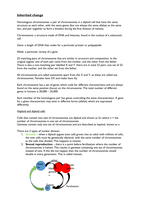
Cells that contain two sets of chromosomes are diploid and shown as 2n where n = the
number of chromosomes in one set of chromosomes.
Gametes contain only one set of chromosomes and are described as haploid, shown as n.
There are 2 types of nuclear division:
1. Growth – when a diploid zygote (one cell) grows into an adult with millions of cells,
the new cells must be genetically identical, with the same number of chromosomes
as the cells that divided. This happens in mitosis.
2. Sexual reproduction – there is a point before fertilisation where the number of
chromosomes is halved. This results in gametes containing one set of chromosomes
instead of two. If this did not happen then the number of chromosomes would
double in every generation. This is called meiosis.
either
Adult Female
2n Male gamete
gamete n
n
Zygote
Fertilisation
2n
Homologous chromosomes: a pair of chromosomes in a diploid cell that have the same
structure as each other, with the same genes (but not always the same alleles) at the same
loci, and pair together to form a bivalent during the first division of meiosis.
Chromosome: a structure made of DNA and histones, found in the nucleus of a eukaryotic
cell
Gene: a length of DNA that codes for a particular protein or polypeptide
Allele: a particular variety of a gene
22 matching pairs of chromosome that are similar in structure and composition. In the
original zygote, one of each pair came from the mother, and the other from the father.
There is also a non-matching pair labelled X and Y. there are in total 23 pairs, one set of 23
from the mother, and the other set from the father.
All chromosomes are called autosomes apart from the X and Y, as these are called sex
chromosomes. Females have XX and males have Xy.
Each chromosome has a set of genes which code for different characteristics and are always
found on the same position (locus) on the chromosome. The total number of different
genes in humans is 20,000 – 25,000.
Each member of the homologous pair has genes controlling the same characteristics. A gene
for a given characteristic may exist in different forms (alleles) which are expressed
differently.
Haploid and diploid cells
Cells that contain two sets of chromosomes are diploid and shown as 2n where n = the
number of chromosomes in one set of chromosomes.
Gametes contain only one set of chromosomes and are described as haploid, shown as n.
There are 2 types of nuclear division:
1. Growth – when a diploid zygote (one cell) grows into an adult with millions of cells,
the new cells must be genetically identical, with the same number of chromosomes
as the cells that divided. This happens in mitosis.
2. Sexual reproduction – there is a point before fertilisation where the number of
chromosomes is halved. This results in gametes containing one set of chromosomes
instead of two. If this did not happen then the number of chromosomes would
double in every generation. This is called meiosis.
either
Adult Female
2n Male gamete
gamete n
n
Zygote
Fertilisation
2n


