
Cell membrane structure, function and transport
Phospholipids
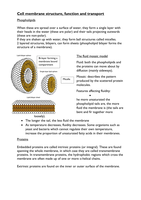
When these are spread over a surface of water, they form a single layer with
their heads in the water (these are polar) and their tails projecting outwards
(these are non-polar).
If they are shaken up with water, they form ball structures called micelles.
2 layered structures, bilayers, can form sheets (phospholipid bilayer forms the
structure of a membrane).
The fluid mosaic model
Bi-layer forming a
membrane bound Fluid: both the phospholipids and
compartment
the proteins can move about by
diffusion (mainly sideways).
Mosaic: describes the pattern
Micelle
produced by the scattered protein
molecules.
Features affecting fluidity:
he more unsaturated the
phospholipid tails are, the more
fluid the membrane is (the tails are
bent and fir together more
loosely).
The longer the tail, the less fluid the membrane
As temperature decreases, fluidity decreases. Some organisms such as
yeast and bacteria which cannot regulate their own temperature,
increase the proportion of unsaturated fatty acids in their membranes.
Proteins
Embedded proteins are called intrinsic proteins (or integral). These are found
spanning the whole membrane, in which case they are called transmembrane
proteins. In transmembrane proteins, the hydrophobic regions which cross the
membrane are often made up of one or more α-helical chains.
Extrinsic proteins are found on the inner or outer surface of the membrane.
Phospholipids
When these are spread over a surface of water, they form a single layer with
their heads in the water (these are polar) and their tails projecting outwards
(these are non-polar).
If they are shaken up with water, they form ball structures called micelles.
2 layered structures, bilayers, can form sheets (phospholipid bilayer forms the
structure of a membrane).
The fluid mosaic model
Bi-layer forming a
membrane bound Fluid: both the phospholipids and
compartment
the proteins can move about by
diffusion (mainly sideways).
Mosaic: describes the pattern
Micelle
produced by the scattered protein
molecules.
Features affecting fluidity:
he more unsaturated the
phospholipid tails are, the more
fluid the membrane is (the tails are
bent and fir together more
loosely).
The longer the tail, the less fluid the membrane
As temperature decreases, fluidity decreases. Some organisms such as
yeast and bacteria which cannot regulate their own temperature,
increase the proportion of unsaturated fatty acids in their membranes.
Proteins
Embedded proteins are called intrinsic proteins (or integral). These are found
spanning the whole membrane, in which case they are called transmembrane
proteins. In transmembrane proteins, the hydrophobic regions which cross the
membrane are often made up of one or more α-helical chains.
Extrinsic proteins are found on the inner or outer surface of the membrane.


