

3.1.3 Bonding
Why atoms form bonds and the types of crystal structure
Atoms form bonds to gain a full outer shell of electrons like inert noble gases. This makes atoms more stable and less
reactive
The 4 types of crystal structure are:
- Ionic
- Simple molecular
- Macromolecular (giant covalent)
- Metallic
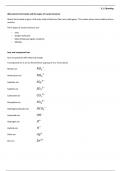
Ions and compound ions
Ions are particles with electrical charge
A compound ion is an ion formed from a group of 2 or more atoms
Nitrate ion 𝑁𝑂
Ammonium ion 𝑁𝐻
Sulphate ion 𝑆𝑂
Sulphite ion 𝑆𝑂
Carbonate ion 𝐶𝑂
Phosphate ion 𝑃𝑂
Hydrogencarbonate ion 𝐻𝐶𝑂
Hydroxide ion 𝑂𝐻
Hydrogen ion 𝐻
Hydride ion 𝐻
Silver ion 𝐴𝑔
Zinc ion 𝑍𝑛
, 3.1.3 Bonding
Ionic bonding
Ionic bonding is the electrostatic attraction between oppositely charged ions in a lattice
Ionic bonds are formed due to the complete transfer of electrons from a metal atom to a non-metal atom
The overall charge of any ionic compound is always zero because it consists of ions with charges that balance each
other out
The formula of an ionic compound can be calculated by:
- Comparing charges of ions in the compound
- Drop n’ swap method
The structure of ionic compounds:
- Crystalline solids
- Giant ionic lattice
‘Giant’ in the context of ionic compounds means the structure is indefinite to say exactly how many ions are present
in the lattice
A giant ionic lattice is a regular, repeating arrangement of oppositely charged ions
A polar molecule is a molecule with a partial negative charge and a partial positive charge
A molten compound is a compound that has been liquefied using heat
Ionic compounds have high melting and boiling points because:
- Giant ionic lattice structure
- Many strong ionic bonds
- Strong electrostatic forces of attraction between oppositely charged ions, that act in all directions
- Requires large amount of energy to overcome
- Large amount of energy obtained by using high temp.
Ionic compounds are solids at room temperature because:
- High melting points
- Giant ionic lattice structure
- Many strong ionic bonds
- Strong electrostatic forces of attraction between oppositely charged ions, that act in all directions
- Requires large amount of energy to overcome
- Large amount of energy obtained by using high temp.
Ionic compounds can’t conduct electricity when solid because:
- Ions can’t move through giant ionic lattice structure
- Ions fixed in place
- Hence ions can’t carry electrical charge
, 3.1.3 Bonding
Ionic compounds can conduct electricity when molten or dissolved in solution because:
- Ions can move through liquid or solution
- Hence ions can carry electrical charge
Ionic compounds are brittle because:
- When ions forced out of position, like charges line up
- Causes repulsion
- Leads to separation of layers and cracking causing ionic compound to break
Size of ions affects strength of ionic bonds because:
- Smaller ion
- Smaller ionic radius
- Stronger electrostatic forces of attraction between oppositely charged ions
- Stronger ionic bonds
Charge of ions affects strength of ionic bonds because:
- Greater charge on ion
- Stronger electrostatic forces of attraction between oppositely charged ions
- Stronger ionic bonds
Covalent bonding, simple molecules and macromolecules
A covalent bond is a shared pair of electrons
A covalent bond is maintained by the electrostatic force of attraction between the negatively charged shared
electrons and the positively charged nuclei at the centre of each atom involved in the covalent bond
A molecule is a substance made up of 2 or more atoms joined by covalent bonds
Single covalent bonds are 1 shared pair of electrons, involving 2 electrons. One electron comes from each atom
involved in covalent bond
Multiple covalent bonds contain multiple pairs of electrons
A dative covalent bond contains a shared pair of electrons with both electrons in the covalent bond being supplied
by one atom
How dative covalent bonding works:
- Electron rich atom donates electron pair, lone pair
- Electron deficient atom accepts electron pair
A dative covalent bond is represented by an arrow in a diagram with the head of the arrow always touching the
atom receiving the electron pair and the arrow always pointing away from the donor atom
Why atoms form bonds and the types of crystal structure
Atoms form bonds to gain a full outer shell of electrons like inert noble gases. This makes atoms more stable and less
reactive
The 4 types of crystal structure are:
- Ionic
- Simple molecular
- Macromolecular (giant covalent)
- Metallic
Ions and compound ions
Ions are particles with electrical charge
A compound ion is an ion formed from a group of 2 or more atoms
Nitrate ion 𝑁𝑂
Ammonium ion 𝑁𝐻
Sulphate ion 𝑆𝑂
Sulphite ion 𝑆𝑂
Carbonate ion 𝐶𝑂
Phosphate ion 𝑃𝑂
Hydrogencarbonate ion 𝐻𝐶𝑂
Hydroxide ion 𝑂𝐻
Hydrogen ion 𝐻
Hydride ion 𝐻
Silver ion 𝐴𝑔
Zinc ion 𝑍𝑛
, 3.1.3 Bonding
Ionic bonding
Ionic bonding is the electrostatic attraction between oppositely charged ions in a lattice
Ionic bonds are formed due to the complete transfer of electrons from a metal atom to a non-metal atom
The overall charge of any ionic compound is always zero because it consists of ions with charges that balance each
other out
The formula of an ionic compound can be calculated by:
- Comparing charges of ions in the compound
- Drop n’ swap method
The structure of ionic compounds:
- Crystalline solids
- Giant ionic lattice
‘Giant’ in the context of ionic compounds means the structure is indefinite to say exactly how many ions are present
in the lattice
A giant ionic lattice is a regular, repeating arrangement of oppositely charged ions
A polar molecule is a molecule with a partial negative charge and a partial positive charge
A molten compound is a compound that has been liquefied using heat
Ionic compounds have high melting and boiling points because:
- Giant ionic lattice structure
- Many strong ionic bonds
- Strong electrostatic forces of attraction between oppositely charged ions, that act in all directions
- Requires large amount of energy to overcome
- Large amount of energy obtained by using high temp.
Ionic compounds are solids at room temperature because:
- High melting points
- Giant ionic lattice structure
- Many strong ionic bonds
- Strong electrostatic forces of attraction between oppositely charged ions, that act in all directions
- Requires large amount of energy to overcome
- Large amount of energy obtained by using high temp.
Ionic compounds can’t conduct electricity when solid because:
- Ions can’t move through giant ionic lattice structure
- Ions fixed in place
- Hence ions can’t carry electrical charge
, 3.1.3 Bonding
Ionic compounds can conduct electricity when molten or dissolved in solution because:
- Ions can move through liquid or solution
- Hence ions can carry electrical charge
Ionic compounds are brittle because:
- When ions forced out of position, like charges line up
- Causes repulsion
- Leads to separation of layers and cracking causing ionic compound to break
Size of ions affects strength of ionic bonds because:
- Smaller ion
- Smaller ionic radius
- Stronger electrostatic forces of attraction between oppositely charged ions
- Stronger ionic bonds
Charge of ions affects strength of ionic bonds because:
- Greater charge on ion
- Stronger electrostatic forces of attraction between oppositely charged ions
- Stronger ionic bonds
Covalent bonding, simple molecules and macromolecules
A covalent bond is a shared pair of electrons
A covalent bond is maintained by the electrostatic force of attraction between the negatively charged shared
electrons and the positively charged nuclei at the centre of each atom involved in the covalent bond
A molecule is a substance made up of 2 or more atoms joined by covalent bonds
Single covalent bonds are 1 shared pair of electrons, involving 2 electrons. One electron comes from each atom
involved in covalent bond
Multiple covalent bonds contain multiple pairs of electrons
A dative covalent bond contains a shared pair of electrons with both electrons in the covalent bond being supplied
by one atom
How dative covalent bonding works:
- Electron rich atom donates electron pair, lone pair
- Electron deficient atom accepts electron pair
A dative covalent bond is represented by an arrow in a diagram with the head of the arrow always touching the
atom receiving the electron pair and the arrow always pointing away from the donor atom


