

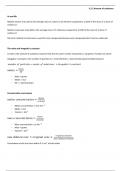
3.1.2 Amount of substance
Ar and Mr
Relative atomic mass (Ar) is the average mass of 1 atom of an element compared to 1/12th of the mass of 1 atom of
carbon-12
Relative molecular mass (Mr) is the average mass of 1 molecule compared to 1/12th of the mass of 1 atom of
carbon-12
The term relative formula mass is used for ionic compounds because ionic compounds don’t exist as molecules
The mole and Avogadro’s constant
A mole is the amount of substance in grams that has the same number of particles in 12 grams of carbon-12 atoms
Avogadro’s constant is the number of particles in 1 mole (Particles = atoms/molecules/ions/electrons/etc)
𝑛𝑢𝑚𝑏𝑒𝑟 𝑜𝑓 𝑝𝑎𝑟𝑡𝑖𝑐𝑙𝑒𝑠 = 𝑚𝑜𝑙𝑒𝑠 𝑜𝑓 𝑠𝑢𝑏𝑠𝑡𝑎𝑛𝑐𝑒 × 𝐴𝑣𝑜𝑔𝑎𝑑𝑟𝑜’𝑠 𝑐𝑜𝑛𝑠𝑡𝑎𝑛𝑡
𝑚𝑜𝑙𝑒𝑠 =
- Mass = grams
- Moles = mol
- Mr = 1 decimal place
Concentration and volume
𝑚𝑜𝑙𝑎𝑟 𝑐𝑜𝑛𝑐𝑒𝑛𝑡𝑟𝑎𝑡𝑖𝑜𝑛 =
- Molar concentration = 𝑚𝑜𝑙 𝑑𝑚
- Moles = mol
- Volume = 𝑑𝑚
𝑚𝑎𝑠𝑠 𝑐𝑜𝑛𝑐𝑒𝑛𝑡𝑟𝑎𝑡𝑖𝑜𝑛 =
- Mass concentration = 𝑔 𝑑𝑚
- Mass = grams
- Volume = 𝑑𝑚
𝑛𝑒𝑤 𝑑𝑖𝑙𝑢𝑡𝑒𝑑 𝑐𝑜𝑛𝑐 = 𝑜𝑟𝑖𝑔𝑖𝑛𝑎𝑙 𝑐𝑜𝑛𝑐 ×
Concordant results are titres within 0.1 𝑐𝑚 of each other
, 3.1.2 Amount of substance
Density
𝑑𝑒𝑛𝑠𝑖𝑡𝑦 =
The units of density vary depending on the question
Unit conversions
𝑐𝑚 to 𝑑𝑚 divide by 1,000
𝑐𝑚 to 𝑚 divide by 1,000,000
𝑑𝑚 to 𝑚 divide by 1,000
°C to K add 273
kPa to Pa multiply by 1,000
kg to tonnes divide by 1,000
g to kg divide by 1,000
mg to g divide by 1,000
μg to mg divide by 1,000
The 3 Laws
Boyle’s Law is “the product of pressure and volume is a constant as long as the temperature remains constant”
(pressure × volume = constant)
Charles’ Law is “the volume is proportional to the temperature as long as the pressure remains constant” (volume ∝
temperature and volume ÷ temperature = constant)
Gay-Lussac’s Law is “the pressure is proportional to the temperature as long as the volume remains constant”
(pressure ∝ temperature and pressure ÷ temperature = constant)
The combined equation of Boyle’s, Charles’ and Gay Lussac’s Laws:
×
= 𝑐𝑜𝑛𝑠𝑡𝑎𝑛𝑡 𝑓𝑜𝑟 𝑎 𝑓𝑖𝑥𝑒𝑑 𝑚𝑎𝑠𝑠 𝑜𝑓 𝑔𝑎𝑠
The ideal gas equation
𝑝𝑉 = 𝑛𝑅𝑇
- p = pressure = Pa
- V = volume = 𝑚
- n = number of moles
Ar and Mr
Relative atomic mass (Ar) is the average mass of 1 atom of an element compared to 1/12th of the mass of 1 atom of
carbon-12
Relative molecular mass (Mr) is the average mass of 1 molecule compared to 1/12th of the mass of 1 atom of
carbon-12
The term relative formula mass is used for ionic compounds because ionic compounds don’t exist as molecules
The mole and Avogadro’s constant
A mole is the amount of substance in grams that has the same number of particles in 12 grams of carbon-12 atoms
Avogadro’s constant is the number of particles in 1 mole (Particles = atoms/molecules/ions/electrons/etc)
𝑛𝑢𝑚𝑏𝑒𝑟 𝑜𝑓 𝑝𝑎𝑟𝑡𝑖𝑐𝑙𝑒𝑠 = 𝑚𝑜𝑙𝑒𝑠 𝑜𝑓 𝑠𝑢𝑏𝑠𝑡𝑎𝑛𝑐𝑒 × 𝐴𝑣𝑜𝑔𝑎𝑑𝑟𝑜’𝑠 𝑐𝑜𝑛𝑠𝑡𝑎𝑛𝑡
𝑚𝑜𝑙𝑒𝑠 =
- Mass = grams
- Moles = mol
- Mr = 1 decimal place
Concentration and volume
𝑚𝑜𝑙𝑎𝑟 𝑐𝑜𝑛𝑐𝑒𝑛𝑡𝑟𝑎𝑡𝑖𝑜𝑛 =
- Molar concentration = 𝑚𝑜𝑙 𝑑𝑚
- Moles = mol
- Volume = 𝑑𝑚
𝑚𝑎𝑠𝑠 𝑐𝑜𝑛𝑐𝑒𝑛𝑡𝑟𝑎𝑡𝑖𝑜𝑛 =
- Mass concentration = 𝑔 𝑑𝑚
- Mass = grams
- Volume = 𝑑𝑚
𝑛𝑒𝑤 𝑑𝑖𝑙𝑢𝑡𝑒𝑑 𝑐𝑜𝑛𝑐 = 𝑜𝑟𝑖𝑔𝑖𝑛𝑎𝑙 𝑐𝑜𝑛𝑐 ×
Concordant results are titres within 0.1 𝑐𝑚 of each other
, 3.1.2 Amount of substance
Density
𝑑𝑒𝑛𝑠𝑖𝑡𝑦 =
The units of density vary depending on the question
Unit conversions
𝑐𝑚 to 𝑑𝑚 divide by 1,000
𝑐𝑚 to 𝑚 divide by 1,000,000
𝑑𝑚 to 𝑚 divide by 1,000
°C to K add 273
kPa to Pa multiply by 1,000
kg to tonnes divide by 1,000
g to kg divide by 1,000
mg to g divide by 1,000
μg to mg divide by 1,000
The 3 Laws
Boyle’s Law is “the product of pressure and volume is a constant as long as the temperature remains constant”
(pressure × volume = constant)
Charles’ Law is “the volume is proportional to the temperature as long as the pressure remains constant” (volume ∝
temperature and volume ÷ temperature = constant)
Gay-Lussac’s Law is “the pressure is proportional to the temperature as long as the volume remains constant”
(pressure ∝ temperature and pressure ÷ temperature = constant)
The combined equation of Boyle’s, Charles’ and Gay Lussac’s Laws:
×
= 𝑐𝑜𝑛𝑠𝑡𝑎𝑛𝑡 𝑓𝑜𝑟 𝑎 𝑓𝑖𝑥𝑒𝑑 𝑚𝑎𝑠𝑠 𝑜𝑓 𝑔𝑎𝑠
The ideal gas equation
𝑝𝑉 = 𝑛𝑅𝑇
- p = pressure = Pa
- V = volume = 𝑚
- n = number of moles


