
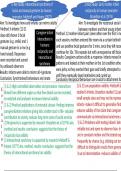
1) Key Study: Interactional synchrony of 2) Key Study: Early mother infant
facial and manual gestures by human reciprocity in human neonates-
neonates- Meltzoff and Moore (1977) Brazelton et al (1974)
Aim: To investigate how early infants can mirror adults Aim: To investigate the reciprocal social in
Method: 6 infants (12-21 between mothers and their young infant
days old) shown 3 facial Caregiver-infant Method: 12 mother-infant pairs (seen often over the first 5 mo
gestures (e.g. smile) and 1 interactions in each session, mothers entered the room via a curtain behind t
manual gesture in a row (e.g humans: and use positive facial gestures for 3 mins, once they left recor
hand raised). Responses reciprocity and continue for 30s. This repeats but with unresponsive still facial
interactional Results: Caregivers actions elicits a response- Infants moved in
were recorded and scored
synchrony patterns and looked at their mothers in the 1st condition other
by unbiased observers
were jerky as they averted their gaze and briefly attempted to
Results: Infants were able to mirror all 4 gestures
until they eventually layed motionless and curled up
Conclusion: Synchronised behaviours are innate Conclusion: Reciprocal behaviours are crucial to attachment fo
1) & 2) High controlled observation and procedure- interactions 1) & 2) Low population validity- Meltzoff &
E studied 6 infants, Brazelton studied 12 pair
filmed from different angles so that fine details can be recorded,
v small sample sizes and may not be represe
re-watched and analysed- increases internal validity
a
1) & 2) Practical applications of antenatal classes- findings improve infants- makes it difficult to generalise find
l
caregiver&infant relations giving kids a better start in life- valuable reduces validity of the claim that caregiver
u communicate via interactional synchrony a
contribution to society, reduces long term costs of social services
a 2) Reciprocity is supported by research- Brazelton et al (1974) aim, 1) & 2) Problems with testing infants’ beha
t method and results- conclusion- suggests that the theory of reliably test and open to observer bias- Inf
I reciprocity has validity are in constant motion and the tested exp
o 1) Interactional synchrony is supported by research-Meltzoff & frequently by chance (e.g. sticking out ton
n Moore (1977) aim, method, results- conclusion- suggests that the difficult to distinguish results from general
theory of interactional synchrony has validity it up to interpretation- reduces validity of
,Aim: To investigate the age which attachments form Method: 60 babies from W/C families in Glasgow (31 m
(including who with and the intensity) visited at home every month for their 1st yr and once a
Results: Attachment behaviours as stages linked to age Mothers were questioned about their babies reaction w
*6-8 months= Babies start to show separation anxiety from and when presented a stranger (separation & stranger
attachment figure shows a 1st attachment has been formed Conc: Mother isn’t always main atta
(65% with mothers due to reciprocity, 3% with fathers, 27% Key Study: it forms with those who display sen
joint, 5% data withdrew from the study) Stages of responsiveness more than those wh
*18 months= 87% had 2+ attachments, 31% attached to 5+ attachment- spend the most time, develops in st
Schaffer and and multiple can be formed, varying
Stage 1: Asocial (1 few weeks)- Babies are happier
st Emerson (1964)
around others especially those with a calming effect, Stage 3: Specific attachment (7 months)- Separation
behaviour towards inanimate objects & humans is similar stranger anxiety occur. Babies have formed a specifi
Stage 2: Indiscriminate attachment (2-7 months)- Babies show a preference for Stage 4: Multiple attachm
humans over objects and familiar faces. All attention and affection is accepted equally months)- Babies form 2nda
E High ecological validity- Most observations made were by the Self report data- collected from the mother's re
v parents during ordinary activities which were then reported infants- some may be less sensitive to infants' p
a back to the researchers so the babies behaviour was natural report them, some may give socially desirable a
l and unaffected by the presence of observers- findings can be disclosing who their child is/isn’t attached to- re
u generalised to real life settings so has high external validity Low population validity- sample consists of bab
a Longitudinal research- carried out over 18 families in a deprived area, high deprivation is
t months- the same children were followed up and mothers and unemployment etc which isn’t rep
I observed regularly- eliminates the issue of babies from other social classes who will have
o individual differences between P’s acting as experiences and patterns of development- mak
n confounding variables- increases internal validity generalise findings to others- reduces validity o


