
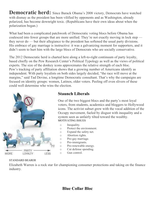
Democratic herd: Since Barack Obama’s 2008 victory, Democrats have watched
with dismay as the president has been vilified by opponents and as Washington, already
polarized, has become downright toxic. (Republicans have their own ideas about when the
polarization began.)
What had been a complicated patchwork of Democratic voting blocs before Obama has
coalesced into fewer groups that are more unified. They’re not exactly moving in lock step —
they never do — but their allegiance to the president has softened the usual party divisions.
His embrace of gay marriage is instructive: it was a galvanizing moment for supporters, and it
didn’t seem to hurt him with the large blocs of Democrats who are socially conservative.
The 2012 Democratic herd is charted here along a left-to-right continuum of party loyalty,
based chiefly on the Pew Research Center’s Political Typology as well as the views of political
experts. The size of the donkey icons approximates the relative strength of each bloc.
Pew’s tracking of party affiliation shows that a growing number of Americans identify as
independent. With party loyalists on both sides largely decided, “the race will move at the
margins,” said Tad Devine, a longtime Democratic consultant. That’s why the campaigns are
focused on identity groups: women, Latinos, older voters. Peeling off even slivers of these
could well determine who wins the election.
Staunch Liberals
One of the two biggest blocs and the party’s most loyal
voters, from students, academics and bloggers to Hollywood
icons. The activist subset grew with the vocal addition of the
Occupy movement, fueled by disgust with inequality and a
system seen as unfairly tilted toward the wealthy.
MOTIVATING ISSUES
o Inequality.
o Protect the environment.
o Expand the safety net.
o Abortion rights.
o Pro-gay marriage.
o Pro-immigrants.
o Pro-renewable energy.
o Cut defense spending.
o Gun control.
STANDARD BEARER
Elizabeth Warren is a rock star for championing consumer protections and taking on the finance
industry.
Blue Collar Bloc


