
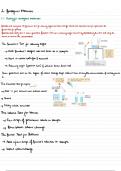
2. Britogiant Molecules
2. 1
Testing for bwiogical molecules
Describe and out the
Benedict test for reducing sugars the iodine test for starch the emulsion test for lipids and the
's
carry , ,
furrier's less for proteins
Describe and carry out semi guanidine Benedict 's test
a -
reducing sugar solution by standardising the test and using the
on a
results to emmine the concentration
the Benedict 's Test
for reducing sugars
→ And Benedict 's reagent into test tube to a
sample
→ Heat in water bath
for 5 minutes
[positive if solution
→
Reducing sugar test] turns brick red
-
semi quunhhie
degree of change helps inihuire how the concentration of carbohydrate
test the colour
strong
-
as
is
The Emulsion Test
for Lipids↳ non-polar
→ Add 1 I pour ethanol and distilled water
:
→ Shake
→ Milky -
white emulsion
The Iodine Test
for
starch
→ Few drops of potassium iodide in
sample
Blue black colour
→ change
-
The Driver Test
for Proteins
→ Add a
few drops of Bruner 's solution to
sample
→ violet colour
change
, Dennis and
carry
out a test to
identify the presence of non reducing sugars using acid hydrolysis and Benedict's
-
,
solution
' ' '
sugars classified reducing ontheir
ability
'
are
reducing↳ to donate electrons
or non
-
↳ able to donate nor able to donate
Test .
→ add HU to
sample
→ boil in bath
for 5
water minutes
→ neutralise with sodium carbonate Calnan )
hydrogen
→ use litmus paper Cshjwrly alkaline conditions needed)
→ add Benedict's reagent
in water bath
→ hear
+ brick-red
positive colour change
Explanation .
→ arid
hydrolysis any glycosidic bonds
allowing precipitate form
monosaccharides are able to donate elections , to
→
remaining
2.2
Carbohydrates and Lipids
Describe and draw the
ring forms of
a -
glucose
and
p ghuose
-
a- Glucose
at.at
(add the H 's) 13 glucose
-
CH,OH
i
-
-
^
OH
OH
OH OH
OH
OH
difference
only
?⃝
2. 1
Testing for bwiogical molecules
Describe and out the
Benedict test for reducing sugars the iodine test for starch the emulsion test for lipids and the
's
carry , ,
furrier's less for proteins
Describe and carry out semi guanidine Benedict 's test
a -
reducing sugar solution by standardising the test and using the
on a
results to emmine the concentration
the Benedict 's Test
for reducing sugars
→ And Benedict 's reagent into test tube to a
sample
→ Heat in water bath
for 5 minutes
[positive if solution
→
Reducing sugar test] turns brick red
-
semi quunhhie
degree of change helps inihuire how the concentration of carbohydrate
test the colour
strong
-
as
is
The Emulsion Test
for Lipids↳ non-polar
→ Add 1 I pour ethanol and distilled water
:
→ Shake
→ Milky -
white emulsion
The Iodine Test
for
starch
→ Few drops of potassium iodide in
sample
Blue black colour
→ change
-
The Driver Test
for Proteins
→ Add a
few drops of Bruner 's solution to
sample
→ violet colour
change
, Dennis and
carry
out a test to
identify the presence of non reducing sugars using acid hydrolysis and Benedict's
-
,
solution
' ' '
sugars classified reducing ontheir
ability
'
are
reducing↳ to donate electrons
or non
-
↳ able to donate nor able to donate
Test .
→ add HU to
sample
→ boil in bath
for 5
water minutes
→ neutralise with sodium carbonate Calnan )
hydrogen
→ use litmus paper Cshjwrly alkaline conditions needed)
→ add Benedict's reagent
in water bath
→ hear
+ brick-red
positive colour change
Explanation .
→ arid
hydrolysis any glycosidic bonds
allowing precipitate form
monosaccharides are able to donate elections , to
→
remaining
2.2
Carbohydrates and Lipids
Describe and draw the
ring forms of
a -
glucose
and
p ghuose
-
a- Glucose
at.at
(add the H 's) 13 glucose
-
CH,OH
i
-
-
^
OH
OH
OH OH
OH
OH
difference
only
?⃝


