
Year 13 biology- STANDARD ANSWERS
Genetics and Types of crosses
What is a genome?
The full set of genes of an organism
What is a proteome?
The full set of proteins coded by the genome
What is a genotype?
The genetic constitution of an organism
What is a phenotype?
The expression of the genetic constitution of an organism and its interaction with its
environment
What is codominance?
The result of both alleles being expressed in the phenotype
Neither allele is recessive or dominant to each other
What is recessive?
Alleles that are only expressed in the absence of other alleles
What is dominant?
Alleles that will be expressed in the phenotype even in the presence of other alleles
What is the difference between a homozygous and heterozygous genotype?
Homozygous genotypes have two copies of the same allele
Heterozygous genotype has two different alleles on the same gene
What is diploid?
A cell with two of each type of chromosome
What is haploid?
A cell with just one type of each chromosome
What is a locus?
The precise position of a gene on a chromosome
What is monohybrid inheritance?
When a phenotype of an organism is determined by a single gene
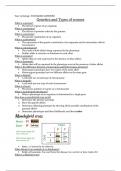
How does a monohybrid cross work?
1. Determine the parents' genotype
2. Show the gamete alleles
3. Determine offspring genotypes by showing all the possible combination of the
parental alleles
4. Determine phenotypes and their likelihoods and their ratios
Ratio: 1:1 brown fur to white fur
What disease is an example of co dominance?
Sickle cell anaemia. You can’t have the disease, be a carrier or have traits of it
What is a dihybrid cross?
, A mating experiment between two organisms that are identically hybrid for two traits
In a dihybrid cross with two heterozygous partners, the ratio will always be 9-3-3-1
What is a sex-linked gene?
A gene that is linked to one sex chromosome (x or y)
What is different between other crosses and sex linkage?
Females always have X X and males always have X Y.
When making a cross, you have to put the X or Y chromosome and then a small letter
on top for the disease. YOU DO NOT NEED TO PUT ONE ON THE Y AS MOST OF
THE TIME THE DISEASE IS X DEPENDENT
Why is it more common to have a disease appear in a man than a woman?
Men can only be homozygous recessive or dominant/ not heterozygous/ only carry
one allele on chromosome x as the y chromosome doesn’t carry and allele
So the other allele cannot mask the one leading to the disease.
E.g. Colour blindness is a recessive x dependent disease. If a heterozygous female and an
unaffected man are crossed, what will the phonotypic ratio of the F1 generation be?
Let N= dominant colour blindness and n=recessive colour blindness
Female gametes= Xn XN as the female is heterozygous/ a carrier
Male gametes= XN Y as the man is unaffected and since colour blindness is a recessive
disease, he must have a dominant N on the X chromosome
Xn XN
X N
X X
N n
XNXN
Y XnY XNY
Ratio= 1:1:1:1 female carrier, female unaffected, male unaffected, male affected or 3:1
unaffected to affected
, X dependent diseases may sometimes be more disadvantageous to men as they only
carry one allele on X chromosome and so don’t have an extra X chromosome that
may mask the disease
Autosomal linkage
What is an autosome?
Any chromosome that isn’t a sex cell
What does it mean in a gene is linked?
Both genes (or more than two) are on the same autosome
They stay together during independent segregation of chromosomes in meiosis I
Their alleles will be passed onto the offspring together
What is the only way linked genes can split?
If chiasmata occurs
B and C are more closely linked. Why? They are Closer together, less likely to split.
After crossing over occurs, B and C remain together but are split from gene A.
What ratio will you get if both genotypes are homozygous?
1
What ratio will you get is one parent is homozygous and the other is heterozygous?
1:1:1:1
Why are the expected ratios not always the same as the observed phenotypic ratios?
Fertilisation of gametes is random
The sample size could be too small
Linked genes may mean some genes are less likely to split
Epistasis
Lethal genotypes
An expected ratio was 1:1:1:1 however the observed was 1:2:2:1. Explain why this may
happen?
The alleles that have a higher ratio number may have been linked in both parents
A parent may have produced mostly (state allele) and (state allele) gametes
Crossing over may produce fewer (state alleles with lower ratio number) gametes
Therefore (state genotypes with larger ratio number) genotypes are more common in
the offspring.
E.g.)
, What ratio would you get if both heterozygous genotypes were crossed?
9-3-3-1
Epistasis
What is epistasis?
When one gene influences/ masks the expression of another
You say a gene is epistatic to another
How do multiple alleles o f a gene arise?
Through random mutations at different positions on the gene
What do dashes represent on a genotype?
A dominant or recessive allele
What is the ratio for dominant epistasis?
12;3:1
What is the ratio for recessive epistasis?
9;3:4


