

Topic 6 Assessment Booklet
Marks = 111 Time Allowed 150 minutes
Q1.
Furosemide and CVT are drugs used to remove excess fluid from the body. Scientists
investigated the effect of these drugs on the volume of urine produced by human
volunteers. The scientists used the following method.
• They divided volunteers into three groups, A, B and C at random.
• They gave all the volunteers the same food for 3 days.
• After 3 days, they gave the volunteers in group A a tablet containing furosemide, the
volunteers in group B a tablet containing CVT and the volunteers in group C a
placebo (a tablet that did not contain either drug).
• They then found the mean volume of urine produced by each group in the 4 hours
after taking the tablets.
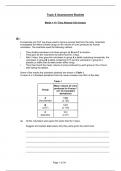
Some of the results the scientists obtained are shown in Table 1.
A value of ± 2 standard deviations from the mean includes over 95% of the data.
Table 1
Mean volume of urine
produced in 4 hours /
Group
cm3 (± 2 standard
deviations)
A 1980
(furosemide) (± 152)
B 1201
(CVT) (± 119)
C 312
(placebo) (± 57)
(a) All the volunteers were given the same food for 3 days.
Suggest and explain one reason why they were given the same food.
___________________________________________________________________
___________________________________________________________________
___________________________________________________________________
___________________________________________________________________
___________________________________________________________________
Page 1 of 34
, ___________________________________________________________________
___________________________________________________________________
___________________________________________________________________
(2)
(b) Using Table 1, what can you conclude about the effectiveness of furosemide and
CVT in the removal of excess fluid from the body?
___________________________________________________________________
___________________________________________________________________
___________________________________________________________________
___________________________________________________________________
___________________________________________________________________
___________________________________________________________________
(2)
(c) Furosemide is sometimes used to treat high blood pressure.
Suggest how furosemide would cause a decrease in blood pressure.
___________________________________________________________________
___________________________________________________________________
___________________________________________________________________
___________________________________________________________________
(1)
(d) Furosemide inhibits the absorption of sodium and chloride ions from the filtrate
produced in the nephrons.
Explain how furosemide causes an increase in the volume of urine produced.
___________________________________________________________________
___________________________________________________________________
___________________________________________________________________
___________________________________________________________________
___________________________________________________________________
___________________________________________________________________
___________________________________________________________________
___________________________________________________________________
(3)
Page 1 of 34
, The scientists also measured the mean rate of flow of blood plasma into the kidneys.
The results the scientists obtained are shown in Table 2.
Table 2
Mean rate of flow of
Group blood plasma into the
kidneys / cm3 min–1
A
380
(furosemide)
B
342
(CVT)
C
295
(placebo)
(e) The mean rate of flow of blood plasma is 60% of the mean rate of blood flow into the
kidneys.
How much greater is the flow of blood into the kidneys with furosemide than with
group C (placebo) over the 4 hours of the investigation? Give your answer in cm3.
Answer = ____________________ cm3
(1)
(Total 9 marks)
Q2.
Osmoreceptors are specialised cells that respond to changes in the water potential of the
blood.
(a) Give the location of osmoreceptors in the body of a mammal.
___________________________________________________________________
___________________________________________________________________
(1)
(b) When a person is dehydrated, the cell volume of an osmoreceptor decreases.
Explain why.
___________________________________________________________________
___________________________________________________________________
___________________________________________________________________
Page 1 of 34
, ___________________________________________________________________
(2)
(c) Stimulation of osmoreceptors can lead to secretion of the hormone ADH. Describe
and explain how the secretion of ADH affects urine produced by the kidneys.
___________________________________________________________________
___________________________________________________________________
___________________________________________________________________
___________________________________________________________________
___________________________________________________________________
___________________________________________________________________
___________________________________________________________________
___________________________________________________________________
(4)
The efficiency with which the kidneys filter the blood can be measured by the rate at which
they remove a substance called creatinine from the blood. The rate at which they filter the
blood is called the glomerular filtration rate (GFR).
In 24 hours, a person excreted 1660 mg of creatinine in his urine. The concentration of
creatinine in the blood entering his kidneys was constant at 0.01 mg cm–3.
(d) Calculate the GFR in cm3 minute–1.
Answer = ____________________
(1)
(e) Creatinine is a breakdown product of creatine found in muscle tissues. Apart from
age and gender, give two factors that could affect the concentration of creatinine in
the blood.
1. _________________________________________________________________
2. _________________________________________________________________
(1)
(Total 9 marks)
Q3.
A biologist investigated the stimulation of a Pacinian corpuscle in the skin of a fingertip.
She used microelectrodes to measure the maximum membrane potential of a Pacinian
corpuscle and its sensory neurone when different pressures were applied to the fingertip.
Page 1 of 34
Marks = 111 Time Allowed 150 minutes
Q1.
Furosemide and CVT are drugs used to remove excess fluid from the body. Scientists
investigated the effect of these drugs on the volume of urine produced by human
volunteers. The scientists used the following method.
• They divided volunteers into three groups, A, B and C at random.
• They gave all the volunteers the same food for 3 days.
• After 3 days, they gave the volunteers in group A a tablet containing furosemide, the
volunteers in group B a tablet containing CVT and the volunteers in group C a
placebo (a tablet that did not contain either drug).
• They then found the mean volume of urine produced by each group in the 4 hours
after taking the tablets.
Some of the results the scientists obtained are shown in Table 1.
A value of ± 2 standard deviations from the mean includes over 95% of the data.
Table 1
Mean volume of urine
produced in 4 hours /
Group
cm3 (± 2 standard
deviations)
A 1980
(furosemide) (± 152)
B 1201
(CVT) (± 119)
C 312
(placebo) (± 57)
(a) All the volunteers were given the same food for 3 days.
Suggest and explain one reason why they were given the same food.
___________________________________________________________________
___________________________________________________________________
___________________________________________________________________
___________________________________________________________________
___________________________________________________________________
Page 1 of 34
, ___________________________________________________________________
___________________________________________________________________
___________________________________________________________________
(2)
(b) Using Table 1, what can you conclude about the effectiveness of furosemide and
CVT in the removal of excess fluid from the body?
___________________________________________________________________
___________________________________________________________________
___________________________________________________________________
___________________________________________________________________
___________________________________________________________________
___________________________________________________________________
(2)
(c) Furosemide is sometimes used to treat high blood pressure.
Suggest how furosemide would cause a decrease in blood pressure.
___________________________________________________________________
___________________________________________________________________
___________________________________________________________________
___________________________________________________________________
(1)
(d) Furosemide inhibits the absorption of sodium and chloride ions from the filtrate
produced in the nephrons.
Explain how furosemide causes an increase in the volume of urine produced.
___________________________________________________________________
___________________________________________________________________
___________________________________________________________________
___________________________________________________________________
___________________________________________________________________
___________________________________________________________________
___________________________________________________________________
___________________________________________________________________
(3)
Page 1 of 34
, The scientists also measured the mean rate of flow of blood plasma into the kidneys.
The results the scientists obtained are shown in Table 2.
Table 2
Mean rate of flow of
Group blood plasma into the
kidneys / cm3 min–1
A
380
(furosemide)
B
342
(CVT)
C
295
(placebo)
(e) The mean rate of flow of blood plasma is 60% of the mean rate of blood flow into the
kidneys.
How much greater is the flow of blood into the kidneys with furosemide than with
group C (placebo) over the 4 hours of the investigation? Give your answer in cm3.
Answer = ____________________ cm3
(1)
(Total 9 marks)
Q2.
Osmoreceptors are specialised cells that respond to changes in the water potential of the
blood.
(a) Give the location of osmoreceptors in the body of a mammal.
___________________________________________________________________
___________________________________________________________________
(1)
(b) When a person is dehydrated, the cell volume of an osmoreceptor decreases.
Explain why.
___________________________________________________________________
___________________________________________________________________
___________________________________________________________________
Page 1 of 34
, ___________________________________________________________________
(2)
(c) Stimulation of osmoreceptors can lead to secretion of the hormone ADH. Describe
and explain how the secretion of ADH affects urine produced by the kidneys.
___________________________________________________________________
___________________________________________________________________
___________________________________________________________________
___________________________________________________________________
___________________________________________________________________
___________________________________________________________________
___________________________________________________________________
___________________________________________________________________
(4)
The efficiency with which the kidneys filter the blood can be measured by the rate at which
they remove a substance called creatinine from the blood. The rate at which they filter the
blood is called the glomerular filtration rate (GFR).
In 24 hours, a person excreted 1660 mg of creatinine in his urine. The concentration of
creatinine in the blood entering his kidneys was constant at 0.01 mg cm–3.
(d) Calculate the GFR in cm3 minute–1.
Answer = ____________________
(1)
(e) Creatinine is a breakdown product of creatine found in muscle tissues. Apart from
age and gender, give two factors that could affect the concentration of creatinine in
the blood.
1. _________________________________________________________________
2. _________________________________________________________________
(1)
(Total 9 marks)
Q3.
A biologist investigated the stimulation of a Pacinian corpuscle in the skin of a fingertip.
She used microelectrodes to measure the maximum membrane potential of a Pacinian
corpuscle and its sensory neurone when different pressures were applied to the fingertip.
Page 1 of 34


