

Topic 5 Assessment Booklet
Marks = 1`9 Time Allowed 165 minutes
Q1.
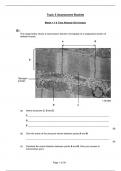
The image below shows a transmission electron micrograph of a longitudinal section of
skeletal muscle.
(a) Name structures C, D and E.
C _________________________________________________________________
D _________________________________________________________________
E _________________________________________________________________
(3)
(b) Give the name of the structure shown between points A and B.
___________________________________________________________________
(1)
(c) Calculate the actual distance between points A and B. Give your answer in
micrometres (µm).
Page 1 of 39
, Answer = __________________ µm
(1)
(d) The image shows glycogen granules present in skeletal muscle.
Explain their role in skeletal muscle.
___________________________________________________________________
___________________________________________________________________
___________________________________________________________________
___________________________________________________________________
___________________________________________________________________
(2)
(e) During vigorous exercise, the pH of skeletal muscle tissue falls. This fall in pH leads
to a reduction in the ability of calcium ions to stimulate muscle contraction.
Suggest how.
___________________________________________________________________
___________________________________________________________________
___________________________________________________________________
___________________________________________________________________
___________________________________________________________________
___________________________________________________________________
___________________________________________________________________
(3)
(Total 10 marks)
Q2.
Yeast cells can respire aerobically or anaerobically. A student used the apparatus shown
in Figure 1 to measure the rate of respiration in yeast.
She:
• positioned the flask in a water bath so that the yeast culture reached a constant
temperature
• then left the apparatus for one hour before starting her investigation.
Figure 1
Page 1 of 39
,(a) Suggest one reason why it was important that the student left the apparatus for one
hour after the yeast culture reached a constant temperature.
___________________________________________________________________
___________________________________________________________________
(1)
(b) During her investigation, the coloured liquid moved to the right.
Explain why it moved to the right.
___________________________________________________________________
___________________________________________________________________
___________________________________________________________________
___________________________________________________________________
___________________________________________________________________
___________________________________________________________________
___________________________________________________________________
___________________________________________________________________
(2)
(c) The student found that the coloured liquid moved 1.5 cm in 24 hours. The diameter
of the lumen (hole) of the capillary tubing was 1 mm.
The volume of a capillary tubing is given by πr2l, where π is 3.14 and l = length.
Calculate the volume of gas produced in cm3 hour–1.
Show your working.
Page 1 of 39
, Answer = ____________________ cm3 hour–1
(2)
Figure 2 shows a typical population growth curve for yeast under laboratory conditions.
Figure 2
(d) Explain why a log scale is used to record the number of cells.
___________________________________________________________________
___________________________________________________________________
___________________________________________________________________
(1)
(e) Many yeast cells die during the death phase.
Suggest one reason why.
___________________________________________________________________
___________________________________________________________________
___________________________________________________________________
___________________________________________________________________
(1)
(f) The following equation can be used to make predictions of the growth in the
population of yeast cells under ideal laboratory conditions.
Xt = X0 ert
Xt = the population after a certain time
X0 = the population at the start
e = 2.72 (base of natural logarithm)
r = growth rate
t = time period in hours over which r applies
A population of 2000 yeast cells was left for 10 hours.
The value for the growth rate was 0.5
Assuming no yeast cells died, calculate the predicted size of the population after 10
Page 1 of 39
Marks = 1`9 Time Allowed 165 minutes
Q1.
The image below shows a transmission electron micrograph of a longitudinal section of
skeletal muscle.
(a) Name structures C, D and E.
C _________________________________________________________________
D _________________________________________________________________
E _________________________________________________________________
(3)
(b) Give the name of the structure shown between points A and B.
___________________________________________________________________
(1)
(c) Calculate the actual distance between points A and B. Give your answer in
micrometres (µm).
Page 1 of 39
, Answer = __________________ µm
(1)
(d) The image shows glycogen granules present in skeletal muscle.
Explain their role in skeletal muscle.
___________________________________________________________________
___________________________________________________________________
___________________________________________________________________
___________________________________________________________________
___________________________________________________________________
(2)
(e) During vigorous exercise, the pH of skeletal muscle tissue falls. This fall in pH leads
to a reduction in the ability of calcium ions to stimulate muscle contraction.
Suggest how.
___________________________________________________________________
___________________________________________________________________
___________________________________________________________________
___________________________________________________________________
___________________________________________________________________
___________________________________________________________________
___________________________________________________________________
(3)
(Total 10 marks)
Q2.
Yeast cells can respire aerobically or anaerobically. A student used the apparatus shown
in Figure 1 to measure the rate of respiration in yeast.
She:
• positioned the flask in a water bath so that the yeast culture reached a constant
temperature
• then left the apparatus for one hour before starting her investigation.
Figure 1
Page 1 of 39
,(a) Suggest one reason why it was important that the student left the apparatus for one
hour after the yeast culture reached a constant temperature.
___________________________________________________________________
___________________________________________________________________
(1)
(b) During her investigation, the coloured liquid moved to the right.
Explain why it moved to the right.
___________________________________________________________________
___________________________________________________________________
___________________________________________________________________
___________________________________________________________________
___________________________________________________________________
___________________________________________________________________
___________________________________________________________________
___________________________________________________________________
(2)
(c) The student found that the coloured liquid moved 1.5 cm in 24 hours. The diameter
of the lumen (hole) of the capillary tubing was 1 mm.
The volume of a capillary tubing is given by πr2l, where π is 3.14 and l = length.
Calculate the volume of gas produced in cm3 hour–1.
Show your working.
Page 1 of 39
, Answer = ____________________ cm3 hour–1
(2)
Figure 2 shows a typical population growth curve for yeast under laboratory conditions.
Figure 2
(d) Explain why a log scale is used to record the number of cells.
___________________________________________________________________
___________________________________________________________________
___________________________________________________________________
(1)
(e) Many yeast cells die during the death phase.
Suggest one reason why.
___________________________________________________________________
___________________________________________________________________
___________________________________________________________________
___________________________________________________________________
(1)
(f) The following equation can be used to make predictions of the growth in the
population of yeast cells under ideal laboratory conditions.
Xt = X0 ert
Xt = the population after a certain time
X0 = the population at the start
e = 2.72 (base of natural logarithm)
r = growth rate
t = time period in hours over which r applies
A population of 2000 yeast cells was left for 10 hours.
The value for the growth rate was 0.5
Assuming no yeast cells died, calculate the predicted size of the population after 10
Page 1 of 39


