

Topic 4 Assessment Booklet
Marks = 164 Time Allowed 207 minutes
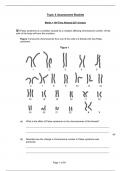
Q1.Patau syndrome is a condition caused by a mutation affecting chromosome number. All the
cells of the body will have this mutation.
Figure 1 shows the chromosomes from one of the cells of a female who has Patau
syndrome.
(a) What is the effect of Patau syndrome on the chromosomes of this female?
___________________________________________________________________
___________________________________________________________________
(1)
(b) Describe how the change in chromosome number in Patau syndrome was
produced.
___________________________________________________________________
___________________________________________________________________
Page 1 of 54
, ___________________________________________________________________
___________________________________________________________________
___________________________________________________________________
___________________________________________________________________
___________________________________________________________________
(2)
(c) Explain why all the cells of the body will have this mutation.
___________________________________________________________________
___________________________________________________________________
___________________________________________________________________
___________________________________________________________________
___________________________________________________________________
___________________________________________________________________
___________________________________________________________________
(2)
(d) Most children born with Patau syndrome die in the first 12 months, often due to
defects of circulation of blood.
One of these defects is patent ductus arteriosus (PDA). This can result in some of
the blood flowing between the aorta and the pulmonary artery.
Figure 2 shows a healthy child’s heart and the heart of a child with PDA.
Suggest how the flow of some of the blood between the aorta and pulmonary artery
Page 2 of 54
, could cause children to die in the first 12 months.
___________________________________________________________________
___________________________________________________________________
___________________________________________________________________
___________________________________________________________________
___________________________________________________________________
___________________________________________________________________
___________________________________________________________________
___________________________________________________________________
(3)
(Total 8 marks)
Q2.
(a) There are many different species of field mouse in Europe. Using a phylogenetic
classification, all of these species have names that start with Apodemus.
What information does this give about field mice?
___________________________________________________________________
___________________________________________________________________
___________________________________________________________________
___________________________________________________________________
(2)
The long-tailed field mouse, Apodemus sylvaticus, is a small mammal common in
mainland Britain.
(b) Complete Table 1 to show the classification of the long-tailed field mouse.
Table 1
Taxon Name of Taxon
Eukarya
Kingdom Animalia
Chordata
Mammalia
Order Rodentia
Family Muridae
(2)
Page 3 of 54
, The St. Kilda field mouse lives only on one island off the coast of Scotland. It is very
similar in appearance to the long-tailed field mouse but is larger and has lighter
coloured fur.
Biologists wanted to find out if the St. Kilda field mouse and the long-tailed field mouse
populations belonged to different species. They measured the length of the same features
of a large number of individuals from the two populations.
The results are shown in Table 2.
Table 2
Mean length (±SD) / mm
Population Head and
Tail
body
St. Kilda
112.3 (±9.3) 105.5 (±8.4)
field mouse
Long-tailed
95.2 (±8.2) 90.2 (±7.3)
field mouse
(c) Do the data in Table 2 provide evidence that the two populations belong to different
species? Use calculations of ratios to support your answer.
___________________________________________________________________
___________________________________________________________________
___________________________________________________________________
___________________________________________________________________
___________________________________________________________________
___________________________________________________________________
___________________________________________________________________
___________________________________________________________________
(3)
(d) Describe how breeding experiments could determine whether the two populations
are from the same species.
___________________________________________________________________
___________________________________________________________________
___________________________________________________________________
___________________________________________________________________
(2)
(Total 9 marks)
Q3.
Page 4 of 54
Marks = 164 Time Allowed 207 minutes
Q1.Patau syndrome is a condition caused by a mutation affecting chromosome number. All the
cells of the body will have this mutation.
Figure 1 shows the chromosomes from one of the cells of a female who has Patau
syndrome.
(a) What is the effect of Patau syndrome on the chromosomes of this female?
___________________________________________________________________
___________________________________________________________________
(1)
(b) Describe how the change in chromosome number in Patau syndrome was
produced.
___________________________________________________________________
___________________________________________________________________
Page 1 of 54
, ___________________________________________________________________
___________________________________________________________________
___________________________________________________________________
___________________________________________________________________
___________________________________________________________________
(2)
(c) Explain why all the cells of the body will have this mutation.
___________________________________________________________________
___________________________________________________________________
___________________________________________________________________
___________________________________________________________________
___________________________________________________________________
___________________________________________________________________
___________________________________________________________________
(2)
(d) Most children born with Patau syndrome die in the first 12 months, often due to
defects of circulation of blood.
One of these defects is patent ductus arteriosus (PDA). This can result in some of
the blood flowing between the aorta and the pulmonary artery.
Figure 2 shows a healthy child’s heart and the heart of a child with PDA.
Suggest how the flow of some of the blood between the aorta and pulmonary artery
Page 2 of 54
, could cause children to die in the first 12 months.
___________________________________________________________________
___________________________________________________________________
___________________________________________________________________
___________________________________________________________________
___________________________________________________________________
___________________________________________________________________
___________________________________________________________________
___________________________________________________________________
(3)
(Total 8 marks)
Q2.
(a) There are many different species of field mouse in Europe. Using a phylogenetic
classification, all of these species have names that start with Apodemus.
What information does this give about field mice?
___________________________________________________________________
___________________________________________________________________
___________________________________________________________________
___________________________________________________________________
(2)
The long-tailed field mouse, Apodemus sylvaticus, is a small mammal common in
mainland Britain.
(b) Complete Table 1 to show the classification of the long-tailed field mouse.
Table 1
Taxon Name of Taxon
Eukarya
Kingdom Animalia
Chordata
Mammalia
Order Rodentia
Family Muridae
(2)
Page 3 of 54
, The St. Kilda field mouse lives only on one island off the coast of Scotland. It is very
similar in appearance to the long-tailed field mouse but is larger and has lighter
coloured fur.
Biologists wanted to find out if the St. Kilda field mouse and the long-tailed field mouse
populations belonged to different species. They measured the length of the same features
of a large number of individuals from the two populations.
The results are shown in Table 2.
Table 2
Mean length (±SD) / mm
Population Head and
Tail
body
St. Kilda
112.3 (±9.3) 105.5 (±8.4)
field mouse
Long-tailed
95.2 (±8.2) 90.2 (±7.3)
field mouse
(c) Do the data in Table 2 provide evidence that the two populations belong to different
species? Use calculations of ratios to support your answer.
___________________________________________________________________
___________________________________________________________________
___________________________________________________________________
___________________________________________________________________
___________________________________________________________________
___________________________________________________________________
___________________________________________________________________
___________________________________________________________________
(3)
(d) Describe how breeding experiments could determine whether the two populations
are from the same species.
___________________________________________________________________
___________________________________________________________________
___________________________________________________________________
___________________________________________________________________
(2)
(Total 9 marks)
Q3.
Page 4 of 54


