

Topic 1 Assessment Booklet
Marks = 123 Time Allowed 152 minutes
Q1.
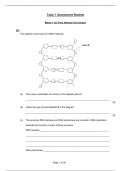
The diagram shows part of a DNA molecule.
(a) How many nucleotides are shown in the diagram above?
___________________________________________________________________
(1)
(b) Name the type of bond labelled X in the diagram.
___________________________________________________________________
(1)
(c) The enzymes DNA helicase and DNA polymerase are involved in DNA replication.
Describe the function of each of these enzymes.
DNA helicase _______________________________________________________
___________________________________________________________________
___________________________________________________________________
___________________________________________________________________
DNA polymerase _____________________________________________________
Page 1 of 36
, ___________________________________________________________________
___________________________________________________________________
___________________________________________________________________
(2)
(d) Adenosine triphosphate (ATP) is a nucleotide derivative.
Contrast the structures of ATP and a nucleotide found in DNA to give two
differences.
1. _________________________________________________________________
___________________________________________________________________
___________________________________________________________________
___________________________________________________________________
2. _________________________________________________________________
___________________________________________________________________
___________________________________________________________________
___________________________________________________________________
(2)
(Total 6 marks)
Q2.
(a) State and explain the property of water that can help to buffer changes in
temperature.
___________________________________________________________________
___________________________________________________________________
___________________________________________________________________
___________________________________________________________________
___________________________________________________________________
___________________________________________________________________
___________________________________________________________________
___________________________________________________________________
___________________________________________________________________
___________________________________________________________________
(2)
(b) Water is used to hydrolyse ATP.
Page 2 of 36
, Name the two products of ATP hydrolysis.
1. _________________________________________________________________
2. _________________________________________________________________
(1)
Hydrolysis of ATP is catalysed by the enzyme ATP hydrolase.
A student investigated the effect of ATP concentration on the activity of ATP hydrolase.
She used shortening of strips of muscle tissue caused by contraction as evidence that
ATP was being hydrolysed.
• She took four slides A, B, C and D, and added strips of muscle tissue of the same
length to each slide.
• She then added the same volume of ATP solutions of different concentrations to the
four slides and left each slide for five minutes.
• She then recorded the final length of each strip of muscle tissue.
Her results can be seen in the table.
Concentration
Final length of muscle
of ATP solution
Slide tissue after 5
added to slide /
minutes / mm
× 10 mol dm
–6 –3
A 2 36
B 4 31
C 6 29
D 8 26
(c) Other than those given, name two variables the student should have controlled.
1. _________________________________________________________________
___________________________________________________________________
2. _________________________________________________________________
___________________________________________________________________
(2)
(d) Describe and explain the pattern shown by the data in the table.
Description
__________________________________________________________
___________________________________________________________________
___________________________________________________________________
___________________________________________________________________
___________________________________________________________________
Page 3 of 36
, Explanation _________________________________________________________
___________________________________________________________________
___________________________________________________________________
___________________________________________________________________
___________________________________________________________________
(2)
(e) The hydrolysis of 1 dm3 of a 1 mol dm–3 solution of ATP releases 30 500 J of energy.
60% of the energy released during the hydrolysis of 1 mol dm–3 of ATP is released
as heat; the rest is used for muscle contraction.
The student added 0.05 cm3 of ATP solution to slide D.
Calculate the energy available from ATP for contraction of the muscle on this slide.
Answer = ____________________ J
(3)
(Total 10 marks)
Q3.
(a) Name the monomers from which a maltose molecule is made.
___________________________________________________________________
(1)
(b) Name the type of chemical bond that joins the two monomers to form maltose.
___________________________________________________________________
(1)
A student wanted to produce a dilution series of a maltose solution so he could plot a
calibration curve. He had a stock solution of maltose of concentration 0.6 mol dm−3 and
distilled water. He made a series of dilutions from 0.1 to 0.6 mol dm−3.
(c) Complete the table below by giving all headings, units and the concentration of the
maltose solution produced.
Concentration of Volume of 0.6 mol
maltose solution dm−3 maltose _______________
solution / cm3
Page 4 of 36
Marks = 123 Time Allowed 152 minutes
Q1.
The diagram shows part of a DNA molecule.
(a) How many nucleotides are shown in the diagram above?
___________________________________________________________________
(1)
(b) Name the type of bond labelled X in the diagram.
___________________________________________________________________
(1)
(c) The enzymes DNA helicase and DNA polymerase are involved in DNA replication.
Describe the function of each of these enzymes.
DNA helicase _______________________________________________________
___________________________________________________________________
___________________________________________________________________
___________________________________________________________________
DNA polymerase _____________________________________________________
Page 1 of 36
, ___________________________________________________________________
___________________________________________________________________
___________________________________________________________________
(2)
(d) Adenosine triphosphate (ATP) is a nucleotide derivative.
Contrast the structures of ATP and a nucleotide found in DNA to give two
differences.
1. _________________________________________________________________
___________________________________________________________________
___________________________________________________________________
___________________________________________________________________
2. _________________________________________________________________
___________________________________________________________________
___________________________________________________________________
___________________________________________________________________
(2)
(Total 6 marks)
Q2.
(a) State and explain the property of water that can help to buffer changes in
temperature.
___________________________________________________________________
___________________________________________________________________
___________________________________________________________________
___________________________________________________________________
___________________________________________________________________
___________________________________________________________________
___________________________________________________________________
___________________________________________________________________
___________________________________________________________________
___________________________________________________________________
(2)
(b) Water is used to hydrolyse ATP.
Page 2 of 36
, Name the two products of ATP hydrolysis.
1. _________________________________________________________________
2. _________________________________________________________________
(1)
Hydrolysis of ATP is catalysed by the enzyme ATP hydrolase.
A student investigated the effect of ATP concentration on the activity of ATP hydrolase.
She used shortening of strips of muscle tissue caused by contraction as evidence that
ATP was being hydrolysed.
• She took four slides A, B, C and D, and added strips of muscle tissue of the same
length to each slide.
• She then added the same volume of ATP solutions of different concentrations to the
four slides and left each slide for five minutes.
• She then recorded the final length of each strip of muscle tissue.
Her results can be seen in the table.
Concentration
Final length of muscle
of ATP solution
Slide tissue after 5
added to slide /
minutes / mm
× 10 mol dm
–6 –3
A 2 36
B 4 31
C 6 29
D 8 26
(c) Other than those given, name two variables the student should have controlled.
1. _________________________________________________________________
___________________________________________________________________
2. _________________________________________________________________
___________________________________________________________________
(2)
(d) Describe and explain the pattern shown by the data in the table.
Description
__________________________________________________________
___________________________________________________________________
___________________________________________________________________
___________________________________________________________________
___________________________________________________________________
Page 3 of 36
, Explanation _________________________________________________________
___________________________________________________________________
___________________________________________________________________
___________________________________________________________________
___________________________________________________________________
(2)
(e) The hydrolysis of 1 dm3 of a 1 mol dm–3 solution of ATP releases 30 500 J of energy.
60% of the energy released during the hydrolysis of 1 mol dm–3 of ATP is released
as heat; the rest is used for muscle contraction.
The student added 0.05 cm3 of ATP solution to slide D.
Calculate the energy available from ATP for contraction of the muscle on this slide.
Answer = ____________________ J
(3)
(Total 10 marks)
Q3.
(a) Name the monomers from which a maltose molecule is made.
___________________________________________________________________
(1)
(b) Name the type of chemical bond that joins the two monomers to form maltose.
___________________________________________________________________
(1)
A student wanted to produce a dilution series of a maltose solution so he could plot a
calibration curve. He had a stock solution of maltose of concentration 0.6 mol dm−3 and
distilled water. He made a series of dilutions from 0.1 to 0.6 mol dm−3.
(c) Complete the table below by giving all headings, units and the concentration of the
maltose solution produced.
Concentration of Volume of 0.6 mol
maltose solution dm−3 maltose _______________
solution / cm3
Page 4 of 36


