100% satisfaction guarantee Immediately available after payment Both online and in PDF No strings attached 4.6 TrustPilot
logo-home
Essay

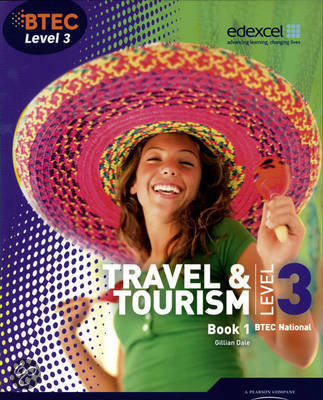
P1, P2, P3, M1, D1 - Investigating the Travel and Tourism Sector

Rating
3.2
(13)
Sold
16
Pages
12
Uploaded on
23-02-2017
Written in
2016/2017

BTEC Travel and Tourism Level 3 - Unit 1 - Investigating the Travel and Tourism Sector. For P1, learners need to describe all of the travel and tourism component industries and identify one named organisation within each. Learners should ensure that they include all the items in brackets, eg transport provision (road, rail, sea, air). Learners should demonstrate knowledge of the nature of domestic, inbound and outbound tourism by ensuring that across all the named organisations they have included all three types of tourism. It is required that learners include a short definition of the different types of tourism within their evidence for P1. The examples they select, such as a named tour operator or a named travel agent, will need to be appropriate. Note that the criterion requires learners to ‘describe’ each of the component industries and ‘identify’ the organisations within them. Methods of assessment could involve learners in putting on a travel trade fair, making presentations, producing displays or an information file. It is not necessary to provide examples of each type of tourism for each of the component industries; it is sufficient to provide examples of each type of tourism across all the component industries. Edexcel BTEC Level 3 Nationals specification in Travel and Tourism – Issue 1 – June 2010 © Edexcel Limited 2010 10 Within P2, roles should be covered according to the unit content: to meet key organisational aims, to provide products and services, to be responsible to stakeholders, to be environmentally and ethically responsible, to contribute to international and UK economies. Learners should select three organisations each from a different component industry. At least one of these should be a medium to large organisation to enable learners to fully cover the range within the content. Descriptions should be comprehensive, covering all of the key roles of the organisations, summarised in the learner’s own words. For P3, learners need to review the different types of interrelationships, ie chains of distribution (how travel products are distributed through the levels), integration (including both horizontal and vertical) and interdependencies (how different organisations rely on each other, eg a tour operator has to contract rooms from a hotel). Learners can use a variety of diagrams to illustrate their review and should include relevant and up-to-date examples of each aspect of interrelation. To meet M1, the learner should select a minimum of two organisations, preferably each in a different component industry. The explanation needs to be detailed, showing a progression in understanding from the more basic description at pass level. Examples should be carefully selected for their relevance and in particular to provide sufficient coverage of all items in the range for roles and interrelationships; to do this it is expected that at least one of the organisations would be a medium to large company. Care should be taken if selecting one of the large integrated multinational companies, eg TUI Travel Group, as these organisations are complex. If learners select a large multinational company they should focus their evidence on the UK part of the company. For D1, learners can select one organisation. The work has to be analytical and it is important that the selected organisation will provide sufficient coverage of all aspects of interrelationships. For example, a large tour operator could have complex chains of distribution that may involve many levels, ie sales directly to the customer through their own call centres, via their own website, sales indirectly to customers via high street retail agents, via web-based agents. The tour operator may be integrated horizontally and vertically and they will have certain interdependencies such as retail travel agents, principals (flights and accommodation) and excursion providers. Learners will need to explore all these aspects of interrelationship and analyse their importance to the selected organisation and to the other organisations involved. All the criterias included.

Show more Read less


Whoops! We can’t load your doc right now. Try again or contact support.

Document information

Uploaded on
February 23, 2017
Number of pages
12
Written in
2016/2017
Type
Essay
Professor(s)
Unknown
Grade
Unknown

Subjects

Content preview

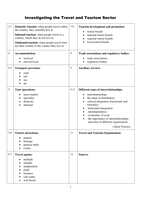
Investigating the Travel and Tourism Sector

2-3 Domestic tourism: when people travel within 7-8 Tourism development and promotion:
the country, they currently live at
 tourist boards
Inbound tourism: when people travel to a  national tourist boards
country, which they do not live in  regional tourist boards
Outbound tourism: when people travel from  local tourist boards
not their country to the country they live at

4 Accommodation: 8 Trade associations and regulatory bodies:
 serviced  trade associations
 non-serviced  regulatory bodies

4-5 Transport provision: 9 Ancillary services
 road
 rail
 sea
 air

5 Tour operations: 9-11 Different types of interrelationships:
 mass-market  interrelationships
 specialist  the chain of distribution
 domestic  vertical integration (backwards and
 inbound forwards)
 horizontal integration
 interdependency
 economies of scale
 the importance of interrelationships
and roles of different organisations
(Alton Towers)

5-6 Tourist attractions: 11 Travel and Tourism Organisations
 natural
 heritage
 purpose-built
 events

6-7 Travel agents: 12 Sources
 multiple
 miniple
 independent
 retail
 business
 call centre
 web-based

1

Reviews from verified buyers

Showing 7 of 13 reviews
4 year ago

this isnt was it says it was. this work will not help in any way. ive tried to file for a refund but it has failed

6 year ago

7 year ago

7 year ago

Thank you so much:)

7 year ago

7 year ago

7 year ago

Hey, this work has achieved all the criteria marked by real examiners. What was your problem?

7 year ago

7 year ago

Thank you so much for your positive feedback:)

7 year ago

7 year ago

Thank you for your feedback:)

3.2

13 reviews

5
5
4
2
3
0
2
2
1
4
Trustworthy reviews on Stuvia

All reviews are made by real Stuvia users after verified purchases.

Get to know the seller

Seller avatar
Reputation scores are based on the amount of documents a seller has sold for a fee and the reviews they have received for those documents. There are three levels: Bronze, Silver and Gold. The better the reputation, the more your can rely on the quality of the sellers work.
Lisa66 Pearson
View profile
Follow You need to be logged in order to follow users or courses
Sold
930
Member since
8 year
Number of followers
516
Documents
113
Last sold
1 year ago

3.5

365 reviews

5
110
4
107
3
52
2
34
1
62

Recently viewed by you

Why students choose Stuvia

Created by fellow students, verified by reviews

Quality you can trust: written by students who passed their exams and reviewed by others who've used these revision notes.

Didn't get what you expected? Choose another document

No problem! You can straightaway pick a different document that better suits what you're after.

Pay as you like, start learning straight away

No subscription, no commitments. Pay the way you're used to via credit card and download your PDF document instantly.

Student with book image

“Bought, downloaded, and smashed it. It really can be that simple.”

Alisha Student

Frequently asked questions