Ionic Bonding
What is Ionic Bonding?:
Ionic bonding occurs between metals and non-metals.
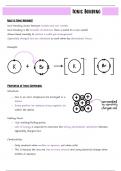
Ionic bonding is the transfer of electrons from a metal to a non-metal.
Atoms bond ionically to achieve a noble gas arrangement.
Oppositely charged ions are attracted to each other by electrostatic forces.
Example:
Properties of Ionic Compounds:
Structure:
– Ions in an ionic compound are arranged in a
lattice.
– Every positive ion attracts every negative ion
within the lattice
Melting Point:
- High melting/boiling points.
- Lots of energy is required to overcome the strong electrostatic attraction between
oppositely charged ions.
Conductivity:
- Only conducts when molten or aqueous, not when solid.
- This is because the ions are free to move around and carry electrical charge when
molten or aqueous.
What is Ionic Bonding?:
Ionic bonding occurs between metals and non-metals.
Ionic bonding is the transfer of electrons from a metal to a non-metal.
Atoms bond ionically to achieve a noble gas arrangement.
Oppositely charged ions are attracted to each other by electrostatic forces.
Example:
Properties of Ionic Compounds:
Structure:
– Ions in an ionic compound are arranged in a
lattice.
– Every positive ion attracts every negative ion
within the lattice
Melting Point:
- High melting/boiling points.
- Lots of energy is required to overcome the strong electrostatic attraction between
oppositely charged ions.
Conductivity:
- Only conducts when molten or aqueous, not when solid.
- This is because the ions are free to move around and carry electrical charge when
molten or aqueous.