

Psychology Research Methods - Data handling and analysis
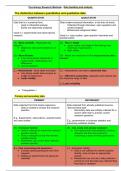
The distinction between quantitative and qualitative data:
QUANTITATIVE QUALITATIVE
Data that is in numerical form. Data is non numerical information. In the form of words.
- Used in inferential analysis - Collected through interviews, open questions and
- Easily and objectively analysed content analysis
- Behavioural categories tallied
Used in = experimental and observational
research Used in = case studies, open-question interviews and
questionnaires
(S) - More scientific - Replicable and (S) - Rich in Detail -
objective ➔ gives origins and insight of the feelings and
➔ Objectivity reduces the likelihood of meanings of participants
bias ➔ High validity
(S) - More Reliable - (S) - Allows the researcher to find issues that are often
➔ It can be analysed statistically to missed
reveal trends, relationships and
differences
➔ Can be repeated
(L) - Reductionist - lacks depth and detail (L) - Interpretation can lead to researcher bias
➔ only shows results does not give an
insight on behaviours (L) - difficult to summarise, categories and analyse due
➔ Lacks validity too extensive range of data
(L) Lacks reliability
● Triangulation =
Primary and secondary data:
PRIMARY SECONDARY
Data collected from first-hands experience Data collected from already published sources.
- Data is created to answer the research “Second-hand data”
question - Secondary data was initially collected for a
reason other than to answer current
research questions.
E.g., Experiments, observations, questionnaires
and case studies E.g., governments or business statistics and
previously published studies
(S) - Increases Validity - (S) - less costly and already analysed -
➔ Data is collected to answer the research ➔ Can reduce both time needed to conduct
question directly research and the cost involved in
➔ Study is designed to test the intended conducting a study involving participants
variable directly
➔ Researcher can control data collection
process carefully
(L) - time consuming and expensive - (L) - decreased validity -
➔ Includes paying participants and other ➔ Data is not collected to answer question
research directly may not give an appropriate
➔ Setting up experiments and paying for answer
materials ➔ Researcher has not role in data collection -
cannot be sure that data was collected free
from bias or variables
The distinction between quantitative and qualitative data:
QUANTITATIVE QUALITATIVE
Data that is in numerical form. Data is non numerical information. In the form of words.
- Used in inferential analysis - Collected through interviews, open questions and
- Easily and objectively analysed content analysis
- Behavioural categories tallied
Used in = experimental and observational
research Used in = case studies, open-question interviews and
questionnaires
(S) - More scientific - Replicable and (S) - Rich in Detail -
objective ➔ gives origins and insight of the feelings and
➔ Objectivity reduces the likelihood of meanings of participants
bias ➔ High validity
(S) - More Reliable - (S) - Allows the researcher to find issues that are often
➔ It can be analysed statistically to missed
reveal trends, relationships and
differences
➔ Can be repeated
(L) - Reductionist - lacks depth and detail (L) - Interpretation can lead to researcher bias
➔ only shows results does not give an
insight on behaviours (L) - difficult to summarise, categories and analyse due
➔ Lacks validity too extensive range of data
(L) Lacks reliability
● Triangulation =
Primary and secondary data:
PRIMARY SECONDARY
Data collected from first-hands experience Data collected from already published sources.
- Data is created to answer the research “Second-hand data”
question - Secondary data was initially collected for a
reason other than to answer current
research questions.
E.g., Experiments, observations, questionnaires
and case studies E.g., governments or business statistics and
previously published studies
(S) - Increases Validity - (S) - less costly and already analysed -
➔ Data is collected to answer the research ➔ Can reduce both time needed to conduct
question directly research and the cost involved in
➔ Study is designed to test the intended conducting a study involving participants
variable directly
➔ Researcher can control data collection
process carefully
(L) - time consuming and expensive - (L) - decreased validity -
➔ Includes paying participants and other ➔ Data is not collected to answer question
research directly may not give an appropriate
➔ Setting up experiments and paying for answer
materials ➔ Researcher has not role in data collection -
cannot be sure that data was collected free
from bias or variables


