

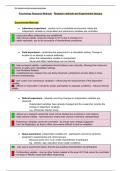
RM - Research methods and experimental design
Psychology Research Methods - Research methods and Experimental designs
Experimental Methods:
● Laboratory experiment - carried out in a controlled environment, where the
independent variable is manipulated and extraneous variables are controlled
(S) - cause-and-effect relationships are established
(S) - high internal validity, observed change in DV is due to change in IV
(S) - easily replicable, due to the procedure of standardised procedures
● Field experiment - conducting the experiment in a naturalistic setting. Change in
location in an attempt to reduce artificiality.
- where the independent variable is manipulated
- Cause-and-effect relationships can be inferred
(S) - high ecological validity = participants should behave more naturally, allowing their observed
behaviour to apply other naturalistic settings.
(S) - has Mundane Realism
(S) - if participants are unaware they are being observed, participants are less likely to show
demand characteristics
……………………………………………………………………………………………………………………
(L) - lack control over extraneous variables = influencing the measurement of the dependent
variable
(L) - difficult or impossible to randomly assign participants to separate conditions - reduces internal
validity
● Natural experiment - naturally occurring changes in independent variables are
observed
- Independent variables have already changed and the researcher records the
change in dependent variables.
e.g., Romanian Orphan study
(S) - Allows us to research areas that could not be studied due to ethical or cost reasons
(S) - High external validity - real behaviour means less chance of demand characteristics
…………………………………………………………………………………………………………………...
(L) - Extraneous variables cannot be controlled - as events have already happened
(L) - Can't be Replicated, as they’re often rare events (difficult to test for reliability)
● Quasi-experiment -independent variable (IV) - participants cannot be randomly
assigned to experimental and control groups
- Because levels of IV is an innate characteristic if participant
Eg., Gender, age, education level, health conditions
(S) - only way to experiment factors that are pre-existing characteristics of participants
…………………………………………………………………………………………………………………..
(L) - Confounding variable - may be other factors related to the level of IV that cannot be controlled.
(L) - not easy to identify cause-and-effect relationship
, RM - Research methods and experimental design
Key words:
❖ Independent variable = is manipulated
❖ Dependent variable (DV) = Something that is measured, following the manipulation
of the IV
❖ Operationalisation of variables = how variables are defined and measured
❖ Extraneous variables = unwanted variable that adds error to an experiment
Experimental Designs:
Independent group design Repeated measures design Matched pairs design
- Participants take part in - The same participants - (two) Participants are
only one of the complete all conditions of an matched according to
conditions they have experiment important variables and
been randomly assigned - Counterbalancing can be used assigned to two different
to conditions
Eg., one group does condition A first
and the other group does condition B E.g., two people are matched with
first levels of aggression
EV: EV: EV:
(S) - less demand (S) - needs half the participants, (S) - reduced participant variables
characteristics - less likely to compared to Independent GD as participants are matched on
work out the aim if they are only (S) - participant variables is not a relevant characteristics
in one condition problem as participants take part in (S) - no oder effect - participants
(S) - no order effects both conditions take part in one condition
…………………………………… ……………………………………….. ……………………………………….
(L) - . needs double participant (L) - .increased demand (L) - Matched PD take longer to set
compared to Repeated MD characteristics - both conditions up compared to other experimental
(L) - .participant variables is a mean, they are likely going to find out design
problem as they only take part the aim (L) - need twice as many
in one conditions (L) - .order effects - [participants participants as Repeated MD
performance can worsen or improve (L) - participants won’t be exactly
between conditions (e.g., fatigue) similar
Psychology Research Methods - Research methods and Experimental designs
Experimental Methods:
● Laboratory experiment - carried out in a controlled environment, where the
independent variable is manipulated and extraneous variables are controlled
(S) - cause-and-effect relationships are established
(S) - high internal validity, observed change in DV is due to change in IV
(S) - easily replicable, due to the procedure of standardised procedures
● Field experiment - conducting the experiment in a naturalistic setting. Change in
location in an attempt to reduce artificiality.
- where the independent variable is manipulated
- Cause-and-effect relationships can be inferred
(S) - high ecological validity = participants should behave more naturally, allowing their observed
behaviour to apply other naturalistic settings.
(S) - has Mundane Realism
(S) - if participants are unaware they are being observed, participants are less likely to show
demand characteristics
……………………………………………………………………………………………………………………
(L) - lack control over extraneous variables = influencing the measurement of the dependent
variable
(L) - difficult or impossible to randomly assign participants to separate conditions - reduces internal
validity
● Natural experiment - naturally occurring changes in independent variables are
observed
- Independent variables have already changed and the researcher records the
change in dependent variables.
e.g., Romanian Orphan study
(S) - Allows us to research areas that could not be studied due to ethical or cost reasons
(S) - High external validity - real behaviour means less chance of demand characteristics
…………………………………………………………………………………………………………………...
(L) - Extraneous variables cannot be controlled - as events have already happened
(L) - Can't be Replicated, as they’re often rare events (difficult to test for reliability)
● Quasi-experiment -independent variable (IV) - participants cannot be randomly
assigned to experimental and control groups
- Because levels of IV is an innate characteristic if participant
Eg., Gender, age, education level, health conditions
(S) - only way to experiment factors that are pre-existing characteristics of participants
…………………………………………………………………………………………………………………..
(L) - Confounding variable - may be other factors related to the level of IV that cannot be controlled.
(L) - not easy to identify cause-and-effect relationship
, RM - Research methods and experimental design
Key words:
❖ Independent variable = is manipulated
❖ Dependent variable (DV) = Something that is measured, following the manipulation
of the IV
❖ Operationalisation of variables = how variables are defined and measured
❖ Extraneous variables = unwanted variable that adds error to an experiment
Experimental Designs:
Independent group design Repeated measures design Matched pairs design
- Participants take part in - The same participants - (two) Participants are
only one of the complete all conditions of an matched according to
conditions they have experiment important variables and
been randomly assigned - Counterbalancing can be used assigned to two different
to conditions
Eg., one group does condition A first
and the other group does condition B E.g., two people are matched with
first levels of aggression
EV: EV: EV:
(S) - less demand (S) - needs half the participants, (S) - reduced participant variables
characteristics - less likely to compared to Independent GD as participants are matched on
work out the aim if they are only (S) - participant variables is not a relevant characteristics
in one condition problem as participants take part in (S) - no oder effect - participants
(S) - no order effects both conditions take part in one condition
…………………………………… ……………………………………….. ……………………………………….
(L) - . needs double participant (L) - .increased demand (L) - Matched PD take longer to set
compared to Repeated MD characteristics - both conditions up compared to other experimental
(L) - .participant variables is a mean, they are likely going to find out design
problem as they only take part the aim (L) - need twice as many
in one conditions (L) - .order effects - [participants participants as Repeated MD
performance can worsen or improve (L) - participants won’t be exactly
between conditions (e.g., fatigue) similar


