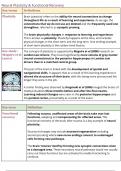
Neural Plasticity & Functional Recovery
Key terms Definitions
Plasticity Brain ‘plasticity’ refers to the ability for neural connections to change
throughout life as a result of learning and experience. As we age, the
connections that we do not use are deleted and the frequently used one
strengthen, referred to as synaptic pruning
The brain physically changes in response to learning and experience.
This is known as plasticity. Plasticity happens all the time, and includes
physical changes in the short term and the long term. One striking example
of short term plasticity is the rubber hand illusion.
Key study: The concept of plasticity is supported by Maguire et al (2000) research on
Maguire et al London taxi drivers. They found significantly more volume of grey matter
(2007) (neural connections) in the posterior hippocampus in London taxi
drivers than in a matched control group.
This part of the brain is linked with the development of spatial and
navigational skills. It appears that as a result of this learning experience it
altered the structure of their brain, with this being more pronounced the
longer they were in the job.
A similar finding was observed by Draganski et al (2006) imaged the brains of
medical students three months before and after the final exams.
Learning induced changes were seen in the posterior hippocampus and
the parietal cortex, presumably as a result of the exam.
Key term Definition
Functional Following trauma, unaffected areas of the brain take over lost
recovery functions, adapting and compensating for affected areas. This
functional recovery of the brain after trauma is a key example of neural
plasticity.
Structural changes may include neuronal regeneration including
axonal sprouting where new nerve endings connect to undamaged
cells forming new pathways.
The brain ‘rewires’ itself by forming new synaptic connections close
to a damaged area. These secondary neural pathways would not usually
carry out these functions but are activated to enable functioning to
continue.
Key terms Definitions
Plasticity Brain ‘plasticity’ refers to the ability for neural connections to change
throughout life as a result of learning and experience. As we age, the
connections that we do not use are deleted and the frequently used one
strengthen, referred to as synaptic pruning
The brain physically changes in response to learning and experience.
This is known as plasticity. Plasticity happens all the time, and includes
physical changes in the short term and the long term. One striking example
of short term plasticity is the rubber hand illusion.
Key study: The concept of plasticity is supported by Maguire et al (2000) research on
Maguire et al London taxi drivers. They found significantly more volume of grey matter
(2007) (neural connections) in the posterior hippocampus in London taxi
drivers than in a matched control group.
This part of the brain is linked with the development of spatial and
navigational skills. It appears that as a result of this learning experience it
altered the structure of their brain, with this being more pronounced the
longer they were in the job.
A similar finding was observed by Draganski et al (2006) imaged the brains of
medical students three months before and after the final exams.
Learning induced changes were seen in the posterior hippocampus and
the parietal cortex, presumably as a result of the exam.
Key term Definition
Functional Following trauma, unaffected areas of the brain take over lost
recovery functions, adapting and compensating for affected areas. This
functional recovery of the brain after trauma is a key example of neural
plasticity.
Structural changes may include neuronal regeneration including
axonal sprouting where new nerve endings connect to undamaged
cells forming new pathways.
The brain ‘rewires’ itself by forming new synaptic connections close
to a damaged area. These secondary neural pathways would not usually
carry out these functions but are activated to enable functioning to
continue.