Class Worksheet: EZ & EP Infleunces
Research studies supporting the Role of EPs
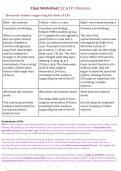
Siffre - the caveman Folkard - clock in a cave Ralph - the mutant hamster's
Procedure and findings ... Procedure and findings ... Procedure and findings ...
Folkard (1985) studied a group
Siffre is a cave explorer of 12 people who had agreed to The role of the
who has spent several spend time in a cave with a suprachiasmatic nucleus was
periods of weeks or clock, but without external time investigated by Ralph et al,
months underground, cues. They were instructed to who bred a strain of
away from natural light, go to bed at 11.45 pm and hamsters with an abnormally
and has studied the wake up at 7.45 am. The clock short circadian rhythm (20
changes in his body clock. was changed while they were hours). When SCN neurons
He found that he sleeping, ending up at a were transplanted from
maintained a ‘free-running’ 22-hour cycle. The sleep-wake these mutant hamsters into
circadian rhythm which cycle of most subjects ordinary ones, they too
lasted a little longer than remained at 24 hours, began to show the abnormal
24 hours. providing further evidence rhythm, showing that the
supporting the role of the EP. SCN plays an important role
in initiating circadian
rhythms.
What does this research What does this research show? What does this research
show? show?
The sleep-wake cycle of most
This case study provides subjects remained at 24 hours, the SCN plays an important
evidence that biorhythms providing further evidence role in initiating circadian
can persist without supporting the role of the EP. rhythms.
external cues.
Evaluations of EPs
Siffre (a cave explorer) spent long periods of time living underground with no daylight, no clocks and no radio, simply
waking and sleeping as and when he wanted. Over a period of two months, he found that his sleep-wake cycle
generally adjusted to a 24-hour cycle. Tested these patterns by removing time cues including watches and daylight.
This supports the existence of an EP internal biological clock that regulates these patterns.
One limitation of EPs is that they cannot be studied in isolation. Only in exceptional circumstances are EPs
‘free-running’ and unaffected by the influence of EZs. Total isolation studies (eg, Siffre’s cave study) are rare. In
everyday life, pacemakers and zeitgebers interact so it may make little sense to separate the two. This suggests the
more researchers attempt to isolate them, the lower the internal validity of the research.
The influence of the SCN on the sleep/wake cycle has been demonstrated in animals. Ralph et al (1990) supported
the key role that the endogenous pacemaker makes in controlling the circadian rhythm. He found that transplanting
mutant hamster SCN with circadian rhythms of 20 hours instead of 24 hours, displayed the same mutant rhythms of
Research studies supporting the Role of EPs
Siffre - the caveman Folkard - clock in a cave Ralph - the mutant hamster's
Procedure and findings ... Procedure and findings ... Procedure and findings ...
Folkard (1985) studied a group
Siffre is a cave explorer of 12 people who had agreed to The role of the
who has spent several spend time in a cave with a suprachiasmatic nucleus was
periods of weeks or clock, but without external time investigated by Ralph et al,
months underground, cues. They were instructed to who bred a strain of
away from natural light, go to bed at 11.45 pm and hamsters with an abnormally
and has studied the wake up at 7.45 am. The clock short circadian rhythm (20
changes in his body clock. was changed while they were hours). When SCN neurons
He found that he sleeping, ending up at a were transplanted from
maintained a ‘free-running’ 22-hour cycle. The sleep-wake these mutant hamsters into
circadian rhythm which cycle of most subjects ordinary ones, they too
lasted a little longer than remained at 24 hours, began to show the abnormal
24 hours. providing further evidence rhythm, showing that the
supporting the role of the EP. SCN plays an important role
in initiating circadian
rhythms.
What does this research What does this research show? What does this research
show? show?
The sleep-wake cycle of most
This case study provides subjects remained at 24 hours, the SCN plays an important
evidence that biorhythms providing further evidence role in initiating circadian
can persist without supporting the role of the EP. rhythms.
external cues.
Evaluations of EPs
Siffre (a cave explorer) spent long periods of time living underground with no daylight, no clocks and no radio, simply
waking and sleeping as and when he wanted. Over a period of two months, he found that his sleep-wake cycle
generally adjusted to a 24-hour cycle. Tested these patterns by removing time cues including watches and daylight.
This supports the existence of an EP internal biological clock that regulates these patterns.
One limitation of EPs is that they cannot be studied in isolation. Only in exceptional circumstances are EPs
‘free-running’ and unaffected by the influence of EZs. Total isolation studies (eg, Siffre’s cave study) are rare. In
everyday life, pacemakers and zeitgebers interact so it may make little sense to separate the two. This suggests the
more researchers attempt to isolate them, the lower the internal validity of the research.
The influence of the SCN on the sleep/wake cycle has been demonstrated in animals. Ralph et al (1990) supported
the key role that the endogenous pacemaker makes in controlling the circadian rhythm. He found that transplanting
mutant hamster SCN with circadian rhythms of 20 hours instead of 24 hours, displayed the same mutant rhythms of