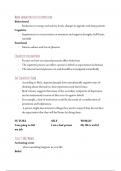
Main characteristics of depression
Behavioural
- Reduction in energy and activity levels, changes in appetite and sleep patterns
Cognitive
- Impairments in concentration or attention and negative thoughts (self-harm,
suicidal)
Emotional
- Intense sadness and loss of pleasure
Cognitive explanation
- Focuses on how our mental processes affect behaviour
- The cognitive process can affect a person’s beliefs or expectations (schemas)
- The internal mental process can and should be investigated scientifically
The Cognitive Triad
- According to Beck, depressed people have unrealistically negative ways of
thinking about themselves, their experiences and their future.
- Beck’s theory suggests that many of the secondary symptoms of depression
can be understood in terms of this core of negative beliefs.
- For example, a lack of motivation could be the result of a combination of
pessimism and helplessness.
- A person might lose interest in things they used to enjoy if they do not have
the expectation that they will feel better by doing them.
FUTURE SELF WORLD
I am going to fail I am a bad person My life is awful
my job
Ellis’s ABC Model.
Activating event
- when something happens in your life
Belief
, - forming a belief about the event which may be rational or irrational
Consequences
- the emotional and behavioural that flow from your beliefs which may be
unhealthy and self-destructive or healthy.
Information Processing
The third aspect of Beck’s model concerns how depressed people are prone to
distorting and misinterpreting information from the world. They are inclined to
make overly negative and self-defeating interpretations that lead to low mood and
passivity.
Fault Thinking Strategy
Arbitrary inferences
- Drawing negative conclusions off the back of insufficient evidence.
Selective thinking
- Focusing on negative details or events whilst ignoring positive ones.
Overgeneralisation
- Drawing sweeping conclusions based on a single incident.
Catastrophising
- Exaggerating a minor setback until it becomes a complete disaster.
Personalising
- Taking responsibility and blame for all unpleasant things that happen.
Black and white thinking
- Seeing everything in terms of success or failure
Cognitive treatments for depression.
- The main aim of cognitive behavioural therapy (CBT) is changing the thoughts and
perceptions that underlie depression. This is known as cognitive restructuring, and involves
challenging and changing the irrational thoughts that characterise depressive thinking.
Challenging irrational thoughts.
- Both Ellis and Beck developed forms of CBT to used with depressed clients. Over the
course of the treatment (often around 12 weeks) the client learns to identify, challenge and
Behavioural
- Reduction in energy and activity levels, changes in appetite and sleep patterns
Cognitive
- Impairments in concentration or attention and negative thoughts (self-harm,
suicidal)
Emotional
- Intense sadness and loss of pleasure
Cognitive explanation
- Focuses on how our mental processes affect behaviour
- The cognitive process can affect a person’s beliefs or expectations (schemas)
- The internal mental process can and should be investigated scientifically
The Cognitive Triad
- According to Beck, depressed people have unrealistically negative ways of
thinking about themselves, their experiences and their future.
- Beck’s theory suggests that many of the secondary symptoms of depression
can be understood in terms of this core of negative beliefs.
- For example, a lack of motivation could be the result of a combination of
pessimism and helplessness.
- A person might lose interest in things they used to enjoy if they do not have
the expectation that they will feel better by doing them.
FUTURE SELF WORLD
I am going to fail I am a bad person My life is awful
my job
Ellis’s ABC Model.
Activating event
- when something happens in your life
Belief
, - forming a belief about the event which may be rational or irrational
Consequences
- the emotional and behavioural that flow from your beliefs which may be
unhealthy and self-destructive or healthy.
Information Processing
The third aspect of Beck’s model concerns how depressed people are prone to
distorting and misinterpreting information from the world. They are inclined to
make overly negative and self-defeating interpretations that lead to low mood and
passivity.
Fault Thinking Strategy
Arbitrary inferences
- Drawing negative conclusions off the back of insufficient evidence.
Selective thinking
- Focusing on negative details or events whilst ignoring positive ones.
Overgeneralisation
- Drawing sweeping conclusions based on a single incident.
Catastrophising
- Exaggerating a minor setback until it becomes a complete disaster.
Personalising
- Taking responsibility and blame for all unpleasant things that happen.
Black and white thinking
- Seeing everything in terms of success or failure
Cognitive treatments for depression.
- The main aim of cognitive behavioural therapy (CBT) is changing the thoughts and
perceptions that underlie depression. This is known as cognitive restructuring, and involves
challenging and changing the irrational thoughts that characterise depressive thinking.
Challenging irrational thoughts.
- Both Ellis and Beck developed forms of CBT to used with depressed clients. Over the
course of the treatment (often around 12 weeks) the client learns to identify, challenge and