Theories of Romantic Relationships
EQUITY THEORY
AO1
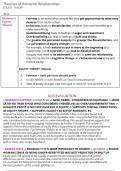
Walster’s - Fairness is achieved when people feel they get approximately what they
Equity deserve from relationships.
Theory - Unfairness leads to dissatisfaction, whether it be over-benefitting or
under-benefitting.
- Underbenefittung leads to feelings of anger and resentment
- Overbenefitting can lead to feelings of guilt and shame.
- The greater the perceived inequity the greater the dissatisfaction, and
our perception of equity changes over time.
- For example, it feels natural to put in more at the beginning of a
relationship, but if it persists it can lead to dissatisfaction.
- Inequity may need to be addressed in order to save the relationship,
may this be this be a cognitive change or a behavioural one to try and
restore equity.
EQUITY THEORY: Walster
1. Fairness = both partners should profit
2. Under-benefit or over-benefit can lead to dissatisfaction
3. View of equity changes over time (put in more ST, but want fair in LT)
AO3 EVALUATION
+ RESEARCH SUPPORT -> UTNE ET AL -> NEWLYWEDS - CONSIDERED RS EQUITABLE -> MORE
SATISFIED THAN THOSE WHO CONSIDERED THEMSELVES AS OVER/UNDERBENEFITTING ->
SUGGESTS PROFIT IS NOT KEY ISSUE BUT IS EQUITY -> SUPPORTS CENTRAL PREDICTIONS
OF EQUITY THEORY -> SUPPORTS VALIDITY AS EXP OF ROMANTIC RS
Support for equity as a key factor in relationship stability. Utne et al (1984) found that
newly-weds who considered their relationship equitable were more satisfied than those
who considered themselves as over or under-benefitting. This would therefore suggest that
profit is not the key issue in judging relationships, but rather it is equity. This research
supports the central predictions of equity theory supporting its validity as an explanation of
romantic relationships. Furthermore, Walster et al (1977) found that in a prospective
study, students who had judged their relationship to be equitable at the beginning of
their relationship were more likely to still be together 14 weeks later than those who
judged it to be inequitable. Crucially, those who over-benefitted were as likely to initiate a
split as those who under-benefitted.
- GENDER DIFFS -> EVIDENCE IT IS IS MORE IMPORTANT TO WOMEN -> DE MARIS -> FOUND
WOMANS SENSE OF BEING UNDER-BENEFITTED WAS BEST PREDICTOR OF SPLIT UP
Equity does not appear to be equally important to all relationships, and that gender
differences persist. There is considerable evidence that it is more important to women.
For example, Da Maris (2007) found that a woman's sense of being under-benefitted was
the best predictor of the couple splitting up.
EQUITY THEORY
AO1
Walster’s - Fairness is achieved when people feel they get approximately what they
Equity deserve from relationships.
Theory - Unfairness leads to dissatisfaction, whether it be over-benefitting or
under-benefitting.
- Underbenefittung leads to feelings of anger and resentment
- Overbenefitting can lead to feelings of guilt and shame.
- The greater the perceived inequity the greater the dissatisfaction, and
our perception of equity changes over time.
- For example, it feels natural to put in more at the beginning of a
relationship, but if it persists it can lead to dissatisfaction.
- Inequity may need to be addressed in order to save the relationship,
may this be this be a cognitive change or a behavioural one to try and
restore equity.
EQUITY THEORY: Walster
1. Fairness = both partners should profit
2. Under-benefit or over-benefit can lead to dissatisfaction
3. View of equity changes over time (put in more ST, but want fair in LT)
AO3 EVALUATION
+ RESEARCH SUPPORT -> UTNE ET AL -> NEWLYWEDS - CONSIDERED RS EQUITABLE -> MORE
SATISFIED THAN THOSE WHO CONSIDERED THEMSELVES AS OVER/UNDERBENEFITTING ->
SUGGESTS PROFIT IS NOT KEY ISSUE BUT IS EQUITY -> SUPPORTS CENTRAL PREDICTIONS
OF EQUITY THEORY -> SUPPORTS VALIDITY AS EXP OF ROMANTIC RS
Support for equity as a key factor in relationship stability. Utne et al (1984) found that
newly-weds who considered their relationship equitable were more satisfied than those
who considered themselves as over or under-benefitting. This would therefore suggest that
profit is not the key issue in judging relationships, but rather it is equity. This research
supports the central predictions of equity theory supporting its validity as an explanation of
romantic relationships. Furthermore, Walster et al (1977) found that in a prospective
study, students who had judged their relationship to be equitable at the beginning of
their relationship were more likely to still be together 14 weeks later than those who
judged it to be inequitable. Crucially, those who over-benefitted were as likely to initiate a
split as those who under-benefitted.
- GENDER DIFFS -> EVIDENCE IT IS IS MORE IMPORTANT TO WOMEN -> DE MARIS -> FOUND
WOMANS SENSE OF BEING UNDER-BENEFITTED WAS BEST PREDICTOR OF SPLIT UP
Equity does not appear to be equally important to all relationships, and that gender
differences persist. There is considerable evidence that it is more important to women.
For example, Da Maris (2007) found that a woman's sense of being under-benefitted was
the best predictor of the couple splitting up.