
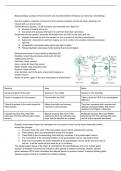
Biopsychology- analysis of how the brain and neurotransmitters influence our behaviour and feelings.
Nervous system- a network of neurons to carry electric impulses around the body, allowing us to
interact with our environment.
Central Nervous System : all life functions are controlled here. Split into
★ the brain (controls all we do)
★ the spinal cord (passes information to and from their brain and body)
Peripheral nervous system: transmits information from the CNS to the body split into
● Somatic (transmits to and from senses so it is in control of voluntary movements)
● Autonomic (transmits to and from organs so it is in control of involuntary internal processes)
split into
❖ Sympathetic (increases bodily activity like fight or flight )
❖ Parasympathetic (decreases bodily activity like rest and digest)
Neurons are nerves to carry electrical impulses (EI)
Dendrite- branch like structures which carry EI from
neighbouring nerves
Cell body- holds nucleus
Axon- carries EI down the neuron
Myelin sheath- fatty protection layer
Nucleus- holds cell dna
Axon terminal- end of the axon where the EI passes to
another neuron
Nodes of ranvier- gaps in the axon that speed up transmission
Sensory relay Motor
Nucleus projects off the side Nucleus in the middle Nucleus in the dendrites
Found in receptors (in the senses) Found within the CNS Takes it from the CNS to a muscle/gland
(effector)
Take all impulses to the brain except for Allows the motor and sensory They form synapses with muscles and
reflex actions neurons to communicate release neurotransmitters that bind to
receptors and trigger a response
Unipolar because they only ONE Bipolar because they have TWO Multipolar because they have MANY
extension from the cell body (the whole extensions from the cell body (one extensions from the cell body (the axon
neuron) axon and the dendrite as a whole) and all of the separate dendrites)
Synaptic transmission takes the massage from one neuron to the next by being chemically carried
across the synapse.
1. EI is sent down the axon of the presynaptic neuron which activates the vesicles
2. They release their neurotransmitters across the synapse
3. These bind to the corresponding (lock and key) receptors in the postsynaptic neuron
4. The summation of the neurotransmitters in the postsynaptic neuron may lead to firing
5. If the sum is excitatory the action potential of the postsynaptic neuron will be turned on and it
will fire- it will be turned off and wont fire if it is inhibitory.
The pituitary gland (base of the brain) is controlled by the hypothalamus and is the master gland
because it releases hormones that influence other glands to release hormones. Anterior pituitary
gland releases ACTH which stimulates the adrenal glands to produce cortisol. Posterior pituitary gland
releases oxytocin which is important for mothers bonding.
, Adrenal glands are above the kidneys. Adrenal Cortex releases cortisol in response to stress and
adrenal medulla releases adrenaline and noradrenaline for fight or flight.
The ovaries release oestrogen and progesterone to control the menstrual cycle/pregnancy
The testes release testosterone to control sex drive, sperm production and male characteristics
The HPA axis is a response to chronic (ongoing) stress:
1) Amygdala associates sensory signals with emotions
2) Hypothalamus releases CRF so
3) The pituitary releases ACTH so
4) The adrenal cortex releases cortisol
Cortisol immediately increases blood clotting but suppresses the immune system in the long term
The SAM pathway is the body's response to acute (sudden) stress:
1) Amygdala associates sensory signals with emotions
2) Hypothalamus activates the sympathetic branch of the autonomic nervous system so
3) Adrenal medulla releases adrenaline
Adrenal immediately does fight or flight but in the long term can cause coronary heart disease due to
the increased heart rate and blood pressure
Then when the stress is gone the amygdala switches off the stress response and parasympathetic
kicks in to return everything to normal.
The cerebral cortex is high folded grey matter which is the outer layer of the brain that's responsible
for higher cognitive processes like consciousness.
The two hemispheres are connected by the corpus callosum (pathway of neural fibres) and the lobes
are identified by the central sulcus and lateral fissure which are the main folds in the brain.
Things that are more sensitive to control need more cortical space.
Localisation- specific tasks are located in certain areas of the cerebral cortex
Lateralisation- the hemispheres specialise in different things because the left is good at language and
the right is good at visual and spatial tasks
Motor cortex Frontal lobe (anterior to central Voluntary motor movements of skeletal muscles via contralateral
sulcus) representations
Visual area Occipital lobe Visual perception in three tiers- primary is easiest tasks and tertiary
most complex- via contralateral representation
Somatosensory Parietal lobe posterior to central Skin sensation via upside down contralateral representation
area sulcus
Auditory cortex temporal lobe (posterior to lateral Auditory perception of inputs from the ear via the auditory nerve in the
fissure) three tiers
Broca's area Left frontal lobe (anterior to the Production of language via sending instructions to the motor area to
motor cortex) send to the mouth
Wernicke's area Left temporal lobe (posterior to Comprehension of language when the auditory area passes it
auditory cortex) information


