
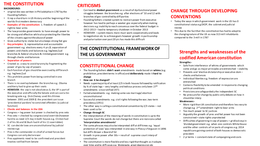
THE CONSTITUTION CRITICISMS
BACKGROUND:
•
• original doc was written in Philadelphia in 1787 by the
Can lead to divided government as a result of dysfunctional power
struggles between the branches e.g. after elections of ‘10 and 12 with
CHANGE THROUGH DEVELOP
Founding Fathers.
• It rep a shard turn in US History and the beginning of the
branches of gov controlled by diff parties CONVENTIONS
• Founding fathers created system to restrain power from executive
worlds first modern democracy • Today the ways in which government work in the
however has lead to perhaps a weaker gov especially when making
• Examples of the constitution: 1. freedom of speech 2. constitutional status e.g.EXOP, the cabinet and ju
decisions e.g. inability to reach consensus over the federal budget in
right to bear arms review
2012-2013 – lead to temporary shutdown in October 2013
• The law provides governments to have enough power to • This due to the fact that the constitution has had
• HOWEVER – system means more must work cooperatively and leads
be strong and effective while also protecting the liberties the changing nature of the US as now 313 mill in
to negotiation etc to achieve goals however growth in partisanship
of the citizens against the abuse of power compared to the 3 mill in 1787
and polarisation over past 20 yrs has made this difficult
• Gives authority to states but also keeps strong fed gov
• Key principles: 1. representative and accountable
government e.g. elections every 4 yrs 2. separation of
powers and checks and balances e.g. leg/exec/jud
THE CONSTITUTIONAL FRAMEWORK OF
Strengths and weakness
branches 3. federal structure 4. limited government e.g. THE US GOVERNMENT
through checks and balances
• Separation of powers
codified American const
Strengths:-
• Created as a way to avoid tyranny by fragmenting the
power of gov by sep of powers CONSTITUTIONAL CHANGE • Safe from interference of whims of gover
come and go as major principles are entr
• Each function of gov should be exercised by diff branch • The founding fathers didn’t want amendments made based on whims (e.g.
• Prevents and ‘elective dictatorship or exe
e.g. leg/exec/jud prohibition, president terms in office) and deliberately made it hard to
checks and balances
• This prohibits power from being controlled in one change
• Individual liberties e.g. freedom of expres
branch • How can it be changed?
entrenched
• There is no overlap between the branches e.g. Obama • Needs supermajority of at least 2/3 in both houses followed by ratification
• Contains flexibility to be amended in resp
and Kerry had to give up their seats by ¾ of state legs – very lengthy and tedious process only been 27th
political conditions
• HOWEVER: the sep is not absolute as 1. the VP is part of amendments since ratified 1971
• Provisions are safeguarded y the indepen
the executive and officially the Senate and can cast a tie- • Failed amendments: e.g. making same-sex marriage/ abortion
• No pressure for change by public only de
breaking vote e.g. Dick Cheney used this 8 times unconstitutional
should be interp
between 2001 and 2009 2. the president can issue • Successful amendments: e.g. civil rights following the war, two-term
Weaknesses:-
‘presidential pardons’ to convicted offenders (a judicial presidency (1951)
• More rigid than UK constitution and there
function) • The other way is calling a constitutional convention by 2/3 states – not
change e.g. 2 nd amendment right to bear
• Checks and balances in the USA been used so far
• Too much power to SC justices
• Congress = leg power but power is checked by pres veto • Change through SC
• Arguably the growth of pres and fed pow
• Pres veto = checked by congressional override (however • the interpretation of the meaning of words in constitution is up to the
constrained = state rights unprotected
hard to as need 2/3 maj in both houses e.g. Clinton had Supreme Court the words do not change but there are revisions called
• Difficulties of governing in sep of powers
2 of his 36 and W.Bush had 4 of his 11 overridden) ‘interpretative amendments’
‘divided government e.g. when one contr
• SC can decide laws are unconstitutional by judicial • The same phrases may also be interpreted diff at diff times e.g. ‘equal
and the other controls all or parts of cong
review e.gs protection of laws’ was interpreted in one way in Plessy v Ferguson in 1896
republicans gaining control of both house
• Pres is the commander-in-chief of armed forces but but diff n Brown v Board of Ed
president
Congress can only declare war • Growth in pres power after 30s = result of supreme court interp of
• 2 yr terms = constant state of campaignin
• Pres apptments need to be confirmed and president constitution
treaties ratified from Senate • The constitution is more flexible and less rigid that thought as it adapts
over time and to diff cases e.g. Watergate, great depression etc


