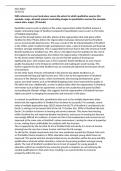
With reference to a recent seismic event, assess the extent to which you agree that
physical factors are more important than human factors in determining the level of
impacts experienced by the local population.
Plan:
Haiti
Human: development, LIC, poor governance, aid reliant.
Physical: multi-hazardous environment, complex plate margins.
Answer:
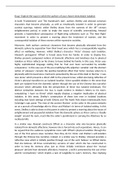
Physical factors are partially less important than human factors in determining the level of
impact experienced by the local people in the event of a volcanic eruption as governance
and development play a large role in the response to the event and the mitigation of
impacts experienced by people.
An example of a recent volcanic event in which human factors played a larger role than
physical factors can be seen in Haiti. The Port-au-Prince 2010 earthquake was a magnitude
6.3 earthquake that occurred in the heart of Haiti’s capital city Port-au-Prince. Haiti is an LIC
that has poor governance and has been called the ‘country of NGOs’ as a result of its
reliance on aid to sustain its society and economy. Additionally, 86% of people in Port-au-
Prince live in slums that have weak structures and are prone to collapsing. Because of this,
when the earthquake hit Port-au-Prince over 200,000 people were killed by the collapse of
60% of the city including the majority of the slum structures in which they lived in. This was
enhanced by landslides caused by intensely deforested, unstable soil that had been shaken
off of hill and mountain sides.
In addition to this, due to Haiti’s poor governance and heavy reliance on aid, the
government did not have an emergency response plan and did not have the emergency
services needed to provide its people with aid. This resulted in further loss of life as medical
treatment was not given. In response to this however, international aid from the Dominican
Republic was offered in which they opened their borders to provide medical treatment to
the injured as well as food and water and heavy machinery to help search and rescue teams
remove rubble. In addition to this, NGOs such as Save the children provided food and water
provisions as well as created temporary relief camps for those who lost their home. As a
result of the governments lack of response and the low development of Haiti the seismic
hazard caused a significant amount of damage a large percentage of which Haiti still has not
recovered from today.
On the other hand, physical factors also played a role in the level of impact experienced by
people during the seismic event. For example, Haiti lies on a set of complex plate margins,
which allows for large amounts of tectonic activity to occur developing larger seismic
events. Furthermore, these earthquakes do not occur frequently meaning that many people
will have never experienced an earthquake before making response and emergency plans
harder to impose. In addition to this, Haiti is a multi- hazardous environment. This impacts
their economy significantly as due to the multiple hazards Haiti experiences such as
hurricanes and earthquakes they are unable to recover from the previous hazardous event
before the next one occurs. This also results in a loss of business and finance as rebuilding is
physical factors are more important than human factors in determining the level of
impacts experienced by the local population.
Plan:
Haiti
Human: development, LIC, poor governance, aid reliant.
Physical: multi-hazardous environment, complex plate margins.
Answer:
Physical factors are partially less important than human factors in determining the level of
impact experienced by the local people in the event of a volcanic eruption as governance
and development play a large role in the response to the event and the mitigation of
impacts experienced by people.
An example of a recent volcanic event in which human factors played a larger role than
physical factors can be seen in Haiti. The Port-au-Prince 2010 earthquake was a magnitude
6.3 earthquake that occurred in the heart of Haiti’s capital city Port-au-Prince. Haiti is an LIC
that has poor governance and has been called the ‘country of NGOs’ as a result of its
reliance on aid to sustain its society and economy. Additionally, 86% of people in Port-au-
Prince live in slums that have weak structures and are prone to collapsing. Because of this,
when the earthquake hit Port-au-Prince over 200,000 people were killed by the collapse of
60% of the city including the majority of the slum structures in which they lived in. This was
enhanced by landslides caused by intensely deforested, unstable soil that had been shaken
off of hill and mountain sides.
In addition to this, due to Haiti’s poor governance and heavy reliance on aid, the
government did not have an emergency response plan and did not have the emergency
services needed to provide its people with aid. This resulted in further loss of life as medical
treatment was not given. In response to this however, international aid from the Dominican
Republic was offered in which they opened their borders to provide medical treatment to
the injured as well as food and water and heavy machinery to help search and rescue teams
remove rubble. In addition to this, NGOs such as Save the children provided food and water
provisions as well as created temporary relief camps for those who lost their home. As a
result of the governments lack of response and the low development of Haiti the seismic
hazard caused a significant amount of damage a large percentage of which Haiti still has not
recovered from today.
On the other hand, physical factors also played a role in the level of impact experienced by
people during the seismic event. For example, Haiti lies on a set of complex plate margins,
which allows for large amounts of tectonic activity to occur developing larger seismic
events. Furthermore, these earthquakes do not occur frequently meaning that many people
will have never experienced an earthquake before making response and emergency plans
harder to impose. In addition to this, Haiti is a multi- hazardous environment. This impacts
their economy significantly as due to the multiple hazards Haiti experiences such as
hurricanes and earthquakes they are unable to recover from the previous hazardous event
before the next one occurs. This also results in a loss of business and finance as rebuilding is