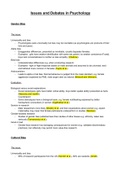
Issues and Debates in Psychology
Gender Bias
The issue:
Universality and bias
- Psychologists seek universality but bias may be inevitable (as psychologists are products of their
time and pace).
Alpha bias
- Exaggerates differences, presented as inevitable, usually degrades females.
- Examples - girls have weaker identification with same sex parent, so weaker conscience (Frued),
boys lack connectedness to mother so less empathy (Chodrow).
Beta bias
- Underestimates differences e.g. when conducting research.
- Examples - fight or flight response based on male animals and assumed to be universal, tend
and befriend more common in females (Taylor et al.)
Androcentrism
- Leads to alpha or bet bias. Normal behaviour is judged from the male standard, e.g. female
aggression explained by PMS, male anger seen as rational (Brescoll and Uhlmann).
Evaluation:
Biological versus social explanations
- Social stereotypes (girls have better verbal ability, boys better spatial ability) presented as facts
(Maccoby and Jacklin).
Counterpoint
- Some stereotypes have a biological basis, e.g. female multitasking explained by better
hemispheric connections in women (Ingalhalikar et al.)
Sexism in research
- Male researchers more likely (Murphy et al. and their expectations about women e.g. expect
irrationality) may mean that female participants underperform in studies (Nicolson).
Gender-biassed research
- Studies of gender bias published less than studies of other biases e.g. ethnicity, taken less
seriously (Formanowicz et al.).
Good or bad
- Gender-bias research has damaging consequences for women (e.g. validates discriminatory
practices), but reflexivity may permit more value-free research.
Cultural Bias
The issue:
Universality and bias
- 68% of research participants from the US (Henrich et al.), 80% are students (Arnett).
, - WEIRD participants - Westernised, Educated people from Industrialised, Risch Democracies
(Henrich et al.).
Ethnocentrism
- Superiority of own cultural group, others seen as deficient.
- Example - Anisworth’s attachment types, babies left on their own classed as insecure led to
Japanese babies classed as insecure (Takahashi).
Cultural relativism
- Etic (study behaviour from outside a culture) and emic (from outside) (Berry).
- Imposed etic = Ainsworth’s Strange Situation, definitions of abnormality.
Evaluation:
Classical studies
- Social influences research, e.g. Asch findings in individualist US, not replicated in collectivist
culture (Smith and Bond).
Counterpoint
- Studies how people shape/are shaped by their culture (Cohen), emic approach to avoid
ethnocentrism, e.g. local researchers and culturally-based techniques.
Ethnic stereotyping
- Early Army IQ tests were ethnocentric but then used as evidence that certain ethnic/cultural
groups were genetically inferior (Gould).
Relativism versus universality
- Relativism challenges our ethnocentric views and highlights social influences, but there are
universals (e.g. emotion and interactional synchrony).
Free Will and Determinism
The debate:
Is our behaviour selected without constraint (free will) or caused by internal or external factors
(determinism)?
Key concepts:
Free will
- Humans are free to make choices. Biological and environmental influences can be rejected, the
humanistic approach.
Determinism
- Hard determinism (fatalism) - all human action has a case.
- Soft determinism - people have freedom to make choices within a restricted range of options.
- James thought scientists should explain the determining forces acting upon us, but we will still
have freedom to make choices.
Types of determinism
- Biological determinism - e.g. influence of ANS on stress response, genes on mental health.
Mediating the influence of the environment is also determinist.
- Environmental determinism - Skinner describes free will as ‘an illusion’. ‘Choice’ is the sum total
of our reinforcement contingencies.
- Psychic determinism - Freud identified drives, instincts and unconscious conflicts, repressed in
childhood.
Gender Bias
The issue:
Universality and bias
- Psychologists seek universality but bias may be inevitable (as psychologists are products of their
time and pace).
Alpha bias
- Exaggerates differences, presented as inevitable, usually degrades females.
- Examples - girls have weaker identification with same sex parent, so weaker conscience (Frued),
boys lack connectedness to mother so less empathy (Chodrow).
Beta bias
- Underestimates differences e.g. when conducting research.
- Examples - fight or flight response based on male animals and assumed to be universal, tend
and befriend more common in females (Taylor et al.)
Androcentrism
- Leads to alpha or bet bias. Normal behaviour is judged from the male standard, e.g. female
aggression explained by PMS, male anger seen as rational (Brescoll and Uhlmann).
Evaluation:
Biological versus social explanations
- Social stereotypes (girls have better verbal ability, boys better spatial ability) presented as facts
(Maccoby and Jacklin).
Counterpoint
- Some stereotypes have a biological basis, e.g. female multitasking explained by better
hemispheric connections in women (Ingalhalikar et al.)
Sexism in research
- Male researchers more likely (Murphy et al. and their expectations about women e.g. expect
irrationality) may mean that female participants underperform in studies (Nicolson).
Gender-biassed research
- Studies of gender bias published less than studies of other biases e.g. ethnicity, taken less
seriously (Formanowicz et al.).
Good or bad
- Gender-bias research has damaging consequences for women (e.g. validates discriminatory
practices), but reflexivity may permit more value-free research.
Cultural Bias
The issue:
Universality and bias
- 68% of research participants from the US (Henrich et al.), 80% are students (Arnett).
, - WEIRD participants - Westernised, Educated people from Industrialised, Risch Democracies
(Henrich et al.).
Ethnocentrism
- Superiority of own cultural group, others seen as deficient.
- Example - Anisworth’s attachment types, babies left on their own classed as insecure led to
Japanese babies classed as insecure (Takahashi).
Cultural relativism
- Etic (study behaviour from outside a culture) and emic (from outside) (Berry).
- Imposed etic = Ainsworth’s Strange Situation, definitions of abnormality.
Evaluation:
Classical studies
- Social influences research, e.g. Asch findings in individualist US, not replicated in collectivist
culture (Smith and Bond).
Counterpoint
- Studies how people shape/are shaped by their culture (Cohen), emic approach to avoid
ethnocentrism, e.g. local researchers and culturally-based techniques.
Ethnic stereotyping
- Early Army IQ tests were ethnocentric but then used as evidence that certain ethnic/cultural
groups were genetically inferior (Gould).
Relativism versus universality
- Relativism challenges our ethnocentric views and highlights social influences, but there are
universals (e.g. emotion and interactional synchrony).
Free Will and Determinism
The debate:
Is our behaviour selected without constraint (free will) or caused by internal or external factors
(determinism)?
Key concepts:
Free will
- Humans are free to make choices. Biological and environmental influences can be rejected, the
humanistic approach.
Determinism
- Hard determinism (fatalism) - all human action has a case.
- Soft determinism - people have freedom to make choices within a restricted range of options.
- James thought scientists should explain the determining forces acting upon us, but we will still
have freedom to make choices.
Types of determinism
- Biological determinism - e.g. influence of ANS on stress response, genes on mental health.
Mediating the influence of the environment is also determinist.
- Environmental determinism - Skinner describes free will as ‘an illusion’. ‘Choice’ is the sum total
of our reinforcement contingencies.
- Psychic determinism - Freud identified drives, instincts and unconscious conflicts, repressed in
childhood.