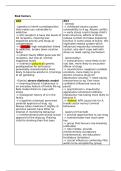
Risk factors
AO1 AO1
- (stress)
- (genetics) inherit a predisposition -> childhood trauma causes
that makes you vulnerable to vulnerability to A eg. Abuse/ conflict
addiction -> early stress could change child’s
-> (D2 receptor) A have low levels of brain structure, effects of stress
D2 receptors, meaning less release cortisol (increase dopamine
dopamine activity and drugs as function in some areas of brain), this
compensation implicates reward system which
-> (CYP2A6) high metabolism linked influences impulsivity/ emotional
to addiction, breaks down nicotine control, also don’t cope well with
faster stress so need coping mechanism
-> (direct) faulty DRD2 gene less D2
receptors, but now at ‘normal’ - (personality)
happiness levels -> extroversion= more likely to be
-> (indirect) (Jang et al) genetic out/ talk, more likely to encounter
predisposition for anti-social offeror of drugs
personality characteristics more -> neuroticism= negative/ unstable
likely to become alcohol A, (Comings emotions, more likely to go to
et al) gambling doctors (receive drugs for
depression/ anxiety) + need coping
- (family) stress-diathesis model mechanisms to eg. Feel more
-> (learning theory) A behaviour is confident (influenced more by
an everyday feature of family life eg. peers)
Role model drinks to cope with -> psychoticism= impulsivity/
stress aggression/ emotional coldness,
-> (biological) history of A in the impulsivity/ risk-taking more likely to
family become A
-> (cognitive schemas) perceived -> (Robins) APD causal risk for A,
parental approval of drug eg. breaks social norms/ criminal
Always takes medicine if slightly ill, behaviour
perceive parents have little/ no
interest in monitoring behaviour - (peers) (O’Connell)
-> (reinforcement) perceived/ actual -> provide opportunities to use drug
approval of the drug eg. Praising -> overestimates how much peer
child for drinking their first beer has
-> group that favours rule-breaking
(attitudes)
-> role models, provide
reinforcement/ acceptance
(maintenance), are educators/
facilitators (initiation)
-> (social influence) conformity/ NSI,
wants to be accepted by group,
, more likely to conform if has low
self-efficacy
AO3- STRENGTHS AO3- WEAKNESSES
Genetics Genetics
-> (Pianezza) lack of/ faulty CYP2A6 -> (Han et al) 300 MZ, 200 DZ,
gene will smoke less major influences on decision to use
-> (Kendler et al) children adopted substances were environmental NOT
away from biological parents with A genetic
had greater risk of developing A -> family/ twin studies are
(8.6%) vs family with no A history correlational, never 100%, could be
(4.2%) other ‘causes’ so reductionistic
-> use a stress- diathesis model
Family (env. Family + genetic)
-> (Livingston) final-year high-school
students allowed to drink at home Family
are significantly more likely to drink -> depends on child’s age/ strength
excessively at college of relationship
-> (Madras) strong positive -> individual differences (role of
correlation between parents’ use of cognitive processes eg. Motivation
cannabis and adolescents'’ drug from elsewhere)
use, observation/ modelling (SLT)/ -> difficult to isolate family from
perceived approval peers/ stress/ personality influences
Peers
Peers -> (Sussman + Ames) also found
-> (Bullers) longitudinal study, peer family conflict, poor supervision,
groups predict individual drinking, drug-use by parents, family
but you choose your groups modelling of A behaviour
(freewill/ social selection)
-> (real-world application) (Social Stress
norms marketing advertisement/ -> (Lo + Cheng) causal issues, not
SNMA) intervention to change direct, through depression (abuse=
mistaken beliefs about how much depression= A)
peers drink eg. Beer mats/ posters in -> (not risk factor) A has negative
Student Union bar ‘Students effects on lifestyle= stress, A causes
overestimate how much others drink stress
by 44%’ -> (Piazza) animal studies,
-> (Stang) more likely to conform if generalisation
group is attractive, social influence
Personality
-> (Dalley) animals, hard to
Stress generalise
-> (Cleck + Blendy) greater physical -> cause/ effect issues but Dalley
abuse in childhood (length), more study
likely drug A -> extroversion= only vulnerability
-> (Lo + Cheng) physical abuse
AO1 AO1
- (stress)
- (genetics) inherit a predisposition -> childhood trauma causes
that makes you vulnerable to vulnerability to A eg. Abuse/ conflict
addiction -> early stress could change child’s
-> (D2 receptor) A have low levels of brain structure, effects of stress
D2 receptors, meaning less release cortisol (increase dopamine
dopamine activity and drugs as function in some areas of brain), this
compensation implicates reward system which
-> (CYP2A6) high metabolism linked influences impulsivity/ emotional
to addiction, breaks down nicotine control, also don’t cope well with
faster stress so need coping mechanism
-> (direct) faulty DRD2 gene less D2
receptors, but now at ‘normal’ - (personality)
happiness levels -> extroversion= more likely to be
-> (indirect) (Jang et al) genetic out/ talk, more likely to encounter
predisposition for anti-social offeror of drugs
personality characteristics more -> neuroticism= negative/ unstable
likely to become alcohol A, (Comings emotions, more likely to go to
et al) gambling doctors (receive drugs for
depression/ anxiety) + need coping
- (family) stress-diathesis model mechanisms to eg. Feel more
-> (learning theory) A behaviour is confident (influenced more by
an everyday feature of family life eg. peers)
Role model drinks to cope with -> psychoticism= impulsivity/
stress aggression/ emotional coldness,
-> (biological) history of A in the impulsivity/ risk-taking more likely to
family become A
-> (cognitive schemas) perceived -> (Robins) APD causal risk for A,
parental approval of drug eg. breaks social norms/ criminal
Always takes medicine if slightly ill, behaviour
perceive parents have little/ no
interest in monitoring behaviour - (peers) (O’Connell)
-> (reinforcement) perceived/ actual -> provide opportunities to use drug
approval of the drug eg. Praising -> overestimates how much peer
child for drinking their first beer has
-> group that favours rule-breaking
(attitudes)
-> role models, provide
reinforcement/ acceptance
(maintenance), are educators/
facilitators (initiation)
-> (social influence) conformity/ NSI,
wants to be accepted by group,
, more likely to conform if has low
self-efficacy
AO3- STRENGTHS AO3- WEAKNESSES
Genetics Genetics
-> (Pianezza) lack of/ faulty CYP2A6 -> (Han et al) 300 MZ, 200 DZ,
gene will smoke less major influences on decision to use
-> (Kendler et al) children adopted substances were environmental NOT
away from biological parents with A genetic
had greater risk of developing A -> family/ twin studies are
(8.6%) vs family with no A history correlational, never 100%, could be
(4.2%) other ‘causes’ so reductionistic
-> use a stress- diathesis model
Family (env. Family + genetic)
-> (Livingston) final-year high-school
students allowed to drink at home Family
are significantly more likely to drink -> depends on child’s age/ strength
excessively at college of relationship
-> (Madras) strong positive -> individual differences (role of
correlation between parents’ use of cognitive processes eg. Motivation
cannabis and adolescents'’ drug from elsewhere)
use, observation/ modelling (SLT)/ -> difficult to isolate family from
perceived approval peers/ stress/ personality influences
Peers
Peers -> (Sussman + Ames) also found
-> (Bullers) longitudinal study, peer family conflict, poor supervision,
groups predict individual drinking, drug-use by parents, family
but you choose your groups modelling of A behaviour
(freewill/ social selection)
-> (real-world application) (Social Stress
norms marketing advertisement/ -> (Lo + Cheng) causal issues, not
SNMA) intervention to change direct, through depression (abuse=
mistaken beliefs about how much depression= A)
peers drink eg. Beer mats/ posters in -> (not risk factor) A has negative
Student Union bar ‘Students effects on lifestyle= stress, A causes
overestimate how much others drink stress
by 44%’ -> (Piazza) animal studies,
-> (Stang) more likely to conform if generalisation
group is attractive, social influence
Personality
-> (Dalley) animals, hard to
Stress generalise
-> (Cleck + Blendy) greater physical -> cause/ effect issues but Dalley
abuse in childhood (length), more study
likely drug A -> extroversion= only vulnerability
-> (Lo + Cheng) physical abuse