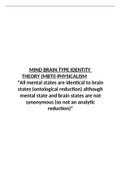
MIND BRAIN TYPE IDENTITY
THEORY (MBTI)-PHYSICALISM
“All mental states are identical to brain
states (ontological reduction) although
mental state and brain states are not
synonymous (so not an analytic
reduction)”
, Notes:
Physicalism = mental states reduce to brain states= MENTAL STATES ARE BRAIN STATES
Mental states are brain states
Mental states are brain processes
Mental properties are physical properties
Facts about the mind are reducible to facts about the brain
o ONTOLOGICAL REDUCTION
(it’s not about the meanings of statements about mental states but
more about what sort of things the mental states are
Mental properties are brain properties
E.g. brains states is c-fibres, e.g to say c-fibres firing is for the brain state associated with
pain
Pain is identical to c-fibres firing in the same way lightning is identical to electrical
charge
- Pain ontologically reduces to c-fibres firing
Type identity theory
- Because it claims that mental types of things are identical to physical types of
things
- All mental states are identical to brain states
- Mental types of things are physical types of things
- E.g I am happy, I have high levels of endorphins
Shows that happiness = endorphins not that happiness means
endorphins
- Through scientific testing = can prove brain and mind are one by examining
hormones and neurons
- Any type of mental state = type of brain state
Mental states and brain states are contingently identical, they ontologically reduce to brain
states
E.g water is H20, lightening is electrical discharge
Ontological reduction are not analytic reductions
- No logical contradiction in saying lightening is not electrical discharge but
analytic reduction = there is analytical contradictions in saying lightening is not
electrical discharge
AS it has to be true by definition
Neurons = thinking a thought is the same thing as neurons firing
THEORY (MBTI)-PHYSICALISM
“All mental states are identical to brain
states (ontological reduction) although
mental state and brain states are not
synonymous (so not an analytic
reduction)”
, Notes:
Physicalism = mental states reduce to brain states= MENTAL STATES ARE BRAIN STATES
Mental states are brain states
Mental states are brain processes
Mental properties are physical properties
Facts about the mind are reducible to facts about the brain
o ONTOLOGICAL REDUCTION
(it’s not about the meanings of statements about mental states but
more about what sort of things the mental states are
Mental properties are brain properties
E.g. brains states is c-fibres, e.g to say c-fibres firing is for the brain state associated with
pain
Pain is identical to c-fibres firing in the same way lightning is identical to electrical
charge
- Pain ontologically reduces to c-fibres firing
Type identity theory
- Because it claims that mental types of things are identical to physical types of
things
- All mental states are identical to brain states
- Mental types of things are physical types of things
- E.g I am happy, I have high levels of endorphins
Shows that happiness = endorphins not that happiness means
endorphins
- Through scientific testing = can prove brain and mind are one by examining
hormones and neurons
- Any type of mental state = type of brain state
Mental states and brain states are contingently identical, they ontologically reduce to brain
states
E.g water is H20, lightening is electrical discharge
Ontological reduction are not analytic reductions
- No logical contradiction in saying lightening is not electrical discharge but
analytic reduction = there is analytical contradictions in saying lightening is not
electrical discharge
AS it has to be true by definition
Neurons = thinking a thought is the same thing as neurons firing