

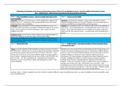
‘Eliminating rival claimants to the throne was the greatest success of Henry VII’s consolidation of power’. Assess the validity of this claim [25 marks]
Intro – outline factors – extent of success correlates to the threat posed by each factor.
Topic 1 – Early consolidation of power – this was arguably when Henry at his Topic 2 – control over the nobility
most vulnerable.
Bosworth: Airlift para 1 from other essay – firstly, backdated his reign from 22 nd Sanctions: characterised by nepotism, cynicism and a deep distrust. Heavy
August 1485 to 21st , rendering any who had opposed him traitors and thereby financial and legal sanctions such as Acts of Attainder, the most notable being an
subjecting them to Acts of Attainder. immense £100,000 fine on George Neville, Lord Avergavenny.
Parliament: Henry arranged for the first meeting of Parliament to occur on 7 th Reward: also consolidated power over nobility through reward and capitalised on
November 1485, 8 days after his coronation. Established his right to rule: as Elton their power – Earl of Northumberland – neutralised Richard’s power base. Earl of
notes, ‘only a true king can summon Parliament’ – Henry would not require Oxford – led to death of troublesome EoL. 37 Knights of the Garter. Loyalty and
validation of his title. ability were the only criteria of service – a prudent policy which benefited Henry
greatly.
Elizabeth of York: married January 1486. Publicised and propagated emblem of
Tudor rose, plastering on walls and ceilings of Westminster Abbey.
These only consolidated power in the short term. Pretenders to the throne far
more threatening – whereas nobles in England war-fatigued, in other countries
had resources to invade.
Topic 3 – Edmund de la Pole Topic 4 – Perkin Warbeck – international problem and most persistent threat
over period of 8 years.
Threat: received hospitality of HRE Maximilian and began referring to himself as Warbeck was such a serious threat received backing of major foreign powers, e.g.
the ‘White Rose’, making it clear he was the leading Yorkist pretender. Maximilian Charles VIII, Margaret of Burgundy and James IV of Scotland. Sir William Stanley.
was immensely powerful. Edmund de la Pole was nephew of Richard III – had a However, Henry successfully adopted pragmatic, discriminative policy in order to
strong claim to the throne. Henry lacked sufficient weight in European politics to mitigate Warbeck as a threat and ensure England’s national security not
secure release – England internally riven by Wars of Roses. Paid £250,000 in the threatened. 1493, trade embargo on Burgundy after offered hospitality towards
form of ‘loans’ – Jan 1505 suspended trade – emphasises how threatening. Warbeck. Exhibited his readiness to sacrifice trade for dynastic recognition –
Therefore, as such a serious threat, capture was particularly successful – 1506 embargo led to Warbeck’s expulsion after the ratification of the Intercursus
Treaty of Windsor. Magnus – in this way, successful. Scotland, as Stephen Gunn notes, ‘perhaps the
greatest crisis of Henry VII’s reign’. Nevertheless, henry successful – swift
mobilisation of army led to Warbeck’s retreat. Henry showed readiness to pursue
peace rather than war for the sake of it – 1497 Truce of Ayton – Warbeck expelled.
Henry also successfully appeased James IV with marriage alliance.
Conclusion: Agree – dynastic recognition was Henry’s priority. It would be difficult to argue that without key factors, e.g. early consolidation of power and nobility, could
have consolidated power.
Intro – outline factors – extent of success correlates to the threat posed by each factor.
Topic 1 – Early consolidation of power – this was arguably when Henry at his Topic 2 – control over the nobility
most vulnerable.
Bosworth: Airlift para 1 from other essay – firstly, backdated his reign from 22 nd Sanctions: characterised by nepotism, cynicism and a deep distrust. Heavy
August 1485 to 21st , rendering any who had opposed him traitors and thereby financial and legal sanctions such as Acts of Attainder, the most notable being an
subjecting them to Acts of Attainder. immense £100,000 fine on George Neville, Lord Avergavenny.
Parliament: Henry arranged for the first meeting of Parliament to occur on 7 th Reward: also consolidated power over nobility through reward and capitalised on
November 1485, 8 days after his coronation. Established his right to rule: as Elton their power – Earl of Northumberland – neutralised Richard’s power base. Earl of
notes, ‘only a true king can summon Parliament’ – Henry would not require Oxford – led to death of troublesome EoL. 37 Knights of the Garter. Loyalty and
validation of his title. ability were the only criteria of service – a prudent policy which benefited Henry
greatly.
Elizabeth of York: married January 1486. Publicised and propagated emblem of
Tudor rose, plastering on walls and ceilings of Westminster Abbey.
These only consolidated power in the short term. Pretenders to the throne far
more threatening – whereas nobles in England war-fatigued, in other countries
had resources to invade.
Topic 3 – Edmund de la Pole Topic 4 – Perkin Warbeck – international problem and most persistent threat
over period of 8 years.
Threat: received hospitality of HRE Maximilian and began referring to himself as Warbeck was such a serious threat received backing of major foreign powers, e.g.
the ‘White Rose’, making it clear he was the leading Yorkist pretender. Maximilian Charles VIII, Margaret of Burgundy and James IV of Scotland. Sir William Stanley.
was immensely powerful. Edmund de la Pole was nephew of Richard III – had a However, Henry successfully adopted pragmatic, discriminative policy in order to
strong claim to the throne. Henry lacked sufficient weight in European politics to mitigate Warbeck as a threat and ensure England’s national security not
secure release – England internally riven by Wars of Roses. Paid £250,000 in the threatened. 1493, trade embargo on Burgundy after offered hospitality towards
form of ‘loans’ – Jan 1505 suspended trade – emphasises how threatening. Warbeck. Exhibited his readiness to sacrifice trade for dynastic recognition –
Therefore, as such a serious threat, capture was particularly successful – 1506 embargo led to Warbeck’s expulsion after the ratification of the Intercursus
Treaty of Windsor. Magnus – in this way, successful. Scotland, as Stephen Gunn notes, ‘perhaps the
greatest crisis of Henry VII’s reign’. Nevertheless, henry successful – swift
mobilisation of army led to Warbeck’s retreat. Henry showed readiness to pursue
peace rather than war for the sake of it – 1497 Truce of Ayton – Warbeck expelled.
Henry also successfully appeased James IV with marriage alliance.
Conclusion: Agree – dynastic recognition was Henry’s priority. It would be difficult to argue that without key factors, e.g. early consolidation of power and nobility, could
have consolidated power.


