
• Wrong document? Swap it for free
  • Written by students who passed
  • Immediately available after payment
  • Read online or as PDF
Sell
Where do you study
Your language
Start selling Create your account
Document preview thumbnail
Preview 1 out of 3 pages
Lecture notes

Final Accounts

Document preview thumbnail
Preview 1 out of 3 pages

A look at the key accounts: income statement and statement of financial position.

Content preview

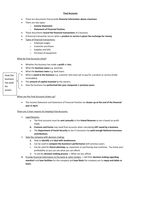
Final Accounts

 These are documents that provide financial information about a business.
 There are two types:
o Income Statement.
o Statement of Financial Position.
 These documents record the financial transactions of a business.
 A financial transaction occurs when a product or service is given the exchange for money.
 Types of financial transactions:
o Employee wages.
o Customer purchases.
o Supplies and bills.
o Purchase of equipment.

What do Final Accounts show?

 Whether the business has made a profit or loss.
 What the business owns e.g. premises.
 What the business owes e.g. bank loans.
How the  What is owed to the business e.g. customer who have yet to pay for a product or service (trade
business receivables).
has paid  The amount of capital invested by the owners.
 How the business has performed this year compared to previous years.
for
assets.

When are the Final Accounts drawn up?

 The Income Statement and Statement of Financial Position are drawn up at the end of the financial
year in April.

There are 3 main reasons for keeping Final Accounts:

1. Legal Reasons:
a. The final accounts must be sent annually to the Inland Revenue as tax is based on profit
made.
b. Customs and Excise may need final accounts when calculating VAT owed by a business.
c. The Department of Social Security to see if a business has paid enough National Insurance
contributions.
2. Help the company with decision making:
a. Help to identify and deal with weaknesses.
b. Can be used to compare the business's performance with previous years.
c. Can be used for future planning e.g. expansion or purchasing new machines. You know your
profitability so you can see what you can afford.
d. To aid the decision making process -> What can you afford.
3. Provide financial information to the bank or other lenders -> Aid their decision making regarding
overdraft and loan facilities for the company and how likely the company are to repay and debts or
loans.


Document information

Study Level
Uploaded on
June 30, 2016
Number of pages
3
Written in
2014/2015
Type
Lecture notes
Professor(s)
Unknown
Contains
All classes
£6.49

Wrong document? Swap it for free Within 14 days of purchase and before downloading, you can choose a different document. You can simply spend the amount again.
Written by students who passed
Immediately available after payment
Read online or as PDF

Seller avatar
Reputation scores are based on the amount of documents a seller has sold for a fee and the reviews they have received for those documents. There are three levels: Bronze, Silver and Gold. The better the reputation, the more your can rely on the quality of the sellers work.
MarkC57
4.3
(102)
Sold
66
Followers
49
Items
231
Last sold
1 year ago


Why students choose Stuvia

Created by fellow students, verified by reviews

Quality you can trust: written by students who passed their exams and reviewed by others who've used these revision notes.

Didn't get what you expected? Choose another document

No problem! You can straightaway pick a different document that better suits what you're after.

Pay as you like, start learning straight away

No subscription, no commitments. Pay the way you're used to via credit card and download your PDF document instantly.

Student with book image

“Bought, downloaded, and smashed it. It really can be that simple.”

Alisha Student

Working on your references?

Create accurate citations in APA, MLA and Harvard with our free citation generator.

Working on your references?

Frequently asked questions
