

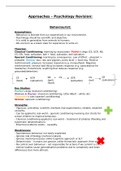
Approaches – Psychology Revision:
Behaviourist:
Assumptions:
- Behaviour is learned from our experiences in our environment.
- Psychology should be scientific and objective.
- It is valid to generalise from animals to humans.
- We are born as a blank slate for experience to write on.
Theories:
Classical Conditioning: learning by association. Pavlov’s dogs (CS, UCR, NS,
CS, CR), food, salivation, bell + food, salivation, bell salivation.
Operant Conditioning: learning by consequence. Law of Effect – pleasant >
probable. Skinner box; rats and pigeons, press lever = food tray. Positive
reinforcement; pleasure increases response (e.g. money/food). Negative
reinforcement; remove bad thing increases response (e.g. paracetamol for
headache). Punishment; anything that reduces response (e.g.
grounded/detention).
CS UCR NS + CS UCR CS CR
(food) (salivation) (bell) (salivation) (bell (salivation)
(food) )
Key Studies:
Pavlov’s dogs (classical conditioning)
Watson & Rayner (classical conditioning, Little Albert – white rat)
Thorndike’s cats (operant conditioning)
Skinner (operant conditioning)
Strengths:
- Vigorous, controlled, scientific methods (lab experiments), reliable, establish
causality.
- Can be applied to real world – operant conditioning involving star charts for
school children to improve behaviour.
- Classical conditioning applied to real world – treatment of phobias (flooding and
systematic desensitisation).
- Empirical evidence exists – causality.
Weaknesses:
- Spontaneous behaviour not easily explained.
- Ignores role of biology (nurture>nature).
- Ignores mental processes unlike Cognitive approach or SLT.
- Deterministic – humans are passive unlike Humanistic approach (free will).
- No control over behaviour – not responsible for actions if we commit a crime.
- Animal studies cause generalisation problems due to complexity and brain
differences (but more ethical).
, Social Learning Theory:
Assumptions:
- Learning by observation – we select, watch and imitate behaviour.
- Mental processes occur between stimulus and response which is essential for
learning.
Theories:
Modelling: A form of attachment to an individual. Aspire to be like them. Uses
operant conditioning and vicarious reinforcement (happens to model). Well liked,
powerful, respected, (same sex also included) are all models more likely to be
imitated.
Mediational Processes – ARRM: Attention; watch model. Retention; recall
behaviour and consequence. Replication; can they copy? Motivation; vicarious
reinforcement.
Key Studies:
Bandura et al – if children witness aggressive behaviour = more likely to be
aggressive? Lab, independent measures, 36 boys, 36 girls 3-6yrs old, 4
conditions. 1. Same sex + aggression. 2. Same sex + no aggression. 3. Opposite
sex + aggression. 4. Opposite sex + no aggression. Aggressive group = direct
imitation. Boys = physical. Girls = verbal. Same sex imitation = higher.
Strengths:
- Uses scientific methods to study learning in people so possible generalisations
can be made.
- Empirical supporting evidence (Bandura).
- Mental processes taken into account (less ‘mechanistic’ view on human
behaviour).
- Applied to real world – media violence copied. Can help keep people safe, e.g.
age certifications on video games.
- Applied to psychological research; how people acquire gender roles.
- Akers – increases criminal behaviour when exposed to criminal models,
identify, expect positive consequences.
Weaknesses:
- Can explain aggression but doesn’t take into account biology and genetics.
- Lab = artificial so low validity and generalisability.
- Does not account for all behaviour; criminal but no association / association but
not criminal?
Behaviourist:
Assumptions:
- Behaviour is learned from our experiences in our environment.
- Psychology should be scientific and objective.
- It is valid to generalise from animals to humans.
- We are born as a blank slate for experience to write on.
Theories:
Classical Conditioning: learning by association. Pavlov’s dogs (CS, UCR, NS,
CS, CR), food, salivation, bell + food, salivation, bell salivation.
Operant Conditioning: learning by consequence. Law of Effect – pleasant >
probable. Skinner box; rats and pigeons, press lever = food tray. Positive
reinforcement; pleasure increases response (e.g. money/food). Negative
reinforcement; remove bad thing increases response (e.g. paracetamol for
headache). Punishment; anything that reduces response (e.g.
grounded/detention).
CS UCR NS + CS UCR CS CR
(food) (salivation) (bell) (salivation) (bell (salivation)
(food) )
Key Studies:
Pavlov’s dogs (classical conditioning)
Watson & Rayner (classical conditioning, Little Albert – white rat)
Thorndike’s cats (operant conditioning)
Skinner (operant conditioning)
Strengths:
- Vigorous, controlled, scientific methods (lab experiments), reliable, establish
causality.
- Can be applied to real world – operant conditioning involving star charts for
school children to improve behaviour.
- Classical conditioning applied to real world – treatment of phobias (flooding and
systematic desensitisation).
- Empirical evidence exists – causality.
Weaknesses:
- Spontaneous behaviour not easily explained.
- Ignores role of biology (nurture>nature).
- Ignores mental processes unlike Cognitive approach or SLT.
- Deterministic – humans are passive unlike Humanistic approach (free will).
- No control over behaviour – not responsible for actions if we commit a crime.
- Animal studies cause generalisation problems due to complexity and brain
differences (but more ethical).
, Social Learning Theory:
Assumptions:
- Learning by observation – we select, watch and imitate behaviour.
- Mental processes occur between stimulus and response which is essential for
learning.
Theories:
Modelling: A form of attachment to an individual. Aspire to be like them. Uses
operant conditioning and vicarious reinforcement (happens to model). Well liked,
powerful, respected, (same sex also included) are all models more likely to be
imitated.
Mediational Processes – ARRM: Attention; watch model. Retention; recall
behaviour and consequence. Replication; can they copy? Motivation; vicarious
reinforcement.
Key Studies:
Bandura et al – if children witness aggressive behaviour = more likely to be
aggressive? Lab, independent measures, 36 boys, 36 girls 3-6yrs old, 4
conditions. 1. Same sex + aggression. 2. Same sex + no aggression. 3. Opposite
sex + aggression. 4. Opposite sex + no aggression. Aggressive group = direct
imitation. Boys = physical. Girls = verbal. Same sex imitation = higher.
Strengths:
- Uses scientific methods to study learning in people so possible generalisations
can be made.
- Empirical supporting evidence (Bandura).
- Mental processes taken into account (less ‘mechanistic’ view on human
behaviour).
- Applied to real world – media violence copied. Can help keep people safe, e.g.
age certifications on video games.
- Applied to psychological research; how people acquire gender roles.
- Akers – increases criminal behaviour when exposed to criminal models,
identify, expect positive consequences.
Weaknesses:
- Can explain aggression but doesn’t take into account biology and genetics.
- Lab = artificial so low validity and generalisability.
- Does not account for all behaviour; criminal but no association / association but
not criminal?


