
Distribution of income and wealth
Income- money a person receives over a period of time
FOR EXAMPLE- Wages, Interest, Salaries, rent etc
Wealth- measure of the value of assets
For example- property, land, shares
Marketable wealth- wealth that can be transferred between individuals, such as property
Non-marketable wealth- cannot be transferred between individuals (life assurance)
Distribution of wealth- measure of how evenly wealth is distributed among the population
Sources of income and wealth inequality-
Inheritance
Marriage- wealthy people tend to marry other wealthy people
Chance- lottery
Education and skill training- higher skilled workers tend to earn more
Unemployment- reduces income and benefits
Age- old people tend to have more wealth due to more time to save
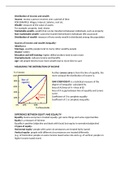
MEASURING THE DISTRIBUTION OF INCOME
Further Lorenz curve is from the line of equality, the
more unequal the distribution of income is.
GINI COEFFICIENT is a statistical measure of the
degree of inequality- calculated by
Area of A/(Area of A + Area of B)
Area of A is gap between line of equality and Lorenz
curve.
Coefficient of 0 is complete equality
Coefficient of 1 is complete inequality
DIFFERENCE BETWEEN EQUITY AND EQUALITY-
Equality means everyone is treated equally- get same things and same opportunities
Equity is a measure of fairness
Equality is positive (objective and deals with facts) but equity is normative(subjective)
2 types of equity-
Horizontal equity- people with same circumstances are treated fairly (same)
Vertical equity- people with different circumstances are treated differently
(e.g. of horizontal- people on same income taxed same rate and e.g. of vertical- people on
higher income taxed more)


