Offender profiling: The bottom-up approach
Definition: Developed in Britain by David Canter, bottom up aims to generate a visual of the
offender, their behaviour and background through systematic analysis of evidence at the crime
scene. Unlike Top-down, it does not begin with typologies and is ‘data driven’.
Investigative psychology Aims to establish patterns of behaviour across crime scenes, to develop
a statistical database which acts as a tool to of comparison. Details of offences can be analysed with
the database to reveal critical information about the offender such as personal history/ family
background, or whether it links to other crimes.
Canter created a 5-factor model to interpret a crime scene:
Interpersonal coherence: How the offender may have interacted with victim e.g.,
controlling? Persuasive?
Time & place significance: may indicate distance where offender lives, significant area?
Criminal characteristics: physical appearance and psychological ways of thinking
Criminal career: Does job involve knives? Experience with dangerous equipment
Forensic awareness: is the offender knowledgeable on the procedures of the police and is
able to ‘cover their tracks’.
Geographical profiling: An offender’s operational base and home, possibility of future offences, can
be revealed by geographical location of previous crimes, helping investigators to narrow down their
search areas. (Crime mapping).
Assumes that offenders will restrict their crimes to locations they are familiar with (Spatial
consistency) and crimes will decrease the further the distance from offender’s base (Distance decay)
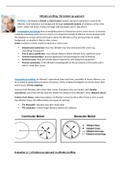
Canters circle theory: states how pattern of offender’s crime locations often forms a circle around
the offender’s base, this differentiates two types of criminals.
The Marauder- operates near their home base
The commuter- travels longer distance away from residence
Evaluation (+/-) of bottom-up approach to offender profiling
Definition: Developed in Britain by David Canter, bottom up aims to generate a visual of the
offender, their behaviour and background through systematic analysis of evidence at the crime
scene. Unlike Top-down, it does not begin with typologies and is ‘data driven’.
Investigative psychology Aims to establish patterns of behaviour across crime scenes, to develop
a statistical database which acts as a tool to of comparison. Details of offences can be analysed with
the database to reveal critical information about the offender such as personal history/ family
background, or whether it links to other crimes.
Canter created a 5-factor model to interpret a crime scene:
Interpersonal coherence: How the offender may have interacted with victim e.g.,
controlling? Persuasive?
Time & place significance: may indicate distance where offender lives, significant area?
Criminal characteristics: physical appearance and psychological ways of thinking
Criminal career: Does job involve knives? Experience with dangerous equipment
Forensic awareness: is the offender knowledgeable on the procedures of the police and is
able to ‘cover their tracks’.
Geographical profiling: An offender’s operational base and home, possibility of future offences, can
be revealed by geographical location of previous crimes, helping investigators to narrow down their
search areas. (Crime mapping).
Assumes that offenders will restrict their crimes to locations they are familiar with (Spatial
consistency) and crimes will decrease the further the distance from offender’s base (Distance decay)
Canters circle theory: states how pattern of offender’s crime locations often forms a circle around
the offender’s base, this differentiates two types of criminals.
The Marauder- operates near their home base
The commuter- travels longer distance away from residence
Evaluation (+/-) of bottom-up approach to offender profiling