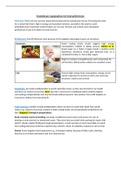
Evolutionary explanations for food preferences
Overview: There are two survival requirements balanced by evolutionary forces, first being the need
for a varied diet that is high in energy and essential nutrients, secondly is the need to avoid
potentially toxic foods that could threaten our survival. Humans and animals have developed
preferences to aid us in better survival chances.
Preferences: Food Preferences exist because of the adaptive advantage it gave our ancestors.
Sweetness Sweet tasting foods would suggest high energy
consumption, reliable in aiding survival. Steiner et al.
found sugar on a baby’s tongue found a positive facial
expression. Ancestors would give favoured fruit, as it
contained fructose (a ‘fast acting’ sugar).
Salt Helps to maintain competitiveness and is important for
cell function. Babies prefer salted over unsalted cereal.
Fats Ensures high energy food consumption, energy can be
stored, important to ancestors when next meal was
uncertain. Calories aid survival.
Neophobia: An innate predisposition to avoid unfamiliar foods, as they may be bad for our health
and limit our chances of survival. Birch says this is most clear in childhood where children explore
surroundings independently and may find foods without parents’ intervention, this is still adaptive as
it prevents children from becoming ill.
Taste Aversion: Another innate predisposition where we learn to avoid toxic foods that would
reduce our chances of survival, evident in bitter tasting foods, we are genetically hardwired to do
this- Seligman’s biological preparedness.
Study example: Garcia & Koelling classically conditioned sweet water with poison for rats to
develop a taste aversion to sweetened water. They were less successful when pairing the water with
electric shocks. Explain findings through preparedness, a taste aversion is much more likely to result
from eating poisonous food than experiencing a electric shock. An adaptive response to aid survival.
Steiner found negative facial expression e.g., frowning in babies because of bitter taste, showing
how this is an innate mechanism and not a learned one.
Overview: There are two survival requirements balanced by evolutionary forces, first being the need
for a varied diet that is high in energy and essential nutrients, secondly is the need to avoid
potentially toxic foods that could threaten our survival. Humans and animals have developed
preferences to aid us in better survival chances.
Preferences: Food Preferences exist because of the adaptive advantage it gave our ancestors.
Sweetness Sweet tasting foods would suggest high energy
consumption, reliable in aiding survival. Steiner et al.
found sugar on a baby’s tongue found a positive facial
expression. Ancestors would give favoured fruit, as it
contained fructose (a ‘fast acting’ sugar).
Salt Helps to maintain competitiveness and is important for
cell function. Babies prefer salted over unsalted cereal.
Fats Ensures high energy food consumption, energy can be
stored, important to ancestors when next meal was
uncertain. Calories aid survival.
Neophobia: An innate predisposition to avoid unfamiliar foods, as they may be bad for our health
and limit our chances of survival. Birch says this is most clear in childhood where children explore
surroundings independently and may find foods without parents’ intervention, this is still adaptive as
it prevents children from becoming ill.
Taste Aversion: Another innate predisposition where we learn to avoid toxic foods that would
reduce our chances of survival, evident in bitter tasting foods, we are genetically hardwired to do
this- Seligman’s biological preparedness.
Study example: Garcia & Koelling classically conditioned sweet water with poison for rats to
develop a taste aversion to sweetened water. They were less successful when pairing the water with
electric shocks. Explain findings through preparedness, a taste aversion is much more likely to result
from eating poisonous food than experiencing a electric shock. An adaptive response to aid survival.
Steiner found negative facial expression e.g., frowning in babies because of bitter taste, showing
how this is an innate mechanism and not a learned one.