Psychological explanations for obesity; Restraint theory, disinhibition, boundary model
Overview: A cognitive explanation which argues that obesity is the paradoxical outcome of attempts
to restrain eating/attempt to diet.
Restraint theory: Herman & Polivy (1975) argues that restrained eating is self-defeating, those that
aim to restrain often fail or even eat more than if they didn’t restrain themselves.
Cognitive control: Set strict limits. Set food into ‘good or bad’, some foods are ‘forbidden’,
restrained eaters believe this is a key control to lose weight. The eater is consciously
assessing food choices all the time (hence cognitive)
Paradoxical outcome: This restriction leads to a contradiction, that the person becomes
more preoccupied with food rather than less. The limits mean they ignore physiological
indicators of hunger and satiety, this leads to disinhibition.
Disinhibition: A period of restrained eating usually follows by the person eating whatever they want.
Internal and external food related cues such as mood, smells or media images are called
disinhibitors and they cause the person to lose control of their restrained eating. A cognitive process
called ‘all or nothing thinking’ promotes disinhibition “I’ve started eating it, now I may as well finish
it”.
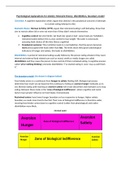
The boundary model: (As shown in diagram below)
Food intake exists on a continuum from hunger to satiety (feeling full). Biological processes
determine how much we eat based on this continuum, feeling an aversive hunger motivates us to
eat, likewise eating until reaching an aversive satiety will create discomfort and motivates us to stop
eating. Between these states is the ‘zone of biological indifference’, where cognitive and social
factors have greater influence on food intake. (homeostasis)
Restrained eaters: have lower hunger boundary so less responsive to hunger, higher satiety
boundary so needs more food to feel full. Their zone of biological indifference is therefore wider,
meaning food intake comes down to cognitive control (rather than physiological) and makes
disinhibition more likely.
Normal eater
Aversion Aversion
Zone of biological indifference
Satiety
Hunger
Increased food intake
Aversion Aversion
Hunger Zone of biological indifference Satiety
Restrained eater
Overview: A cognitive explanation which argues that obesity is the paradoxical outcome of attempts
to restrain eating/attempt to diet.
Restraint theory: Herman & Polivy (1975) argues that restrained eating is self-defeating, those that
aim to restrain often fail or even eat more than if they didn’t restrain themselves.
Cognitive control: Set strict limits. Set food into ‘good or bad’, some foods are ‘forbidden’,
restrained eaters believe this is a key control to lose weight. The eater is consciously
assessing food choices all the time (hence cognitive)
Paradoxical outcome: This restriction leads to a contradiction, that the person becomes
more preoccupied with food rather than less. The limits mean they ignore physiological
indicators of hunger and satiety, this leads to disinhibition.
Disinhibition: A period of restrained eating usually follows by the person eating whatever they want.
Internal and external food related cues such as mood, smells or media images are called
disinhibitors and they cause the person to lose control of their restrained eating. A cognitive process
called ‘all or nothing thinking’ promotes disinhibition “I’ve started eating it, now I may as well finish
it”.
The boundary model: (As shown in diagram below)
Food intake exists on a continuum from hunger to satiety (feeling full). Biological processes
determine how much we eat based on this continuum, feeling an aversive hunger motivates us to
eat, likewise eating until reaching an aversive satiety will create discomfort and motivates us to stop
eating. Between these states is the ‘zone of biological indifference’, where cognitive and social
factors have greater influence on food intake. (homeostasis)
Restrained eaters: have lower hunger boundary so less responsive to hunger, higher satiety
boundary so needs more food to feel full. Their zone of biological indifference is therefore wider,
meaning food intake comes down to cognitive control (rather than physiological) and makes
disinhibition more likely.
Normal eater
Aversion Aversion
Zone of biological indifference
Satiety
Hunger
Increased food intake
Aversion Aversion
Hunger Zone of biological indifference Satiety
Restrained eater