

Biopsychology: The nervous system
The spec says: The divisions of the nervous system: central and peripheral (somatic
and autonomic).
Definition: The nervous system is our primary internal communication system, a
specialised network of cells in our body. The central nervous system receives
information from the senses and controls the behaviour and regulation of the body’s
psychological processes.
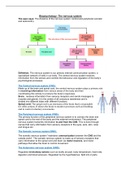
The Central nervous system (CNS):
Made up of the brain and spinal cord, the central nervous system plays a primary role
in receiving information from various areas of the body and then
coordinating this activity to produce the body's responses.
Brain: receives information from sensory receptors and sends messages to
muscles and glands. It is the centre of all conscious awareness and is
divided into different lobes with different functions.
Spinal cord: The spinal cord is an extension of the brain that is responsible
for reflex actions. It allows the brain to monitor processes such as breathing
and to control voluntary movements.
The Peripheral nervous system (PNS):
The primary function of the peripheral nervous system is to connect the brain and
spinal cord to the rest of the body and the external environment. The peripheral
nervous system transmits information to and from the CNS. This is done through
nerves that carry information from sensory receptors in the eyes, ears, skin, nose
and tongue etc.
The Somatic nervous system (SNS):
The somatic nervous system “maintains communication between the CNS and the
outside world”. The somatic nervous system is made up of sensory receptors that
carry information to the spinal cord and brain via motor neurons, and motor
pathways that allow the brain to control movement.
The Autonomic nervous system (ANS):
Regulates involuntary actions such as bodily arousal, body temperature, heart rate,
digestion and blood pressure. Regulated by the hypothalamus. Split into 2 parts.
The spec says: The divisions of the nervous system: central and peripheral (somatic
and autonomic).
Definition: The nervous system is our primary internal communication system, a
specialised network of cells in our body. The central nervous system receives
information from the senses and controls the behaviour and regulation of the body’s
psychological processes.
The Central nervous system (CNS):
Made up of the brain and spinal cord, the central nervous system plays a primary role
in receiving information from various areas of the body and then
coordinating this activity to produce the body's responses.
Brain: receives information from sensory receptors and sends messages to
muscles and glands. It is the centre of all conscious awareness and is
divided into different lobes with different functions.
Spinal cord: The spinal cord is an extension of the brain that is responsible
for reflex actions. It allows the brain to monitor processes such as breathing
and to control voluntary movements.
The Peripheral nervous system (PNS):
The primary function of the peripheral nervous system is to connect the brain and
spinal cord to the rest of the body and the external environment. The peripheral
nervous system transmits information to and from the CNS. This is done through
nerves that carry information from sensory receptors in the eyes, ears, skin, nose
and tongue etc.
The Somatic nervous system (SNS):
The somatic nervous system “maintains communication between the CNS and the
outside world”. The somatic nervous system is made up of sensory receptors that
carry information to the spinal cord and brain via motor neurons, and motor
pathways that allow the brain to control movement.
The Autonomic nervous system (ANS):
Regulates involuntary actions such as bodily arousal, body temperature, heart rate,
digestion and blood pressure. Regulated by the hypothalamus. Split into 2 parts.


