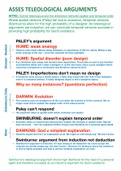
ASSES TELEOLOGICAL ARGUMENTS
INTRO: Outline teleological and the distinction between spatial and temporal order
Where spatial versions (Paley) fail due to evolution, temporal versions
(Swinburne) allow for the high probability of a designer. As teleological
arguments are inductive, we can conclude temporal versions succeed in
providing high probability for God’s existence.
PALEY’s argument
HUME: weak analogy
Stronger Weakest
➢ Observe man-made objects being designed, no experience of this for nature. Makes a big
jump: analogy of the eye = more like naturally forming vegetable.
HUME: Spatial disorder (poor design)
➢ E.g. Ostriches have wings and humans have appendixes. These play no part in any function
and therefore either don’t need a designer or at the very least, show a poor designer which
cannot be omnipotent or omniscient and therefore cannot be God.
PALEY: Imperfections don’t mean no design
➢ If someone came across a watch lying in a eld, they would still infer that it was designed,
even if it contained defects. A badly designed object is still a designed object.
Why so many instances? (questions perfection)
Defeating for Paley
DARWIN: Evolution
➢ The universe was not designed to t life, but rather life evolved to t the universe. We no
longer need God to explain the spatial order of the natural world.
Paley can’t respond
➢ His argument relies of spatial order which evolution can explain
SWINBURNE: doesn’t explain temporal order
➢ Evolution relies on natural laws (temporal) to explain the changes in spatial order. Natural
laws are brute ∴ can’t be explained further. Cause must therefore be a personal agent (God).
DAWKINS: God ≠ simplest explanation
Minor
➢ Dawkins argues God isn’t an explanation at all. We might as well simply say: ’We don’t know.’
Swinburne: argument from induction not deduction
➢ Swinburne’s argument is inductive, if it was aiming to be deductive we could accept the
criticism we should simply say “we don’t know”. However, it’s aiming to prove the existence
of God is highly probable and God is still the simplest explanation we have.
Swinburne’s teleological argument shows high likelihood for the need of a personal
agent and therefore succeeds as an inductive argument for God’s existence.
fi fi fi
INTRO: Outline teleological and the distinction between spatial and temporal order
Where spatial versions (Paley) fail due to evolution, temporal versions
(Swinburne) allow for the high probability of a designer. As teleological
arguments are inductive, we can conclude temporal versions succeed in
providing high probability for God’s existence.
PALEY’s argument
HUME: weak analogy
Stronger Weakest
➢ Observe man-made objects being designed, no experience of this for nature. Makes a big
jump: analogy of the eye = more like naturally forming vegetable.
HUME: Spatial disorder (poor design)
➢ E.g. Ostriches have wings and humans have appendixes. These play no part in any function
and therefore either don’t need a designer or at the very least, show a poor designer which
cannot be omnipotent or omniscient and therefore cannot be God.
PALEY: Imperfections don’t mean no design
➢ If someone came across a watch lying in a eld, they would still infer that it was designed,
even if it contained defects. A badly designed object is still a designed object.
Why so many instances? (questions perfection)
Defeating for Paley
DARWIN: Evolution
➢ The universe was not designed to t life, but rather life evolved to t the universe. We no
longer need God to explain the spatial order of the natural world.
Paley can’t respond
➢ His argument relies of spatial order which evolution can explain
SWINBURNE: doesn’t explain temporal order
➢ Evolution relies on natural laws (temporal) to explain the changes in spatial order. Natural
laws are brute ∴ can’t be explained further. Cause must therefore be a personal agent (God).
DAWKINS: God ≠ simplest explanation
Minor
➢ Dawkins argues God isn’t an explanation at all. We might as well simply say: ’We don’t know.’
Swinburne: argument from induction not deduction
➢ Swinburne’s argument is inductive, if it was aiming to be deductive we could accept the
criticism we should simply say “we don’t know”. However, it’s aiming to prove the existence
of God is highly probable and God is still the simplest explanation we have.
Swinburne’s teleological argument shows high likelihood for the need of a personal
agent and therefore succeeds as an inductive argument for God’s existence.
fi fi fi