GENE.IN FINGERPRINTING
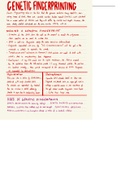
Genetic fingerprinting relies on the fact that the
genome
contains many repetitive non ,
-
coding bases of DNA ,
these are variable number tandem repeats IVNTRS ) each individual .
has a
unique pattern of VNTRS and they will differ by number and length . However the
,
more closely related individuals are the more similar VNTRS will be
MAKING A GENETIC FINGERPRINT
•
Extraction of the DNA from the cell as the amount is small the polymerase
0ham reaction can be used to increase this
•
DNA is cut into
fragments using the same restriction endonuclease
*
•
Fragments separated into size by GEL ELECTROPHORESIS
*
and the gel is the
immersed in alkali to separate the shads
*
•
HYBRIDISATION
*
: radioactive lor fluorescent) DNA probes are used to bind with
vNtRs due to complementary base sequences
•
Development : X -
ray films placed over the nylon membrane ,
the film is exposed
by the radiation from the radioactive probes Iif fluorescent probes the positions
using ,
are located visually ,
these pants correspond to the position of DNA fragments
as separated by electrophoresis
[
Hybridisation Electrophoresis
" " " "" " ""
" " " " "" " " "" d "" d ""
"" " "
" "" "
" "
combined with single stranded DNA .
Fragments are placed onto as agar gel and a
The shards are separated by heated voltage applied across it the resistance of
is
,
then the mixture is cooled
allowing the gel means smaller fragments more faster
strands to rejoin due to complementary bases i. further than larger ones
USES OF GENETIC FINGERPRINTS
GENETIC RELATIONSHIPS (
paternity testing) GENETIC DIVERSITY IN A POPULATION
FORENSIC SCIENCE (other methods must be used as well ) PLANT / ANIMAL BREEDING
MEDICAL DIAGNOSIS I e.
g. huntington s disease or nature of a microbial infection
Genetic fingerprinting relies on the fact that the
genome
contains many repetitive non ,
-
coding bases of DNA ,
these are variable number tandem repeats IVNTRS ) each individual .
has a
unique pattern of VNTRS and they will differ by number and length . However the
,
more closely related individuals are the more similar VNTRS will be
MAKING A GENETIC FINGERPRINT
•
Extraction of the DNA from the cell as the amount is small the polymerase
0ham reaction can be used to increase this
•
DNA is cut into
fragments using the same restriction endonuclease
*
•
Fragments separated into size by GEL ELECTROPHORESIS
*
and the gel is the
immersed in alkali to separate the shads
*
•
HYBRIDISATION
*
: radioactive lor fluorescent) DNA probes are used to bind with
vNtRs due to complementary base sequences
•
Development : X -
ray films placed over the nylon membrane ,
the film is exposed
by the radiation from the radioactive probes Iif fluorescent probes the positions
using ,
are located visually ,
these pants correspond to the position of DNA fragments
as separated by electrophoresis
[
Hybridisation Electrophoresis
" " " "" " ""
" " " " "" " " "" d "" d ""
"" " "
" "" "
" "
combined with single stranded DNA .
Fragments are placed onto as agar gel and a
The shards are separated by heated voltage applied across it the resistance of
is
,
then the mixture is cooled
allowing the gel means smaller fragments more faster
strands to rejoin due to complementary bases i. further than larger ones
USES OF GENETIC FINGERPRINTS
GENETIC RELATIONSHIPS (
paternity testing) GENETIC DIVERSITY IN A POPULATION
FORENSIC SCIENCE (other methods must be used as well ) PLANT / ANIMAL BREEDING
MEDICAL DIAGNOSIS I e.
g. huntington s disease or nature of a microbial infection