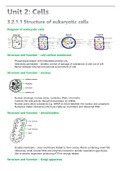
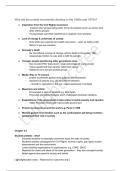
Diagram of eukaryotic cells
Structure and function – cell-surface membrane
- Phospholipid bilayer with embedded proteins etc.
- Selectively permeable – enables control of passage of substances in and out of cell
- Barrier between internal and external environment of cell
Structure and function – nucleus
- Nuclear envelope, nuclear pores, nucleolus, DNA / chromatin
- Controls the cells activity though transcription on mRNA
- Nuclear pores allow substances e.g. mRNA to move between the nucleus and cytoplasm
- Nucleolus makes ribosomes which are made up of proteins and ribosomal RNA
Structure and function – mitochondria
- Double membrane – inner membrane folded to form cristae. Matrix containing small 70S
ribosomes, small circular DNA and enzymes involved in aerobic respiration (glycolysis).
- Site of aerobic respiration producing ATP for energy release
Structure and function – Golgi apparatus
, - 3 or more fluid filled membrane bound sacs with vesicles at edge
- Receives protein from rough endoplasmic reticulum
- Modifies/processes protein e.g. add carbohydrates/sugars
- Packages into vesicles e.g. for transport to cell surface membrane for exocytosis
- Also makes lysosomes
Structure and function – lysosomes
- Type of Golgi vesicle containing lysozymes – hydrolytic enzymes
- Release of lysozymes to break down / hydrolyse pathogens or worn out cell components
Structure and function – ribosomes
- Float free in cytoplasm or bound to rER. Not membrane bound. Made from 1 large and 1
small subunit.
- Site of protein synthesis, specifically, translation
Structure and function – rough endoplasmic reticulum
- Ribosomes bound by a system of membranes
- Folds polypeptides to secondary / tertiary structure
- Packages to vesicles, transport to the Golgi apparatus etc.
Structure and function – smooth endoplasmic reticulum
- Similar to rER but without ribosomes – system of membranes
- Synthesises and processes lipids
Structure and function – chloroplasts (plants and algae)
, - Thylakoid membranes are stacked up in some parts to form grana, which are linked by
lamellae. These sit in the stroma (fluid) and are surrounded by a double membrane. Also
contains starch granules and circular DNA.
- (Chlorophyll) absorbs light for photosynthesis to produce organic substances
Structure and function – cell wall (plants, algae and fungi)
- Made mainly of cellulose in plants and algae, and of chitin in fungi
- Rigid structure surrounding cells in plants, algae and fungi. Prevents the cell changing
shape and bursting (lysis)
Structure and function – cell vacuole (plants)
- Contains cell sap – a weak solution of sugars and salts. Surrounding membrane is called the
tonoplast.
- Maintains pressure in the cell (stop wilting)
- Stores/isolates unwanted chemicals in the cell
Organisation of specialised cells in complex multicellular organisms
- Specialised cell – the most basic structural/functional subunit in all living organisms;
specialised for a particular function
- Tissue – Group of organised specialised cells; joined and working together to perform a
particular function; often with the same origin
- Organ – Group of organised different tissues; joined and working together to perform a
particular function
- Organ system – Group of organised organs; working together to perform a particular
function
You should be able to apply your knowledge to explain adaptations of
eukaryotic cells with particular functions
Structure and function – cell-surface membrane
- Phospholipid bilayer with embedded proteins etc.
- Selectively permeable – enables control of passage of substances in and out of cell
- Barrier between internal and external environment of cell
Structure and function – nucleus
- Nuclear envelope, nuclear pores, nucleolus, DNA / chromatin
- Controls the cells activity though transcription on mRNA
- Nuclear pores allow substances e.g. mRNA to move between the nucleus and cytoplasm
- Nucleolus makes ribosomes which are made up of proteins and ribosomal RNA
Structure and function – mitochondria
- Double membrane – inner membrane folded to form cristae. Matrix containing small 70S
ribosomes, small circular DNA and enzymes involved in aerobic respiration (glycolysis).
- Site of aerobic respiration producing ATP for energy release
Structure and function – Golgi apparatus
, - 3 or more fluid filled membrane bound sacs with vesicles at edge
- Receives protein from rough endoplasmic reticulum
- Modifies/processes protein e.g. add carbohydrates/sugars
- Packages into vesicles e.g. for transport to cell surface membrane for exocytosis
- Also makes lysosomes
Structure and function – lysosomes
- Type of Golgi vesicle containing lysozymes – hydrolytic enzymes
- Release of lysozymes to break down / hydrolyse pathogens or worn out cell components
Structure and function – ribosomes
- Float free in cytoplasm or bound to rER. Not membrane bound. Made from 1 large and 1
small subunit.
- Site of protein synthesis, specifically, translation
Structure and function – rough endoplasmic reticulum
- Ribosomes bound by a system of membranes
- Folds polypeptides to secondary / tertiary structure
- Packages to vesicles, transport to the Golgi apparatus etc.
Structure and function – smooth endoplasmic reticulum
- Similar to rER but without ribosomes – system of membranes
- Synthesises and processes lipids
Structure and function – chloroplasts (plants and algae)
, - Thylakoid membranes are stacked up in some parts to form grana, which are linked by
lamellae. These sit in the stroma (fluid) and are surrounded by a double membrane. Also
contains starch granules and circular DNA.
- (Chlorophyll) absorbs light for photosynthesis to produce organic substances
Structure and function – cell wall (plants, algae and fungi)
- Made mainly of cellulose in plants and algae, and of chitin in fungi
- Rigid structure surrounding cells in plants, algae and fungi. Prevents the cell changing
shape and bursting (lysis)
Structure and function – cell vacuole (plants)
- Contains cell sap – a weak solution of sugars and salts. Surrounding membrane is called the
tonoplast.
- Maintains pressure in the cell (stop wilting)
- Stores/isolates unwanted chemicals in the cell
Organisation of specialised cells in complex multicellular organisms
- Specialised cell – the most basic structural/functional subunit in all living organisms;
specialised for a particular function
- Tissue – Group of organised specialised cells; joined and working together to perform a
particular function; often with the same origin
- Organ – Group of organised different tissues; joined and working together to perform a
particular function
- Organ system – Group of organised organs; working together to perform a particular
function
You should be able to apply your knowledge to explain adaptations of
eukaryotic cells with particular functions