

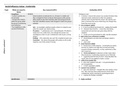
Social Influence review - Conformity
Topic What you need to Key research (AO1) Evaluation (AO3)
know
Compliance JENNESS - Ambiguous task
- Conform publicly but - Asked students to estimate the no. of beans in a bottle and In Jenness' research the answer was unclear therefore they
not privately then arranged for them to discuss their guesses with a group may have easily conformed to others for guidance,
- Temporarily conform - When asked to give their estimates after discussing he found whereas Asch ensured that the answer was obvious and
whilst the group whilst that their individual answers had changed to match the group’s clear so he knew they were conforming even though they
the group is monitoring estimate knew they were wrong
your behaviour ASCH - P – low ecological validity
- E.g. laughing at a joke - Aim – to investigate whether people conform to majority even E - It was an artificial and trivial task – judging line lengths
you don’t find funny when the answer was clearly wrong D – demand characteristics -> knew they were being
- Procedure – 7 confederates and 1 real participant. All asked to researched and may have just gone along with the
match line X to 3 other lines, even though the answer was situation
unambiguous (clear to see). Confederates had to give a wrong C – results can’t be generalised to other real-life situations
answer - P - High control over extraneous variables
- Findings – 37% conformity rate and 75% complied at least once E – all participants see same lines and always asked in
- Conclusion – this shows that people will conform to fit in with same order
dWhat is conformity?
majority, even if the answer if wrong C – more valid
- P – lacks historical validity
E - Carried out in 1950s America – in McCarthy era where
pressure to conform was high due to Americans being
accused of being communists, so they conformed so they
don’t stand out
D – Perrin and Spencer conducted a similar study where
they found only 1 conforming response out of 396 trials
C – suggesting that the time of Asch’s study did affect the
results and can’t be applied to today’s society
- P – suffers from gender bias
E - Only male students took part -> not generalisable to
rest of population
C – so lacks population validity
- P – research was unethical
E – ppts were deceived -> thought they were doing a vision
test. They may have been embarrassed in front of the
confederates which could lead to psychological harm
C – making the findings unreliable
Identification ZIMBARDO - P – highly unethical
, Social Influence review - Conformity
- conform publicly and - Aim: To investigate whether prison guards behave aggressively E – ppts were not protected from psychological harm, as
privately due to their personalities or because of the role and many prisoners suffered breakdowns and asked to be
- temporarily behave environment they are in. removed from the study
the same as the group D – ppts had the right to withdraw but felt they couldn’t
because we value them - Procedure: Mock prison created in the basement of Stamford leave due to lack of informed consent
and want to be part of University. Volunteer participants randomly assigned to the C – means that this study cannot be repeated so we don’t
them role of prisoner or guard. Guards were given uniform, reflective know if these findings are reliable in explaining
sunglasses and were told they had complete power over the identification
prisoners, enforcing the 16 prison rules. Prisoners arrested at - P – high ecological validity, unlike most lab studies
home and booked at real police station, made to wear smocks, E – creates false prison environment based on what a
given a number instead of a name and had a chain around their normal prison would look like. Also arrested, strip searched
ankle. ‘prisoners’ at local station to make them feel like a real
prisoner
- Findings: After an initial rebel from the prisoners, both C – makes ppts behave more naturally, we can generalize
prisoners and guards identified with their social roles. Guards these results to other real-life situations to explain
constantly harassed the prisoners, reminding them they were identification
being monitored at all times and punished prisoners. Prisoners D – however the study could have suffered from
became more submissive, depressed and anxious, on day 2 the participator effects because the ppts knew they were part
first prisoner had a mental breakdown and left the experiment. of a study and that they were being watched, so they may
The experiment was stopped after just 6 days. have changed their behaviour to be or against what they
thought was expected of them, making the results less
- Conclusion: Guard’s aggression seems to be a result of the valid due to the fact that they probably didn’t show their
environment and role they are in, showing identification to true behaviour
social roles. - P – high control
E – carried out in Stanford Uni basement in a lab
environment, so could control environmental factors like
light and heat
C – making the study more valid
- P – suffers from researcher bias
E – Zimbardo put himself forward as the prison warden,
which meant he became very involved in the study, instead
of just observing. He didn’t intervene when the guards
displayed aggressive behaviour towards the prisoners and
it is most likely that it would have been stopped in real life.
This means that Zimbardo may have influenced the results
to get the findings he predicted
C – therefore, we would question whether this is what
would happen in real life situations, so we can’t generalise
Topic What you need to Key research (AO1) Evaluation (AO3)
know
Compliance JENNESS - Ambiguous task
- Conform publicly but - Asked students to estimate the no. of beans in a bottle and In Jenness' research the answer was unclear therefore they
not privately then arranged for them to discuss their guesses with a group may have easily conformed to others for guidance,
- Temporarily conform - When asked to give their estimates after discussing he found whereas Asch ensured that the answer was obvious and
whilst the group whilst that their individual answers had changed to match the group’s clear so he knew they were conforming even though they
the group is monitoring estimate knew they were wrong
your behaviour ASCH - P – low ecological validity
- E.g. laughing at a joke - Aim – to investigate whether people conform to majority even E - It was an artificial and trivial task – judging line lengths
you don’t find funny when the answer was clearly wrong D – demand characteristics -> knew they were being
- Procedure – 7 confederates and 1 real participant. All asked to researched and may have just gone along with the
match line X to 3 other lines, even though the answer was situation
unambiguous (clear to see). Confederates had to give a wrong C – results can’t be generalised to other real-life situations
answer - P - High control over extraneous variables
- Findings – 37% conformity rate and 75% complied at least once E – all participants see same lines and always asked in
- Conclusion – this shows that people will conform to fit in with same order
dWhat is conformity?
majority, even if the answer if wrong C – more valid
- P – lacks historical validity
E - Carried out in 1950s America – in McCarthy era where
pressure to conform was high due to Americans being
accused of being communists, so they conformed so they
don’t stand out
D – Perrin and Spencer conducted a similar study where
they found only 1 conforming response out of 396 trials
C – suggesting that the time of Asch’s study did affect the
results and can’t be applied to today’s society
- P – suffers from gender bias
E - Only male students took part -> not generalisable to
rest of population
C – so lacks population validity
- P – research was unethical
E – ppts were deceived -> thought they were doing a vision
test. They may have been embarrassed in front of the
confederates which could lead to psychological harm
C – making the findings unreliable
Identification ZIMBARDO - P – highly unethical
, Social Influence review - Conformity
- conform publicly and - Aim: To investigate whether prison guards behave aggressively E – ppts were not protected from psychological harm, as
privately due to their personalities or because of the role and many prisoners suffered breakdowns and asked to be
- temporarily behave environment they are in. removed from the study
the same as the group D – ppts had the right to withdraw but felt they couldn’t
because we value them - Procedure: Mock prison created in the basement of Stamford leave due to lack of informed consent
and want to be part of University. Volunteer participants randomly assigned to the C – means that this study cannot be repeated so we don’t
them role of prisoner or guard. Guards were given uniform, reflective know if these findings are reliable in explaining
sunglasses and were told they had complete power over the identification
prisoners, enforcing the 16 prison rules. Prisoners arrested at - P – high ecological validity, unlike most lab studies
home and booked at real police station, made to wear smocks, E – creates false prison environment based on what a
given a number instead of a name and had a chain around their normal prison would look like. Also arrested, strip searched
ankle. ‘prisoners’ at local station to make them feel like a real
prisoner
- Findings: After an initial rebel from the prisoners, both C – makes ppts behave more naturally, we can generalize
prisoners and guards identified with their social roles. Guards these results to other real-life situations to explain
constantly harassed the prisoners, reminding them they were identification
being monitored at all times and punished prisoners. Prisoners D – however the study could have suffered from
became more submissive, depressed and anxious, on day 2 the participator effects because the ppts knew they were part
first prisoner had a mental breakdown and left the experiment. of a study and that they were being watched, so they may
The experiment was stopped after just 6 days. have changed their behaviour to be or against what they
thought was expected of them, making the results less
- Conclusion: Guard’s aggression seems to be a result of the valid due to the fact that they probably didn’t show their
environment and role they are in, showing identification to true behaviour
social roles. - P – high control
E – carried out in Stanford Uni basement in a lab
environment, so could control environmental factors like
light and heat
C – making the study more valid
- P – suffers from researcher bias
E – Zimbardo put himself forward as the prison warden,
which meant he became very involved in the study, instead
of just observing. He didn’t intervene when the guards
displayed aggressive behaviour towards the prisoners and
it is most likely that it would have been stopped in real life.
This means that Zimbardo may have influenced the results
to get the findings he predicted
C – therefore, we would question whether this is what
would happen in real life situations, so we can’t generalise


