Biological Explanations: Genetic and Neural Explanations
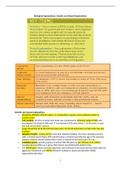
Genetic and neural explanations
Would-be offenders inherit a gene, or combination of genes, that predispose them to
commit crime.
Twin studies- the first criminal twin study was conducted by Johannes Lange (1930) who
investigated 13 identical (MZ) and 17 non-identical (DZ) twins where 1 of the twins in each
pair had served time in prison.
Lange found that 10 of the MZ twins but only 2 of the DZ twins had a co-twin who was also
in prison.
Adoption studies- Crowe (1972) found that adopted children who had a biological parent
with a criminal record had a 50% risk of having a criminal record by the age of 18, whereas
adopted children whose mother didn’t have a criminal record only had a 5% risk.
Candidate genes- genetic analysis of almost 900 offenders by Jari Tihonen et al. (2014)
revealed abnormalities on 2 genes that may be associated with violent crime.
The MAOA gene (which controls dopamine and serotonin in the brain and has been linked to
aggressive behaviour) and CDH13 (linked to substance abuse and attention deficit
hyperactivity disorder).
1
Genetic and neural explanations
Would-be offenders inherit a gene, or combination of genes, that predispose them to
commit crime.
Twin studies- the first criminal twin study was conducted by Johannes Lange (1930) who
investigated 13 identical (MZ) and 17 non-identical (DZ) twins where 1 of the twins in each
pair had served time in prison.
Lange found that 10 of the MZ twins but only 2 of the DZ twins had a co-twin who was also
in prison.
Adoption studies- Crowe (1972) found that adopted children who had a biological parent
with a criminal record had a 50% risk of having a criminal record by the age of 18, whereas
adopted children whose mother didn’t have a criminal record only had a 5% risk.
Candidate genes- genetic analysis of almost 900 offenders by Jari Tihonen et al. (2014)
revealed abnormalities on 2 genes that may be associated with violent crime.
The MAOA gene (which controls dopamine and serotonin in the brain and has been linked to
aggressive behaviour) and CDH13 (linked to substance abuse and attention deficit
hyperactivity disorder).
1