
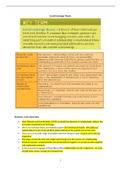
Social Exchange Theory
Rewards, costs and profits
John Thibault and Harold Kelley (1959) contend that behavior in relationships reflects the
economic assumptions of exchange.
We try to minimize losses and maximize gains (the minimax principle). We judge our
relationship in terms of the profit it yields, defined as the reward minus the costs.
There are a very wide range of possible outcomes because such rewards and costs are
subjective.
The value of rewards and costs might well change over the course of a relationship.
Rewards include: companionship, sex and emotional support. It can also involve negative
and unpleasant emotions.
In the economic language of Peter Blau (1964) relationships can be “expensive”, so costs
include time, stress, energy and compromise.
1


