A101 Introduction to Aerodynamics Section 1-7
__________________________________________________________________________
Outline
• Last lecture we introduced the idea of Dimensional Analysis
• We have discussed the physical meaning of the important non-dimensional number
Reynolds number.
• Today we will discuss and equally important non-dimensional number the Mach number
• Finally we will look at a more general approach to finding the non-dimensional numbers
and Buckingham’s Rule.
Mach Number
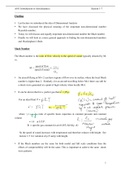
The Mach number is the ratio of flow velocity to the speed of sound typically denoted by M,
i.e.
speed of flow
M= = a-
speed of sound
a
• An aircraft flying at M = 2 can have regions of flow over its surface where the local Mach
number is higher than 2. Similarly, for an aircraft travelling below M=1 there can still be
a shock wave generated at a point of high velocity when locally M>1.
• It can be shown that for a perfect gas that a2 = γP/ρ.
j=Cp/Cv
heat
For an ideal fluid P = PRT cpccv) - amount
of
to raise temperature
2
a = ✓ RT FRY required constant
Kat pressure
by
a -
( volume)
where γ =
speigi ratio of specific heats capacities at constant pressure anduniversal
constant
volume
R=Ro_ gas
= 1.4 at S.T.P.
Molecular constant
R = specific gas constant for air (0.287) KJ/(Kg K)
weight
So the speed of sound increases with temperature and therefore reduces with height. See
lecture 1-5 for variation of ρ,T and p with height.
• If the Mach numbers are the same for both model and full scale conditions then the
effects of compressibility will be the same. This is important to achieve the same shock
wave patterns.
1
, A101 Introduction to Aerodynamics Section 1-7
__________________________________________________________________________
• If M < O 3 then the effects of compressibility are unlikely to be important and hence
.
M no longer needs to be considered. In air this corresponds to U < 100m/s, as a rough
guide. (see Thermodynamics lecture notes).
Dimensional Analysis: Buckingham’s Rule
We have seen that two important non-dimensional parameters of the flow are the Reynolds
number and the Mach number. How do we know if there are any more important non-
dimensional numbers?
To apply dimensional analysis in a more formal manner we can consider an approach
attributed to Buckingham. Let us consider the problems of determining the non-dimensional
parameters that the lift on a wing, L, depend on? First we need to identify the variables of our
problem which are: inertial Woof
Re =
.
forces fores
.
1. Free stream speed u -
2. Size of the wing A -
dynamic viscosity
3. Density of air
Pm in
-
-
4. Viscosity of air
¥
5. The speed of sound = Rmimatie
viscosity
L= f-
( u. A , P , Me a
)
As we have discussed before it is better practice to consider a dimensionless form of L, i.e.
the lift coefficient
L
= C L = f 1 (U, ρ , A, µ , a)
1 2
ρU A
2
CL = f1 (one or more dimensionless parameters or groups)
The formal way of finding the groups is as follows:
• The relation f1, whatever it is, can be expressed as a power series. The argument of the
power series must be dimensionless or successive terms can not have the same
dimensions. Write a typical term as
α γ δ θ
f1(U,ρ,A,µ,a) = …. + c U ρβ A µ a + .....
x
constant
2
__________________________________________________________________________
Outline
• Last lecture we introduced the idea of Dimensional Analysis
• We have discussed the physical meaning of the important non-dimensional number
Reynolds number.
• Today we will discuss and equally important non-dimensional number the Mach number
• Finally we will look at a more general approach to finding the non-dimensional numbers
and Buckingham’s Rule.
Mach Number
The Mach number is the ratio of flow velocity to the speed of sound typically denoted by M,
i.e.
speed of flow
M= = a-
speed of sound
a
• An aircraft flying at M = 2 can have regions of flow over its surface where the local Mach
number is higher than 2. Similarly, for an aircraft travelling below M=1 there can still be
a shock wave generated at a point of high velocity when locally M>1.
• It can be shown that for a perfect gas that a2 = γP/ρ.
j=Cp/Cv
heat
For an ideal fluid P = PRT cpccv) - amount
of
to raise temperature
2
a = ✓ RT FRY required constant
Kat pressure
by
a -
( volume)
where γ =
speigi ratio of specific heats capacities at constant pressure anduniversal
constant
volume
R=Ro_ gas
= 1.4 at S.T.P.
Molecular constant
R = specific gas constant for air (0.287) KJ/(Kg K)
weight
So the speed of sound increases with temperature and therefore reduces with height. See
lecture 1-5 for variation of ρ,T and p with height.
• If the Mach numbers are the same for both model and full scale conditions then the
effects of compressibility will be the same. This is important to achieve the same shock
wave patterns.
1
, A101 Introduction to Aerodynamics Section 1-7
__________________________________________________________________________
• If M < O 3 then the effects of compressibility are unlikely to be important and hence
.
M no longer needs to be considered. In air this corresponds to U < 100m/s, as a rough
guide. (see Thermodynamics lecture notes).
Dimensional Analysis: Buckingham’s Rule
We have seen that two important non-dimensional parameters of the flow are the Reynolds
number and the Mach number. How do we know if there are any more important non-
dimensional numbers?
To apply dimensional analysis in a more formal manner we can consider an approach
attributed to Buckingham. Let us consider the problems of determining the non-dimensional
parameters that the lift on a wing, L, depend on? First we need to identify the variables of our
problem which are: inertial Woof
Re =
.
forces fores
.
1. Free stream speed u -
2. Size of the wing A -
dynamic viscosity
3. Density of air
Pm in
-
-
4. Viscosity of air
¥
5. The speed of sound = Rmimatie
viscosity
L= f-
( u. A , P , Me a
)
As we have discussed before it is better practice to consider a dimensionless form of L, i.e.
the lift coefficient
L
= C L = f 1 (U, ρ , A, µ , a)
1 2
ρU A
2
CL = f1 (one or more dimensionless parameters or groups)
The formal way of finding the groups is as follows:
• The relation f1, whatever it is, can be expressed as a power series. The argument of the
power series must be dimensionless or successive terms can not have the same
dimensions. Write a typical term as
α γ δ θ
f1(U,ρ,A,µ,a) = …. + c U ρβ A µ a + .....
x
constant
2