

Taylor’s Notes Halogenoalkanes Notes
Nomenclature
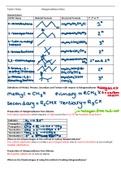
IUPAC Name Skeletal Formula Structural Formula 1°, 2° or 3°
Definitions of Methyl, Primary, Secondary and Tertiary with respect to Halogenoalkanes
Preparation of Halogenoalkanes from Alkanes
Free radical substitution which requires UV light to turn the X2 to 2X° by homolytic bond fission
Initiation
Propagation 1
Propagation 2
Termination 1
Termination 2
Termination 3
What are the Disadvantages of this method of making Halogenoalkanes?
Free radical substitution does not make a pure halogenoalkane due to many terminations or you could get
multiple substitutions
Preparation of Halogenoalkanes from Alkenes
Electrophilic addition of HX onto an alkene
What are the Disadvantages of using this method of making Halogenoalkanes?
, Taylor’s Notes Halogenoalkanes Notes
For unsymmetrical alkenes you get a major and minor product which is not very pure
Identification of Halogenoalkanes
Add NaOH (aqueous sodium hydroxide) to substitute X
Add HNO3 (nitric acid) to remove carbonate impurities
Adding AgNO3 (silver nitrate)
Observe the formation of a precipitate
Relative Reactivity of Halogenoalkanes
Reactivity increases down the halogenoalkanes as atomic radius increases therefore the C – I bond is
longer than the C – Cl bond and so the C – I bond is weaker
Relative Reactivity of Different Classes of Halogenoalkanes
Why is 2-chloro-2-methylpropane more reactive than 1-chloropropane
The more stable the carbocation intermediate, the more reactive
What is a Nucleophile?
An electron pair donor
Why do Halogenoalkanes undergo Nucleophilic Substitution reactions?
X is more electronegative than the carbon in C – X bond so the bond is polar, and the nucleophile is
therefore attracted to the partially positively charged C
Carbon atoms can only have 4 covalent bonds so nucleophiles must substitute X
Nucleophilic Substitution Reactions
Nucleophilic Substitution of OH- with Bromoethane
Reagent NaOH or KOH Conditions Heat under reflux in an Aqueous Solution
Balanced Equation =
Nucleophilic Substitution of CN- with Bromoethane
Reagent KCN Conditions Heat under reflux in ethanol/water mix
Balanced Equation =
Nomenclature
IUPAC Name Skeletal Formula Structural Formula 1°, 2° or 3°
Definitions of Methyl, Primary, Secondary and Tertiary with respect to Halogenoalkanes
Preparation of Halogenoalkanes from Alkanes
Free radical substitution which requires UV light to turn the X2 to 2X° by homolytic bond fission
Initiation
Propagation 1
Propagation 2
Termination 1
Termination 2
Termination 3
What are the Disadvantages of this method of making Halogenoalkanes?
Free radical substitution does not make a pure halogenoalkane due to many terminations or you could get
multiple substitutions
Preparation of Halogenoalkanes from Alkenes
Electrophilic addition of HX onto an alkene
What are the Disadvantages of using this method of making Halogenoalkanes?
, Taylor’s Notes Halogenoalkanes Notes
For unsymmetrical alkenes you get a major and minor product which is not very pure
Identification of Halogenoalkanes
Add NaOH (aqueous sodium hydroxide) to substitute X
Add HNO3 (nitric acid) to remove carbonate impurities
Adding AgNO3 (silver nitrate)
Observe the formation of a precipitate
Relative Reactivity of Halogenoalkanes
Reactivity increases down the halogenoalkanes as atomic radius increases therefore the C – I bond is
longer than the C – Cl bond and so the C – I bond is weaker
Relative Reactivity of Different Classes of Halogenoalkanes
Why is 2-chloro-2-methylpropane more reactive than 1-chloropropane
The more stable the carbocation intermediate, the more reactive
What is a Nucleophile?
An electron pair donor
Why do Halogenoalkanes undergo Nucleophilic Substitution reactions?
X is more electronegative than the carbon in C – X bond so the bond is polar, and the nucleophile is
therefore attracted to the partially positively charged C
Carbon atoms can only have 4 covalent bonds so nucleophiles must substitute X
Nucleophilic Substitution Reactions
Nucleophilic Substitution of OH- with Bromoethane
Reagent NaOH or KOH Conditions Heat under reflux in an Aqueous Solution
Balanced Equation =
Nucleophilic Substitution of CN- with Bromoethane
Reagent KCN Conditions Heat under reflux in ethanol/water mix
Balanced Equation =


