Psychological Explanations: Differential Association Theory
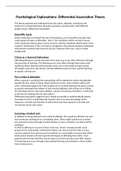
The theory proposes that individuals learn the values, attitudes, techniques and
motives for criminal behaviour through association and interaction with different
people (hence, differential association).
Scientific basis
Edwin Sutherland set himself the task of developing a set of scientific principles that
could explain all types of offending - that is, 'the conditions which are said to cause
crime should be present when crime is present, and they should be absent when crime
is absent' (Sutherland 1924). His theory is designed to discriminate between individuals
who become criminals and those who do not, whatever their race, class or ethnic
background.
Crime as a learned behaviour
Offending behaviour may be acquired in the same way as any other behaviour through
the processes of learning. This learning occurs most often through interactions with
significant others that the child associates with, such as the family and peer group.
Criminality arises from two factors: learned attitudes towards crime, and the learning
of specific criminal acts
Pro-criminal attitudes
When a person is socialised into a group they will be exposed to values and attitudes
towards the law. Some of these values will be pro-crime, some of these will be anti-
crime. Sutherland argues that if the number of pro-criminal attitudes the person comes
to acquire outweighs the number of anti-criminal attitudes, they will go on to offend.
The learning process is the same whether a person is learning criminality or conformity
to the law (or anything else for that matter).
Differential association suggests that it should be possible to mathematically predict
how likely it is that an individual will commit crime if we have knowledge of the
frequency, intensity and duration of which they have been exposed to deviant and
non-deviant norms and values.
Learning criminal acts
In addition to being exposed to pro-criminal attitudes, the would-be offender may also
learn particular techniques for committing crime. These might include how to break
into someone's house through a locked window or how to disable a car stereo before
stealing it.
As Well as offering an account of how crime may "breed' amongst specific social
groups and in communities, Sutherland's theory can also account for why so many
convicts released from prison go on to reoffend. It is reasonable to assume that whilst
inside prison inmates will learn specific techniques of offending from other, more
experienced criminals that they may be eager to put into practice upon their release.
This learning may occur through observational learning and imitation or direct tuition
from criminal peers.
The theory proposes that individuals learn the values, attitudes, techniques and
motives for criminal behaviour through association and interaction with different
people (hence, differential association).
Scientific basis
Edwin Sutherland set himself the task of developing a set of scientific principles that
could explain all types of offending - that is, 'the conditions which are said to cause
crime should be present when crime is present, and they should be absent when crime
is absent' (Sutherland 1924). His theory is designed to discriminate between individuals
who become criminals and those who do not, whatever their race, class or ethnic
background.
Crime as a learned behaviour
Offending behaviour may be acquired in the same way as any other behaviour through
the processes of learning. This learning occurs most often through interactions with
significant others that the child associates with, such as the family and peer group.
Criminality arises from two factors: learned attitudes towards crime, and the learning
of specific criminal acts
Pro-criminal attitudes
When a person is socialised into a group they will be exposed to values and attitudes
towards the law. Some of these values will be pro-crime, some of these will be anti-
crime. Sutherland argues that if the number of pro-criminal attitudes the person comes
to acquire outweighs the number of anti-criminal attitudes, they will go on to offend.
The learning process is the same whether a person is learning criminality or conformity
to the law (or anything else for that matter).
Differential association suggests that it should be possible to mathematically predict
how likely it is that an individual will commit crime if we have knowledge of the
frequency, intensity and duration of which they have been exposed to deviant and
non-deviant norms and values.
Learning criminal acts
In addition to being exposed to pro-criminal attitudes, the would-be offender may also
learn particular techniques for committing crime. These might include how to break
into someone's house through a locked window or how to disable a car stereo before
stealing it.
As Well as offering an account of how crime may "breed' amongst specific social
groups and in communities, Sutherland's theory can also account for why so many
convicts released from prison go on to reoffend. It is reasonable to assume that whilst
inside prison inmates will learn specific techniques of offending from other, more
experienced criminals that they may be eager to put into practice upon their release.
This learning may occur through observational learning and imitation or direct tuition
from criminal peers.