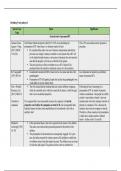
Resulting Trust junkyard
Source/Case/ Quote Significance
Topic
General rules of presumed RT
National Crime Chief Master Marsh interpreted s.60(3) LPA 1925 as not abolishing the This is PC case and thus merely persuasive
Agency v Dong presumption of RT where there is a voluntary transfer of land. precedent.
[2017] EWHC He considered the matter was one of statutory interpretation and that the
3116 (Ch) provision was simply a statutory reminder to conveyancers that a RT will
not be implied simply because a conveyance of property does not expressly
state that the property is for the use of benefit of the grantee
The provision has no effect on whether or not a RT of land will be
presumed where the transferor voluntarily conveys it to the transferee
Re Vinogradoff Grandmother transferred £800 of stock into her own name and that of her Case illustrates the absurdity and arbitrary
[1935] WN 68. granddaughter nature of presumed RTs
Presumption of RT still applied, despite the fact that the granddaughter was
4 and unable to execute trustee duties
Prest v Petrodel The wife claimed that her husband had used various offshore companies, Following the line of reasoning for a
Resources Ltd which he controlled and in which he owned all the shares, to hold the legal presumption of RT in transfer of property
[2013] UKSC 34 title to seven residential properties. without consideration - that people are selfish
and don’t want others to benefit - does not
Transfers to SC recognised that it was not possible to pierce the corporate veil, but the translate/mesh well with voluntary transfers of
companies properties were held by the companies on trust for H, who consequently had a property to companies. This is because the
beneficial interest in them, which enabled them to be transferred to the wife as transferor does want the company to benefit.
ancillary relief Therefore, in these scenarios, the presumption
is futile and is simply another evidential
barrier – further costs to Cs and Ds.
Shephard v Father purchased shares s that were registered in the names of his children.
Cartwright [1955] The shares were sold and the proceeds deposited for the benefit of the
AC 431 children
The presumption of advancement was consequently engaged. Five years
later, the father procured the written consent of the children to enable him
to withdraw money from their deposit account. The children were not aware
of what they had signed. The question for the court was whether this
, document was sufficient to rebut the presumption of advancement.
Since this was evidence that did not form part of the original transaction, it
could be admitted only if it was evidence of the children admitting that their
father had not intended a gift
Illegality
Tinsley v Same sex couple contributed to purchase price of the house, but only in the Compare to Silverwood v Silverwood – in
Milligan (non- sole name of T. This arrangement was made to make it appear that M was a which a grandma’s executors used the
reliance principle) lodger and thus fraudulently claim housing benefit. grandma’s illegal conduct to rebut the
On separation, T argued that she had sole ownership of the house, whilst M claimants (her grandkids) OWN rebuttal of
argued that there was a presumption of an RT and so had a beneficial the presumed RT (kids wanted it to be a gift).
interest. T argued that M could not ask the court to enforce the trust in her
favour because of her illegal conduct If it is legitimate to rely on the illegal purpose
to prevent a presumption being rebutted, as in
By a majority, it was held: Silverwood v Silverwood, why in cases such
Milligan’s counterclaim should succeed: to trigger the presumption of resulting as Tinsley v Milligan cannot the illegal
trust, she simply needed to show that she had contributed to the purchase price purpose be used to rebut the
and she did not need to refer to the illegal purpose to show this. presumption of resulting trust?
I.E. – M did not need to rely on her illegal conduct to prove that she had a
beneficial interest. Simply contributing to the purchase price was enough for a PATEL NOW OVERRULES TINSLEY.
RT to arise – and that contribution was not for illegal conduct – only omitting
her name on the mortgage was for the illegal conduct.
104 The only way in which Tinsley could have sought to rebut this presumption
was by showing that Milligan had intended Tinsley to have sole title to the property
to enable her to perpetrate the fraud
Patel v Mirza’s Patel overrules Tinsley and the non-reliance principle. A claimant may rely on their
construction of illegal conduct to rebut presumption of RT if it meets the trio of considerations.
Tinsley with the
new law (the trio Applying the test to Tinsley, Tinsley v Milligan would have been decided the same
of considerations) way today, but without the artifice of considering whether or not it was necessary to
Source/Case/ Quote Significance
Topic
General rules of presumed RT
National Crime Chief Master Marsh interpreted s.60(3) LPA 1925 as not abolishing the This is PC case and thus merely persuasive
Agency v Dong presumption of RT where there is a voluntary transfer of land. precedent.
[2017] EWHC He considered the matter was one of statutory interpretation and that the
3116 (Ch) provision was simply a statutory reminder to conveyancers that a RT will
not be implied simply because a conveyance of property does not expressly
state that the property is for the use of benefit of the grantee
The provision has no effect on whether or not a RT of land will be
presumed where the transferor voluntarily conveys it to the transferee
Re Vinogradoff Grandmother transferred £800 of stock into her own name and that of her Case illustrates the absurdity and arbitrary
[1935] WN 68. granddaughter nature of presumed RTs
Presumption of RT still applied, despite the fact that the granddaughter was
4 and unable to execute trustee duties
Prest v Petrodel The wife claimed that her husband had used various offshore companies, Following the line of reasoning for a
Resources Ltd which he controlled and in which he owned all the shares, to hold the legal presumption of RT in transfer of property
[2013] UKSC 34 title to seven residential properties. without consideration - that people are selfish
and don’t want others to benefit - does not
Transfers to SC recognised that it was not possible to pierce the corporate veil, but the translate/mesh well with voluntary transfers of
companies properties were held by the companies on trust for H, who consequently had a property to companies. This is because the
beneficial interest in them, which enabled them to be transferred to the wife as transferor does want the company to benefit.
ancillary relief Therefore, in these scenarios, the presumption
is futile and is simply another evidential
barrier – further costs to Cs and Ds.
Shephard v Father purchased shares s that were registered in the names of his children.
Cartwright [1955] The shares were sold and the proceeds deposited for the benefit of the
AC 431 children
The presumption of advancement was consequently engaged. Five years
later, the father procured the written consent of the children to enable him
to withdraw money from their deposit account. The children were not aware
of what they had signed. The question for the court was whether this
, document was sufficient to rebut the presumption of advancement.
Since this was evidence that did not form part of the original transaction, it
could be admitted only if it was evidence of the children admitting that their
father had not intended a gift
Illegality
Tinsley v Same sex couple contributed to purchase price of the house, but only in the Compare to Silverwood v Silverwood – in
Milligan (non- sole name of T. This arrangement was made to make it appear that M was a which a grandma’s executors used the
reliance principle) lodger and thus fraudulently claim housing benefit. grandma’s illegal conduct to rebut the
On separation, T argued that she had sole ownership of the house, whilst M claimants (her grandkids) OWN rebuttal of
argued that there was a presumption of an RT and so had a beneficial the presumed RT (kids wanted it to be a gift).
interest. T argued that M could not ask the court to enforce the trust in her
favour because of her illegal conduct If it is legitimate to rely on the illegal purpose
to prevent a presumption being rebutted, as in
By a majority, it was held: Silverwood v Silverwood, why in cases such
Milligan’s counterclaim should succeed: to trigger the presumption of resulting as Tinsley v Milligan cannot the illegal
trust, she simply needed to show that she had contributed to the purchase price purpose be used to rebut the
and she did not need to refer to the illegal purpose to show this. presumption of resulting trust?
I.E. – M did not need to rely on her illegal conduct to prove that she had a
beneficial interest. Simply contributing to the purchase price was enough for a PATEL NOW OVERRULES TINSLEY.
RT to arise – and that contribution was not for illegal conduct – only omitting
her name on the mortgage was for the illegal conduct.
104 The only way in which Tinsley could have sought to rebut this presumption
was by showing that Milligan had intended Tinsley to have sole title to the property
to enable her to perpetrate the fraud
Patel v Mirza’s Patel overrules Tinsley and the non-reliance principle. A claimant may rely on their
construction of illegal conduct to rebut presumption of RT if it meets the trio of considerations.
Tinsley with the
new law (the trio Applying the test to Tinsley, Tinsley v Milligan would have been decided the same
of considerations) way today, but without the artifice of considering whether or not it was necessary to