

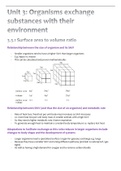
Relationship between the size of organism and its SA:V
- Smaller organisms tend to have a higher SA:V than larger organisms
- E.g. hippo vs. mouse
- This can be calculated and proven mathematically:
Relationship between SA:V (and thus the size of an organism) and metabolic rate
- Rate of heat loss / heat lost per unit body mass increases as SA:V increases
- i.e. more heat lost per unit body mass in smaller animals with a high SA:V
- So they need a higher metabolic rate / faster respiration
- To generate enough heat to maintain a constant body temperature i.e. replace lost heat
Adaptations to facilitate exchange as this ratio reduces in larger organisms include
changes to body shape and the development of systems
- Larger organisms need a specialised surface / organ for gaseous exchange e.g. lungs
- Because they have a smaller SA:V and a long diffusion pathway (and skin is waterproof / gas
tight)
- As well as having a high demand for oxygen and to remove carbon dioxide
, Adaptations of gas exchange surfaces shown by gas exchange…
Across the body surface of a single-celled organism
- Thin, flat shape
- Large SA(:V)
- Short diffusion pathway/distance (all parts of cell are a small distance away from
exchange surfaces)
- For rapid diffusion e.g. oxygen / carbon dioxide
Adaptations of gas exchange surfaces shown by gas exchange…
In the tracheal system of an insect
1. Air moves through spiracles (pores) on the surface of the insect
2. Air moves through tracheae
3. Gas exchange at tracheoles directly to/from cells
- Oxygen diffuses down conc. gradient to respiring cell
- Carbon dioxide diffuses down conc. gradient from respiring cells
- Adaptations: lots of thin, branching tracheoles → short diffusion pathway and SA(:V) → rapid
diffusion
- Note: rhythmic abdominal movements increase the efficiency of gas exchange by increasing the
amount of air/oxygen entering → maintains greater concentration gradient for diffusion
Adaptations of gas exchange surfaces shown by gas exchange…
Across the gills of fish
- Counter current flow
- Blood flows through lamellae and water flows over lamellae in opposite directions
- Always a higher concentration of oxygen in water than the blood it is near
- Hence, a concentration gradient of oxygen between the water and blood is maintained
along the whole length of lamellae (/gill plate) → equilibrium not met
- Maximising diffusion of oxygen
-
- Note: if the current was parallel, equilibrium would be met, so a concentration
gradient wouldn’t be maintained and oxygen wouldn’t diffuse into the blood
along the whole gill plate
- Each gill is made of lots of gill filaments (thin plates) which are covered in many lamellae → gill
filaments provide a large surface area, lamellae increase surface area even more
- Vast network of capillaries on lamellae → remove oxygen to maintain a concentration gradient
- Thin/flattened epithelium → shorter diffusion pathway between water and blood
- Smaller organisms tend to have a higher SA:V than larger organisms
- E.g. hippo vs. mouse
- This can be calculated and proven mathematically:
Relationship between SA:V (and thus the size of an organism) and metabolic rate
- Rate of heat loss / heat lost per unit body mass increases as SA:V increases
- i.e. more heat lost per unit body mass in smaller animals with a high SA:V
- So they need a higher metabolic rate / faster respiration
- To generate enough heat to maintain a constant body temperature i.e. replace lost heat
Adaptations to facilitate exchange as this ratio reduces in larger organisms include
changes to body shape and the development of systems
- Larger organisms need a specialised surface / organ for gaseous exchange e.g. lungs
- Because they have a smaller SA:V and a long diffusion pathway (and skin is waterproof / gas
tight)
- As well as having a high demand for oxygen and to remove carbon dioxide
, Adaptations of gas exchange surfaces shown by gas exchange…
Across the body surface of a single-celled organism
- Thin, flat shape
- Large SA(:V)
- Short diffusion pathway/distance (all parts of cell are a small distance away from
exchange surfaces)
- For rapid diffusion e.g. oxygen / carbon dioxide
Adaptations of gas exchange surfaces shown by gas exchange…
In the tracheal system of an insect
1. Air moves through spiracles (pores) on the surface of the insect
2. Air moves through tracheae
3. Gas exchange at tracheoles directly to/from cells
- Oxygen diffuses down conc. gradient to respiring cell
- Carbon dioxide diffuses down conc. gradient from respiring cells
- Adaptations: lots of thin, branching tracheoles → short diffusion pathway and SA(:V) → rapid
diffusion
- Note: rhythmic abdominal movements increase the efficiency of gas exchange by increasing the
amount of air/oxygen entering → maintains greater concentration gradient for diffusion
Adaptations of gas exchange surfaces shown by gas exchange…
Across the gills of fish
- Counter current flow
- Blood flows through lamellae and water flows over lamellae in opposite directions
- Always a higher concentration of oxygen in water than the blood it is near
- Hence, a concentration gradient of oxygen between the water and blood is maintained
along the whole length of lamellae (/gill plate) → equilibrium not met
- Maximising diffusion of oxygen
-
- Note: if the current was parallel, equilibrium would be met, so a concentration
gradient wouldn’t be maintained and oxygen wouldn’t diffuse into the blood
along the whole gill plate
- Each gill is made of lots of gill filaments (thin plates) which are covered in many lamellae → gill
filaments provide a large surface area, lamellae increase surface area even more
- Vast network of capillaries on lamellae → remove oxygen to maintain a concentration gradient
- Thin/flattened epithelium → shorter diffusion pathway between water and blood


