

Memory
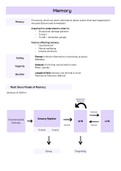
Process by which we retain information about events that have happened in
Memory
the past (distant and immediate)
Important to understand in order to:
- Study brain damage patients
- To learn
- To talk + remember people
Factors affecting memory
- trauma/shock
- Mental wellbeing
- Intense emotions
Format in which information is stored eg. acoustic
Coding
Baddeley
Amount of info that can be held in store
Capacity
Miller, Jacobs
Length of time memory can be held in store
Duration
Peterson & Peterson, Bahrick
Multi Store Model of Memory
Atkinson & Shiffrin
Maintenance
Rehearsal
Rehearsal
Environmental Sensory Register
STM LTM
Stimulus
Attention Retrieval
Echoic Iconic
Decay Forgetting
, Sensory Register STM LTM
Coding
Iconic, Echoic...
Depending on acoustic semantic
stimuli
Capacity
Huge
Millions of 5-9 items unlimited
receptors
Duration
<0.5s 18-30s unlimited
Evaluation of MSM
Strengths Limitations
🢒 Supported by Studies 🢒 There is more than 1 type of STM
- Glanzer & Cunitz - Shown by case study of KF (couldn’t
(Serial Position Curve Primacy process when read to but could
effect - result of rehearsal when reading alone)
Recency effect result of duration - Baddeley & Hitch developed the
STM) WMM
- Sperling 🢒 Different types of rehearsal
(Grid of digits, recalling random row - Craik & Watkins elaborative vs
after 50ms suggests brain takes all maintenance rehearsal
info in - capacity + duration of SR) 🢒 Different types of LTM
- Baddeley, Peterson & Peterson, Bahrick, - Endel Tulving 1985 suggested MSM’s
Miller view of LTM is too simple
🢒 Brain Damage Studies show that the stores
are unitary - HM case study (LTM damaged but
could learn new skills)
Types of LTM Endel Tulving 1985 suggested MSM’s view of LTM is too simple
Episodic Events in our lives, when & where - time stamped, consciously recalled
Semantic Understanding of the world - not time stamped, consciously recalled
Procedural How to do things - not time stamped, not consciously recalled
Supported by HM and clive wearing, episodic damaged but semantic intact = separate stores
Supported by neuroimaging - episodic = right P.C, semantic = left P.C
Process by which we retain information about events that have happened in
Memory
the past (distant and immediate)
Important to understand in order to:
- Study brain damage patients
- To learn
- To talk + remember people
Factors affecting memory
- trauma/shock
- Mental wellbeing
- Intense emotions
Format in which information is stored eg. acoustic
Coding
Baddeley
Amount of info that can be held in store
Capacity
Miller, Jacobs
Length of time memory can be held in store
Duration
Peterson & Peterson, Bahrick
Multi Store Model of Memory
Atkinson & Shiffrin
Maintenance
Rehearsal
Rehearsal
Environmental Sensory Register
STM LTM
Stimulus
Attention Retrieval
Echoic Iconic
Decay Forgetting
, Sensory Register STM LTM
Coding
Iconic, Echoic...
Depending on acoustic semantic
stimuli
Capacity
Huge
Millions of 5-9 items unlimited
receptors
Duration
<0.5s 18-30s unlimited
Evaluation of MSM
Strengths Limitations
🢒 Supported by Studies 🢒 There is more than 1 type of STM
- Glanzer & Cunitz - Shown by case study of KF (couldn’t
(Serial Position Curve Primacy process when read to but could
effect - result of rehearsal when reading alone)
Recency effect result of duration - Baddeley & Hitch developed the
STM) WMM
- Sperling 🢒 Different types of rehearsal
(Grid of digits, recalling random row - Craik & Watkins elaborative vs
after 50ms suggests brain takes all maintenance rehearsal
info in - capacity + duration of SR) 🢒 Different types of LTM
- Baddeley, Peterson & Peterson, Bahrick, - Endel Tulving 1985 suggested MSM’s
Miller view of LTM is too simple
🢒 Brain Damage Studies show that the stores
are unitary - HM case study (LTM damaged but
could learn new skills)
Types of LTM Endel Tulving 1985 suggested MSM’s view of LTM is too simple
Episodic Events in our lives, when & where - time stamped, consciously recalled
Semantic Understanding of the world - not time stamped, consciously recalled
Procedural How to do things - not time stamped, not consciously recalled
Supported by HM and clive wearing, episodic damaged but semantic intact = separate stores
Supported by neuroimaging - episodic = right P.C, semantic = left P.C


